
The Rule You Were Told Would Fix Everything
You’ve probably heard it a hundred times. Keep a consistent sleep schedule. Go to bed at the same time every night. Train your body like a clock. It sounds so reasonable that most people never think to question it and most sleep hygiene articles repeat it without hesitation, as if consistency alone were the cure.
But here’s the problem nobody talks about: for people who genuinely struggle with insomnia, a strict bedtime can quietly make things worse. Not because the science behind sleep timing is wrong, but because the way we apply it rigidly, anxiously, with a kind of desperate precision turns a simple habit into a psychological trap.
When the Clock Becomes the Enemy
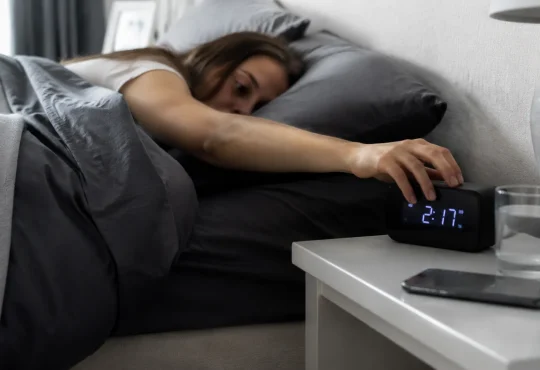
Think about what happens when you decide tonight is the night you commit. You pick10:30 PM. You tell yourself this is it. By 10:15, you’re in bed, staring at the ceiling, mentally calculating how many hours of sleep you’ll get if you fall asleep in the next ten minutes. By 10:40, you’re doing the math again. By 11:15, the frustration has a name and an address, and it lives in that specific time you decided was sacred.
This is what sleep researchers call sleep effort the act of trying to sleep, which activates the arousal systems in your brain and does precisely the opposite of what you want. The harder you try to sleep at a fixed time, the more alert your nervous system becomes. It’s a cruel irony, but it’s also completely predictable once you understand how sleep actually works.
Sleep isn’t something you do. It’s something that happens to you when the conditions are right. Forcing yourself into bed at an arbitrary hour, especially when you’re not genuinely sleepy, doesn’t invite sleep. It invites the kind of lying-awake tension that teaches your brain to associate the bedroom with wakefulness and anxiety.
The Misunderstood Science of Sleep Pressure
There’s a concept in sleep science called homeostatic sleep pressure essentially, the biological drive to sleep that accumulates the longer you’ve been awake. Think of it like hunger. The longer you go without eating, the hungrier you get. Sleep pressure works the same way. The longer you stay awake, the stronger the urge to sleep becomes, and the more easily you’ll fall asleep when you finally do lie down.
Here’s where strict bedtimes can backfire spectacularly. If you slept poorly last night and crawled into bed at 10:30 PM tonight out of sheer obligation, your sleep pressure might not be high enough yet to carry you into deep, restorative sleep. You’ll lie there, half-awake, half-asleep, accumulating neither real rest nor real wakefulness and the next day will feel just as wrecked as the last.
Cognitive Behavioral Therapy for Insomnia, widely considered the gold standard treatment for chronic sleeplessness, actually uses a technique called sleep restriction that deliberately delays your bedtime in the early stages of treatment. The goal is to build up that sleep pressure to a point where falling asleep becomes almost effortless. It feels counterintuitive. It feels almost punishing. But it works, because it’s working with biology rather than against it.
Anxiety Loves a Hard Deadline
There’s a psychological dimension here that rarely gets enough attention. For people with chronic insomnia, bedtime often stops being a neutral event and becomes a performance review. The bed is the stage, sleep is the grade, and the clock is watching.
When 10:30 PM becomes a fixed commitment, it carries weight. Miss the mark and you’ve already failed tonight’s test before it’s begun. Hit the mark and the pressure of having to sleep oncue ramps up. Either way, the emotional stakes attached to a specific hour transform the bedroom into a high-stakes environment exactly the kind of environment where sleep cannot and will not come naturally.
This is the cognitive paradox that CBT-I therapists spend a great deal of time untangling. The more you care about sleeping at the right time, the more psychologically activated you become around that time, and the less likely you are to actually sleep. Some of the most well-rested people you know probably don’t give their bedtime a second thought. That’s not a coincidence.
What Actually Matters More Than Bedtime
None of this means schedules are useless or that you should go to bed at3 AM whenever the mood strikes. The body does have a circadian rhythm an internal clock that responds to light, temperature, and timing and disrupting it dramatically and repeatedly has real consequences for how you feel and function.
But there’s a meaningful difference between a rough, flexible sleep window and a rigid, anxiety-laden deadline. The former gives your body a general signal. The latter gives your nervous system a trigger.
What tends to matter far more than the exact hour you get into bed is the consistency of your wake time. Waking up at roughly the same time every morning even on weekends, even after a bad night anchors your circadian rhythm more effectively than any fixed bedtime does. It also ensures that sleep pressure accumulates steadily throughout the day, making it much more likely you’ll feel genuinely sleepy by the evening, rather than just obligated to be in bed.
Light exposure in the morning, physical movement during the day, and cooling down your environment in the evening all play significant roles too. These are the levers worth pulling not the countdown timer on your phone that starts stressing you out at 10 PM.
The Permission You Didn’t Know You Needed
There’s something quietly liberating about understanding this. If you’ve spent years dutifully going to bed at the same time and lying awake wondering why it isn’t working, the answer might simply be that the rule was never designed for you or at least, not for the version of you that’s been carrying anxiety into the bedroom every night.
Letting go of the strict bedtime doesn’t mean giving up on sleep. It means shifting from a performance mindset to something closer to listening. Are you actually sleepy, or just tired and wired? Is your body ready, or are you just following a schedule because breaking it feels like failure?
Chronic insomnia tends to feed on control the desperate, white-knuckled desire to fix the problem through sheer willpower and rigid routine. The paradox is that loosening that grip, even just a little, is often what finally lets sleep in. Not because relaxation is magic, but because sleep was never the kind of thing you could force in the first place.
The best bedtime for someone with insomnia is rarely the one on the schedule. It’s the one that comes when the body is ready, the mind isn’t racing, and the clock on the wall is just a clock again.