
The Morning Problem Nobody Talks About Honestly
You’re not lazy. That’s the first thing worth saying out loud. The idea that skipping breakfast or grabbing something from a gas station on the way to work is a character flaw that’s a story sold to us by people who have never tried to get two kids ready for school while answering emails in their pajamas. Real mornings are chaotic, fast, and unforgiving. The kitchen isn’t a sanctuary at 7 a.m. It’s an obstacle.
Most nutrition advice about breakfast assumes you have a baseline enthusiasm for food preparation. It assumes you own a blender you actually clean. It assumes you’re the kind of person who enjoys cracking eggs at dawn and doesn’t feel a low-graderesentment toward any recipe that requires more than one pan. If that’s not you and for a lot of people, it genuinely isn’t then the standard morning meal guidance lands somewhere between useless and insulting.
What follows is built around a different premise: cooking aversion is real, mornings are brutal, and five minutes isn’t a constraint to work around. It’s the whole point.
Why “Quick” Recipes Usually Aren’t
There’s a particular kind of food content that promises five-minute meals and then, in the third paragraph, casually mentions that you’ll need to have pre-roasted your vegetables the night before. That sleight of hand is exhausting. So let’s set the terms clearly here: five minutes means five minutes, start to finish, with a reasonable kitchen. Nothing pre-prepped the evening before. Nothing that requires equipment you’d only find in a cooking show.
The recipes here lean on three principles. First, they use ingredients that require no real technique to combine no knife skills, no heat management, no timing. Second, they’re nutritionally complete enough to carry you through a few hours without a crash. Protein slows digestion. Healthy fat supports satiety. Some fiber keeps blood sugar from spiking and dropping. Third, they taste good without needing much from you.
Greek Yogurt with Walnuts, Honey, and a Handful of Whatever Fruit Is Around
This might be the single highest return-on-effort breakfast that exists. You open a container of full-fat Greek yogurt and spoon it into a bowl. You throw in some walnuts a small handful, no measuring needed. You drizzle honey. You add fruit if it’s available: blueberries straight from the package, a banana sliced with your fingers, strawberries that got halved in about twelve seconds.
What’s actually in this bowl is impressive. Greek yogurt carries around 15 to 20 grams of protein per serving depending on the brand. Walnuts bring omega-3 fatty acids that most Americans are chronically short on. The fruit adds antioxidants and enough natural sugar to make the whole thing feel like a reward rather than a chore. The honey isn’t just sweetness raw honey contains trace enzymes and antimicrobial compounds, though at the quantities you’re using here, the real reason it’s in the bowl is that it makes the yogurt taste like dessert.
Total time, including getting the bowl out of the cabinet: four minutes, generously counted.
The Everything Wrap
A whole wheat tortilla laid flat on the counter is already most of the way to a meal. Add a smear of hummus, a couple of slices of deli turkey orcanned tuna drained in about twenty seconds, some baby spinach right from the bag, and a few cherry tomatoes halved or just thrown in whole. Roll it. Eat it over the sink if the day has already gone sideways.
The beauty of this one is that it has basically no ceiling. On a better morning you might add half an avocado or a slice of cheese or a drizzle of hot sauce. On the worst morning you have the minimum: hummus and spinach and tortilla, which is still a legitimately nutritious meal that took you four minutes.
Hummus is an underrated breakfast ingredient. It’s made primarily from chickpeas, which are a slow-digesting carbohydrate with a solid amount of plant protein and fiber. The tahini in most commercial hummus adds calcium and additional fat. This isn’t trail mix energy that vanishes by9 a.m. it’s the kind of fuel that actually holds.
Overnight Oats (The One Exception to the Rule)
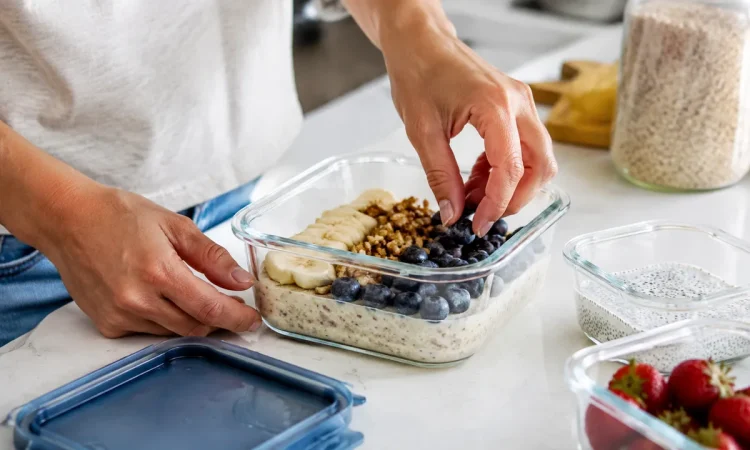
There’s one item here that involves the night before, and it stays on the list because the prep is genuinely two minutes and the payoff is significant. Overnight oats: a jar, some rolled oats, milk or oat milk, a spoonful of chia seeds, a banana or some frozen fruit thrown on top, a lid, into the fridge. In the morning you shake the jar and eat it cold.
Chia seeds are worth knowing about if you don’t already. Two tablespoons contain nearly 10 grams of fiber and 5 grams of protein, along with calcium, magnesium, and enough omega-3s to make a nutritionist’s eyes light up. They also absorb liquid and thicken into a gel overnight, which gives the oats a creamy texture without any cooking. The oats themselves are complex carbohydrates with beta-glucan fiber, which has actual clinical evidence behind its ability to moderate blood sugar response. This jar is working harder than it looks.
The key psychological shift with overnight oats is reframing the effort. You’re not cooking in the morning you’re just retrieving something you already made. That’s a different relationship with breakfast entirely.
Eggs in a Mug, for People Who Thought They Hated Eggs
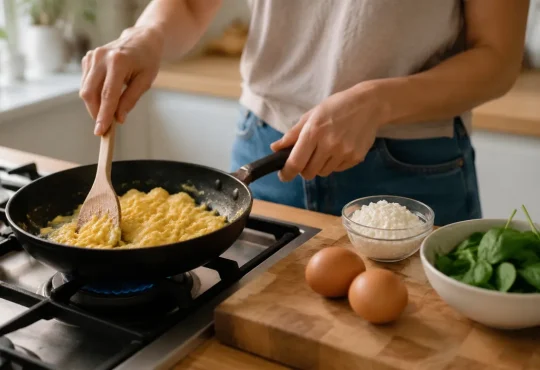
Scrambled eggs in a microwave sound like a culinary compromise, and honestly, they kind of are. But they’re also ready in ninety seconds and nutritionally among the best things you can eat in the morning. Crack two eggs into a mug. Add a splash of milk. Add salt, maybe some shredded cheese, maybe hot sauce. Stir with a fork. Microwave for one minute, stir, another thirty seconds. Done.
Eggs are the rare food that’s simultaneously affordable, fast, and genuinely dense with nutrition. Two eggs give you about 12 grams of complete protein, meaning all nine essential amino acids are present. The yolks contain choline, a nutrient that plays a role in brain function and that most people aren’t getting enough of. There’s also lutein and zeaxanthin for eye health, and vitamins B12, D, and A in meaningful amounts.
The mug trick works because the microwave contains the splatter and the single vessel means you clean one thing. It removes every friction point that makes eggs feel like effort.
Peanut Butter on Anything
This one isn’t a recipe so much as a philosophy. Peanut butter on a rice cake. Peanut butter on a banana. Peanut butter on whole grain toast that went in the toaster while you were in the bathroom. Peanut butter on a spoon, eaten standing at the counter while you check your calendar, which is technically not a meal but which is still delivering8 grams of protein and a solid dose of monounsaturated fat.
The case for keeping good peanut butter the kind where the only ingredient is peanuts in your kitchen as a breakfast staple is simple: it requires no refrigeration, no prep, no skill, and it pairs with basically everything that can be picked up and eaten. It also keeps you full in a way that cold cereal almost never does, because the fat content slows gastric emptying and the protein stabilizes blood sugar.
There’s a reason this is what endurance athletes eat before a long effort. It’s energy that’s available immediately but doesn’t disappear in twenty minutes.
The Real Secret
None of these require you to become someone who loves cooking. That’s not the goal. The goal is removing the gap between “I know I should eat something real” and actually doing it on a Tuesday when you’re running late, when the kids are loud, when the coffee isn’t even finished yet.
The best morning meal isn’t the most impressive one. It’s the one that actually happens.