
There’s a certain kind of freedom that comes from an empty kitchen. Not the chaos of running out of groceries, but the deliberate choice to cook with less fewer ingredients, less clutter, less decision fatigue at7 in the morning when your brain is still catching up to your body. Minimalist cooking, especially at breakfast, isn’t about deprivation. It’s about precision. About trusting that three good ingredients, treated well, can do more than a pantry full of mediocre ones ever could.
The three-ingredient constraint forces something interesting: it makes you care about each component. When you only have three things in the pan, you pay attention to how the butter browns, how the egg sets at the edges, how the bread absorbs heat. Cooking becomes less automatic and more intentional. That shift from routine to presence is quietly one of the most valuable things a morning can offer.
Why Three Ingredients Actually Works
Most people assume that complexity equals quality in the kitchen. More spices, more steps, more prep time it must taste better. But professionalcooks know the opposite is often true. The best dishes in the world tend to have short ingredient lists. A great carbonara has four. Real Neapolitan pizza dough has three. The discipline of limitation sharpens flavor rather than dulling it.
At breakfast specifically, three ingredients works because your palate is fresh and your hunger is real. You don’t need to impress anyone. You need to fuel something your body, your day, your mood. A dish built around eggs, good sourdough, and salted butter delivers exactly what it promises. Nothing competes. Nothing distracts. The flavors are clean and satisfying in a way that a loaded breakfast scramble, ironically, sometimes isn’t.
There’s also the practical side. Three ingredients means a shorter shopping list, less food waste, and a faster exit from the kitchen. For people who genuinely don’t want cooking to be their personality but still want to eat well, this approach is a quiet revelation.
The Recipes Worth Keeping
Banana Oat Pancakes
Two ripe bananas, one cup of rolled oats, two eggs. That’s it. Mash the bananas until smooth, mix in the oats and eggs until you have a loose batter, then cook in small rounds on a buttered pan over medium heat. They take about two minutes per side and come out soft, slightly sweet, and genuinely filling.
What makes this recipe interesting isn’t the ease it’s the texture. Because there’s no flour, no leavening agent, the pancakes stay dense and moist in a way that feels more like a crepe’s cousin than a diner stack. The banana provides all the sweetness you need. The oats give it body. The eggs hold it together. Three things doing exactly their jobs, nothing overlapping, nothing wasted.
This also happens to be naturally gluten-free and dairy-free if you skip the butter, which matters more to more people than recipe developers used to acknowledge.
Ricotta Toast with Honey
Good bread, whole-milk ricotta, and raw honey. Toast the bread until it has real color on it pale toast is a missed opportunity. Spread the ricotta generously, the way you’d spread avocado if you were paying seventeen dollars for someone else to do it. Drizzle the honey in slow spirals and eat it immediately, before the toast softens under the weight of the cheese.
The contrast here is what makes it work: the crunch against the creaminess, the mild saltiness of ricotta against the floral sweetness of the honey. It eats like something from a bakery counter in Rome, which is a remarkable thing for a three-minute breakfast to accomplish.
The choice of bread matters more than people think. A seeded sourdough or a dense whole grain loaf will carry the ricotta better than a soft sandwich bread, which tends to collapse. That single upgrade buying better bread transforms the dish without adding a single ingredient.
Greek Yogurt with Frozen Mango and Granola
Plain full-fat Greek yogurt, frozen mango chunks, granola. Layer them in a bowl and eat. This is almost too simple to call a recipe, but it earns its place here because of how well the components balance each other. The yogurt is thick and tangy. The mango, once it’s sat for two or three minutes, begins to thaw and release a thin syrup that sweetens everything around it. The granola adds crunch and a faint warmth from whatever spices the baker used.
Frozen mango specifically is worth highlighting. It costs less than fresh, keeps indefinitely, and at room temperature for a few minutes achieves a texture that’s softer and juicier than most fresh mango you’ll find outside of a tropical market. It’s one of those cases where the pantry staple quietly outperforms the premium option.
Scrambled Eggs with Cream Cheese and Chives
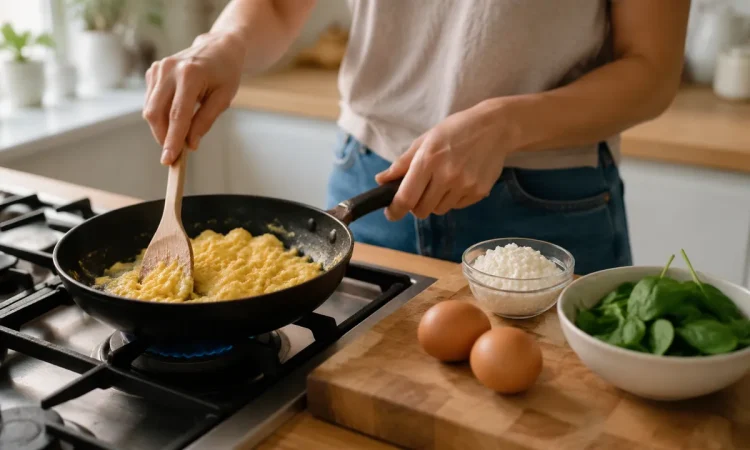
Three eggs, two tablespoons of cream cheese, a handful of fresh chives. Whisk the eggs, add the cream cheese in small torn pieces, and cook slowly over low heat, folding gently rather than stirring aggressively. The cream cheese melts into soft, irregular pockets of richness. The chives go in at the very end so they stay bright green and slightly sharp.
The technique here matters as much as the ingredients. Scrambled eggs cooked low and slow develop a custardy quality that fast-cooked eggs never reach. It takes an extra four minutes and a little patience, but the result is something that feels luxurious rather than rushed which is the entire point of eating well in the morning.
Cream cheese in scrambled eggs is one of those additions that feels counterintuitive until the first time you try it, and then you can’t imagine making them any other way.
The Principle Behind the Practice
What ties all of these recipes together isn’t a dietary philosophy or a lifestyle brand. It’s a simpler idea: that a good breakfast doesn’t require a lot of you. It requires attention to a few things, executed with some care. The minimalist cook isn’t someone who doesn’t care about food they care about it differently. They’re interested in the quality of the experience rather than the complexity of the production.
There’s something almost countercultural about this in a food media landscape that tends to escalate everything. More steps, more garnishes, more equipment, more proof that you really tried. The three-ingredient breakfast opts out of that performance. It asks what’s actually necessary and discards the rest.
That turns out to be a useful question well beyond the kitchen.