
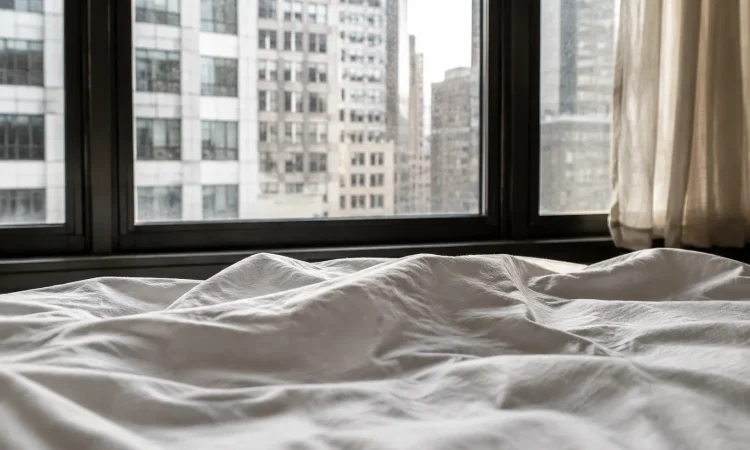
The Body That Still Thinks It Lives Outside
Somewhere inside your skull, a cluster of roughly 20,000 neurons is running the same biological clock your ancestors relied on to survive the African savanna. It doesn’t know about drywall. It has never encountered a thermostat. It cannot distinguish a ceiling light from a full moon. Every evening, this cluster the suprachiasmatic nucleus waits for darkness to fall, for temperatures to dip, for the world to quiet down and signal that it’s safe to relinquish consciousness. In a mud-brick dwelling open to the night breeze, that signal came reliably. In a modern apartment sealed against weather, flooded with artificial light, and climate-controlled to a year-round 72degrees, the signal never quite arrives.
This is the fundamental friction at the heart of contemporary sleep problems. We haven’t changed. Our homes have changed everything around us.
Light Was Never Supposed to Be a Choice
For most of human history, light was non-negotiable. The sun rose, the sun set, and your body synchronized itself to that binary reality without any deliberation on your part. Photoreceptors in the retina specifically the intrinsically photosensitive retinal ganglion cells that project directly to that suprachiasmatic nucleus absorbed the day’s blue-rich morning light and used it to anchor the circadian clock. By evening, as the spectrum shifted toward red and orange, those same cells began releasing melatonin, the hormone that initiates sleep pressure.
Modern architecture broke this elegant loop in two distinct ways. First, it blocked the morning signal. The average American now spends around 93 percent of their time indoors, often waking into artificial light that, while bright enough to see by, lacks the intensity and spectral quality of outdoor morning sun. Natural daylight on a clear morning can hit 10,000 lux or more; a well-lit office rarely exceeds 500. The clock receives a weak, ambiguous dawn and never fully anchors itself.
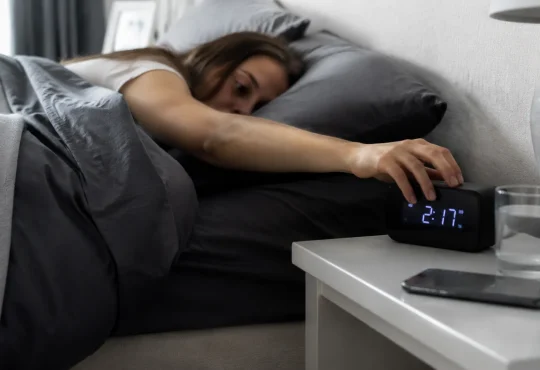
Then, in the evening, the opposite problem: we extended the day. Electric lighting after dark, and more recently the pervasive blue-light emission from screens, keeps those same photoreceptors stimulated hours past sunset. The body interprets this as midday. Melatonin release gets delayed. Sleep onset shifts later. And when the alarm goes off at 6 a.m. regardless of where the body’s clock actually is, the resulting sleep debt compounds quietly over years.
The Thermal Problem Nobody Talks About
Temperature is one of sleep science’s most underappreciated levers. Core body temperature needs to fall by roughly 1to 1.5 degrees Celsius to initiate and maintain deep sleep a drop that, historically, the environment handled automatically. As night fell, ambient temperatures declined. The body detected the shift, began shunting blood toward the extremities to radiate heat, and prepared for sleep as a physiological inevitability rather than a conscious act.
Central heating and cooling systems decoupled this cycle entirely. A bedroom held at 72 degrees year-round the cultural standard of American domestic comfort is actually several degrees warmer than the 65 to 68 degree range that most sleep researchers identify as optimal. That seemingly small difference has real consequences: lighter sleep architecture, more frequent arousals, reduced slow-wave sleep. People often interpret this as insomnia or stress, never realizing that their HVAC system has quietly been working against them every night.
Worse, modern homes are thermally uniform. The body has no gradient to read no cooler bedroom to move into, no drop that signals a transition from the social spaces of the house to the restorative space of sleep. The architecture refuses to encode the rhythm.
What Open Plans and High Ceilings Actually Cost Us
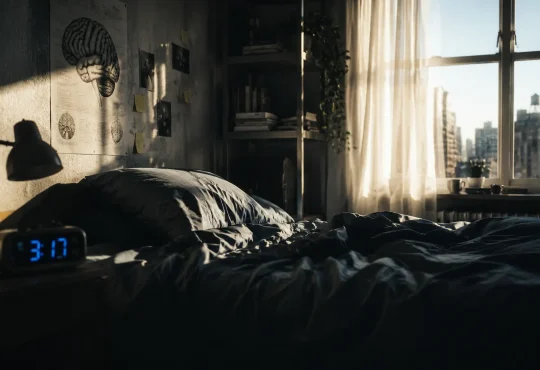
There’s a particular irony in contemporary open-concept design. The aesthetic celebrates light, airiness, and visual continuity large windows, minimal walls, a kitchen that flows into a living room that flows into the dining space. These choices look spectacular in design magazines. They are also structurally hostile to sleep preparation.
Humans are remarkably sensitive to social cues embedded in space. Separate rooms signal separate modes of being. A distinct bedroom, entered through a door, behind which certain behaviors occur and others don’t, trains the nervous system over time. This is partly the logic behind CBT-I’s stimulus control instructions keep the bed for sleep and sex only but it operates at an architectural scale too. When the space where you watch television, eat, argue, and scroll social media bleeds seamlessly into the space where you’re supposed to hand over your vigilance to unconsciousness, the brain’s threat-monitoring systems don’t fully disengage. They’ve been given no spatial permission to.
Open loft apartments take this further. Sound carries. Light spills. The bedroom is a notional zone rather than a physical sanctuary. In a culture that already struggles with the psychological demands of always-on digital connectivity, the removal of literal walls is not a neutral design decision.
Noise Floors and the Acoustic Architecture of Wakefulness
Ancestral sleep was not silent. Wind moved through trees. Water ran over stones. Animals called in the middle distance. What it wasn’t was mechanically irregular the garbage truck stopping and starting at3 a.m., the neighbor’s HVAC unit cycling on, the refrigerator compressor, the ambient street noise of a city that never genuinely quiets.
The auditory system does not shut down during sleep. It maintains a monitoring function, filtering sounds through a relevance hierarchy tuned by evolution. Low-frequency rumbles, consistent natural sounds these were filed as safe. Sharp, irregular, or semantically meaningful sounds triggered arousal. Modern urban sound environments are full of the latter category. Traffic is irregular. Human voices carry. Mechanical systems produce tonal frequencies in ranges the brain tags as potentially significant.
Building codes address sound transmission between units, but they were never designed with sleep biology in mind. Shared walls, hard floors that bounce sound, and the fundamental acoustic porousness of standard wood-frame construction mean that the average city dweller’s bedroom offers nothing like the acoustic containment their nervous system expects at night.
Reclaiming What the Building Won’t Give You
The uncomfortable conclusion is that the modern home, for all its comfort and convenience, was designed around aesthetic preference, material efficiency, and energy systems not around the requirements of a mammalian circadian rhythm shaped across300,000 years of outdoor living. This isn’t a polemic against modernity. It’s just an honest accounting.
What follows practically from this isn’t necessarily a renovation. It’s the realization that you may need to actively reconstruct, inside your home, the environmentalcues that your body is still waiting for. Bright, blue-rich light in the morning ideally outdoors, or via a dedicated light therapy lamp. Deliberate dimming of lights and screens in the two hours before bed. A bedroom temperature that actually drops at night, even if the rest of the house stays warm. Physical separation between waking activity spaces and sleep spaces, enforced by habit or door or blackout curtain if not by architecture.
The irony is that doing these things consciously feels like work. But that effort only exists because we built environments that stripped thecues out in the first place. Your body isn’t broken. It’s simply living inside a building that was never designed to speak its language.