
There’s a good chance you’ve blamed your phone, your stress levels, or that second cup of coffee for your restless nights. But what if the real culprit was sitting much lower tucked inside your digestive tract, quietly running a biological operation that your brain depends on more than you ever realized?
The relationship between gut health and sleep isn’t fringe science anymore. Over the past decade, researchers have built a compelling, sometimes startling, picture of how the microbiome that dense ecosystem of trillions of bacteria, fungi, and microorganisms living in your intestines reaches up into the brain and pulls levers that govern when you feel tired, when you wake up, and how deeply you actually rest.
The Gut-Brain Axis: A Two-Way Highway Nobody Taught You About
Most people think of the gut as a digestive organ. You eat, it processes, done. But the gut operates its own nervous system the enteric nervous system containing roughly 500 million neurons. Scientists sometimes call it the “second brain,” and that nickname isn’t metaphorical flattery. It genuinely processes information, responds to emotional states, and communicates upward to the central nervous system through a thick bundle of nerve fibers known as the vagus nerve.
This gut-brain axis is bidirectional. Your brain sends signals down to regulate digestion. Your gut sends signals back up to influence mood, cognition, and sleep. The conversation never stops.
What makes this relevant to your sleep is what the gut produces during that conversation. The microbiome synthesizes or triggers the production of several key neurotransmitters and one of them is serotonin, a molecule most people associate with happiness. Here’s what most people don’t know: approximately 90 to 95 percent of the body’s serotonin is produced in the gut, not the brain. And serotonin is the direct precursor to melatonin, the hormone that tells your body night has arrived and sleep should follow.
So when your gut bacteria are disrupted through poor diet, antibiotic use, chronic stress, or illness the ripple effect doesn’t stay local. It travels upward, and it lands squarely in your sleep cycle.
Melatonin Starts in Your Intestines, Not Your Pineal Gland
The pineal gland gets all the credit. It’s the tiny structure in the brain that releases melatonin in response to darkness, and it’s what most sleep supplements are trying to supplement. That part is accurate. But the upstream manufacturing process the enzymatic pathway that produces serotonin from the amino acid tryptophan, and then converts serotonin into melatonin relies heavily on gut microbial activity.
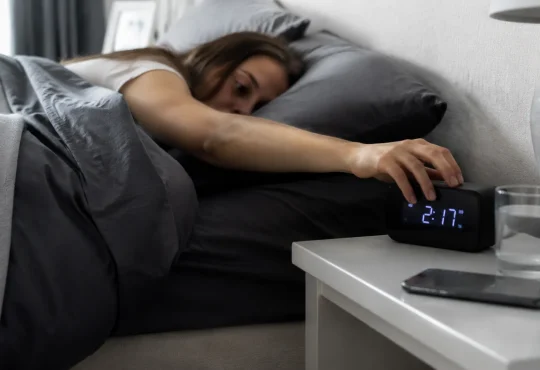
Certain bacterial species, including strains of Lactobacillus and Bifidobacterium, help regulate tryptophan metabolism. When these populations are healthy and diverse, the pathway flows. When they’re depleted, the production can stall. You don’t just feel it as digestive discomfort. You feel it as lying awake at 2 a.m. with your mind inexplicably spinning.
Research published in journals like Cell and Nature Reviews Neuroscience has shown that germ-free mice animals raised without any gut microbiome display significant circadian rhythm disruptions. Their sleep-wake cycles become irregular. When researchers reintroduce specific bacterial strains, the rhythms begin to normalize. The bacteria, in effect, help anchor the clock.
Circadian Rhythms Run on More Than Sunlight
We’ve been taught that circadian rhythms are primarily light-driven. You wake up with sunrise, wind down after sunset, and your internal clock stays synchronized with the outside world. That’s true but incomplete.
The circadian clock is actually a distributed system. Nearly every cell in the body carries its own clock gene expression, and those peripheral clocks need to synchronize with the master clock in the brain’s suprachiasmatic nucleus. The gut microbiome participates in this synchronization in ways researchers are still unpacking.
Gut bacteria follow their own daily oscillations. The composition and activity of your microbiome actually shifts across a 24-hour period, ramping up certain metabolic functions during feeding windows and dialing down others during rest. This microbial rhythm feeds back into host physiology, influencing cortisol timing, body temperature regulation, and immune activity all of which are interlocked with sleep architecture.
Disrupt the microbiome’s rhythm through eating at irregular hours, traveling across time zones, or eating a diet high in ultra-processed foods and you aren’t just upsetting digestion. You’re sending conflicting time signals throughout your entire body. Jet lag, in part, is a gut story.
Inflammation Is the Quiet Bridge Between Gut Dysfunction and Sleeplessness
There’s another mechanism worth sitting with, and it’s less romantic than neurotransmitters but arguably just as powerful: inflammation.
A compromised gut lining sometimes called leaky gut, more precisely described as increased intestinal permeability allows bacterial byproducts to enter the bloodstream. Among the most studied of these is lipopolysaccharide, a fragment of bacterial cell walls that triggers significant inflammatory responses when it escapes the intestinal barrier.
Systemic inflammation disrupts sleep in several well-documented ways. It elevates cortisol, the stress hormone that should be low at night. It interferes with the production and regulation of adenosine, the sleep-pressure molecule that builds throughout the day and drives the urge to sleep. It also activates immune pathways that fragment sleep architecture reducing time spent in slow-wave deep sleep and REM, the phases where actual physical and neurological restoration happens.
People who wake repeatedly throughout the night without a clear reason, who feel unrefreshed despite long hours in bed, often show markers of low-grade systemic inflammation. The connection to gut permeability is becoming harder for mainstream medicine to ignore.
What You Eat at Dinner Is Designing Tonight’s Sleep
This is where the science stops being abstract and becomes entirely practical. The foods you consume don’t just fuel your day they directly shape the microbial community that will influence your neurotransmitter production, your inflammatory status, and your melatonin pathway over the following hours.
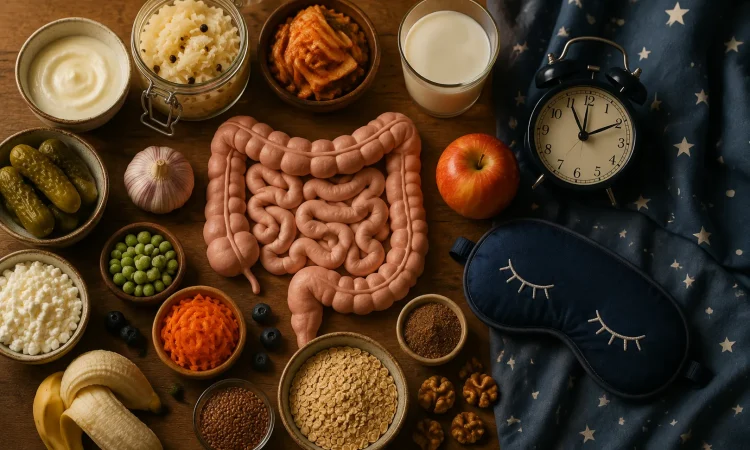
Diets rich in diverse plant fiber feed the bacterial strains most associated with serotonin regulation and gut barrier integrity. Fermented foods yogurt, kefir, kimchi, sauerkraut introduce and support populations of Lactobacillus. Polyphenol-rich foods like berries, dark leafy greens, and olive oil have been shown to reduce gut-derived inflammation and support microbial diversity.
On the other side, a diet heavy in refined carbohydrates, industrial seed oils, and artificial additives tends to reduce microbial diversity, increase intestinal permeability, and create the exact inflammatory environment that fragments sleep. The American diet, specifically, tracks closely with both gut dysbiosis rates and the epidemic levels of sleep disorders the country reports.
There’s also timing. Eating late at night forces the gut microbiome into active metabolic work during what should be a rest phase, sending wakefulness signals into a system trying to wind down. The concept of time-restricted eating isn’t just about weight management it gives the gut’s microbial clock a defined rest window, which in turn supports cleaner circadian signaling throughout the body.
Sleep Fixes the Gut, Too
The loop closes in the other direction as well. Poor sleep doesn’t just result from gut dysfunction it actively causes it.
Sleep deprivation studies consistently show measurable shifts in gut microbiome composition within just a few nights. Protective strains decline. Potentially harmful species gain ground. Gut permeability increases. The intestinal lining, which is regenerated during sleep, gets inadequate maintenance time.
This creates a feedback spiral that many people are caught inside without knowing it. Their gut is disrupting their sleep, and their poor sleep is worsening their gut, and both keep pulling the other further from balance. Breaking that loop requires addressing both ends simultaneously not just chasing sleep hygiene tips while the underlying biology remains uncorrected.
The more honest conversation about sleep disorders probably needs to start not at the bedroom door, but at the table, and inside the complicated, underestimated world living in your gut.