
Your Brain Has No Idea It’s Midnight
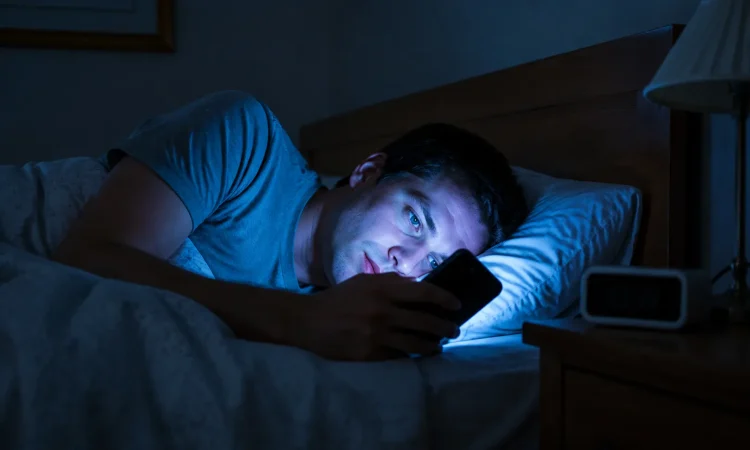
Picture this: it’s 11PM. The house is quiet, the temperature has dropped, and every biologicalcue in your environment is signaling rest. Except for the glowing rectangle in your hands. To your eyes, it might look like a gentle, dimmed screen. To the ancient photoreceptors buried in your retinas, it reads like standing outside at high noon on a cloudless July afternoon.
This isn’t hyperbole. It’s photobiology.
The human brain evolved over hundreds of thousands of years to synchronize its internal clock the circadian rhythm almost entirely with sunlight. Dawn triggers alertness. Dusk triggers the cascade of hormonal and neurological changes that prime the body for sleep. The system worked beautifully, right up until we started manufacturing light and bathing ourselves in it at all hours. And not just any light. Blue light. The specific wavelength that hits the brain’s timekeeping system like a sledgehammer.
What Makes Blue Light Different From, Say, a Candle
Light exists on a spectrum, and not all of it carries the same message to your brain. The key player here is a specialized cell in the retina called the intrinsically photosensitive retinal ganglion cell ipRGC, if you prefer the shorthand. These cells don’t contribute to vision the way rods and cones do. Their only job is to track ambient light levels and report back to the suprachiasmatic nucleus, a tiny cluster of neurons in the hypothalamus that serves as the body’s master clock.
The photopigment that makes ipRGCs tick is called melanopsin, and it’s exquisitely sensitive to short-wavelength blue light specifically in the 460to 480 nanometer range. Candlelight, incandescent bulbs, even sunset these sources are warm, heavily weighted toward the red and orange end of the spectrum. They carry very little blue wavelength energy. The message they send to the suprachiasmatic nucleus is essentially: the day is ending, begin shutdown.
Smartphone screens, tablets, LED monitors, and modern televisions all produce light that peaks in exactly the range melanopsin responds to most strongly. When you scroll through your phone at10 PM, you are flooding those specialized retinal cells with the precise wavelength of light that, in evolutionary terms, meant “the sun is directly overhead stay alert, hunt, work, move.”
The circadian system doesn’t know you’re lying in bed. It responds to photons, not intentions.
The Melatonin Hijack
The downstream consequence of this blue light exposure is the suppression of melatonin the hormone that doesn’t put you to sleep exactly, but acts more like a biological dusk signal. Melatonin tells every organ in your body that night has arrived. It lowers core body temperature, slows digestion, initiates cellular repair processes, and shifts the brain toward the electrochemical patterns associated with drowsiness.
Under normal conditions, melatonin secretion from the pineal gland begins around two hours before your habitual sleep time. It’s a gradual tide. Research from Harvard’s Division of Sleep Medicine found that two hours of exposure to a bright tablet screen in the evening can suppress melatonin onset by up to three hours and reduce overall melatonin levels by as much as 22 percent. That’s not a minor disruption. That’s the equivalent of telling your body the sun just rose, right before you’re supposed to fall asleep.
Here’s where it gets more insidious. The suppression doesn’t end when you put the phone down. Melatonin levels remain blunted for a period after exposure stops meaning even if you’ve been off your device for thirty minutes, the hormonal signal for sleep is still compromised. You lie down. You feel awake. You assume you’re just not tired. But the more accurate description is that your brain is chemically convinced it’s still afternoon.
Sleep Architecture Takes the Hit Too
Most conversations about blue light and sleep stop at melatonin, but that’s only the opening act. Even when screen-exposed people do eventually fall asleep, the quality of what follows is measurably different.
Sleep isn’t a uniform state. It cycles through distinct stages light sleep, deep slow-wave sleep, and REM sleep each serving a different biological function. Deep sleep is when the glymphatic system in your brain goes to work, flushing metabolic waste products including the amyloid plaques associated with Alzheimer’s disease. REM sleep consolidates emotional memory, facilitates creative problem-solving, and regulates mood. You need substantial quantities of both.
Evening blue light exposure disrupts this architecture. Studies using polysomnography the clinical gold standard for sleep measurement have consistently shown that people who use screens before bed spend less time in slow-wave sleep and report higher subjective fatigue the following day, even when total sleep duration appears similar. The hours are there. The restoration isn’t.
This distinction matters enormously. There’s a widespread assumption that sleep quantity is the primary variable get your eight hours and you’re fine. But a night spent cycling through lighter, shallower stages isn’t equivalent to a night of properly sequenced, architecturally intact sleep. You can be in bed for nine hours and still wake up running a neurological deficit.
The Paradox of the Wind-Down Scroll
There’s a cruel irony embedded in how most people actually use their phones before bed. The behavior is almost universally framed as relaxation. Lying down, scrolling through social media, watching a few videos, catching up on messages it feels like decompression. The mental intention is rest. The physiological effect is stimulation on two separate fronts: the light itself is suppressing melatonin while the content notifications, social comparison, news is activating the stress response system and elevating cortisol.
So the “wind-down scroll” is, biologically speaking, the opposite of winding down. It’s a perfectly engineered mechanism for staying wired. And because the stimulation is subtle you’re horizontal, the room is dim, you feel subjectively calm the mismatch between what you feel and what your nervous system is actually doing goes unnoticed until you’ve been staring at the ceiling for an hour wondering why sleep won’t come.
What the Evidence Actually Recommends
Night mode and blue light filter apps are worth using, but they’re not a complete solution. They shift the color temperature of the screen toward warmer tones, which does reduce melanopsin stimulation to a meaningful degree. Research suggests filters that bring the screen to 3000 kelvin or below roughly equivalent to incandescent light can significantly attenuate melatonin suppression. However, brightness remains a separate variable. A warm-toned but intensely bright screen still delivers enough photon energy to affect the circadian system.
The most reliable intervention remains the most obvious one: physical distance from screens in the ninety minutes before bed. Not because this number is arbitrary, but because ninety minutes represents roughly the window during which the melatonin onset cascade needs to begin in earnest to support sleep architecture through the early morning hours.
Blue-light-blocking glasses have attracted significant consumer interest and some clinical support, though the evidence is more mixed than the marketing suggests. A 2021 meta-analysis in the journal Sleep found modest but real benefits for sleep onset latency in regular screen users. They’re a tool, not a solution.
The harder conversation is about habituation. Our nervous systems have adapted to treat evening screen exposure as normal, which means the disruption is no longer perceived as disruption it’s just the baseline state of feeling slightly underslept, slightly foggy, slightly emotionally reactive. The damage becomes invisible because it becomes constant.
An Evolutionary Mismatch Running on Borrowed Time
There’s a useful frame for understanding all of this: evolutionary mismatch. The human body is extraordinarily well-adapted to conditions that no longer exist for most of the people living in developed societies. Our sleep systems were calibrated for firelight at best after sunset, for darkness that arrived reliably and completely, for a light environment our biology spent two hundred thousand years learning to read.
We’ve rewritten that environment in about fifty years. The brain’s timekeeping system hasn’t caught up, and there’s no sign it will evolution moves on a timescale that makes technological change look instantaneous. The suprachiasmatic nucleus is still doing exactly what it was designed to do. It’s just receiving inputs it was never designed to interpret.
When you look at your phone screen at 11 PM, you are not breaking a rule or failing at sleep hygiene in some abstract, optional sense. You are sending a photon signal to one of the most ancient and deeply conserved biological mechanisms in your body, one that governed the sleep and wakefulness of every human ancestor you’ve ever had and you’re telling it that the sun is high and noon has barely passed. The brain believes you. Every time.