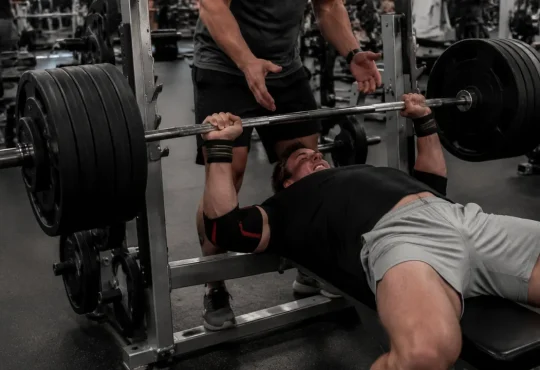


There’s a version of gym culture that quietly punishes you for not going heavy enough. You’ve seen it the guy loading extra plates before his form has any business handling them, the social media clip where the bar bends under the weight and everyone in the comments celebrates it like a feat of courage. Somewhere along the way, heavier became synonymous with better. And that assumption has quietly sabotaged more muscle-building efforts than almost anything else.
The question worth sitting with isn’t whether you’re strong. It’s whether the way you’re training is actually doing what you think it’s doing.
The Ego Load Problem Nobody Talks About Honestly
Here’s what actually happens when you go too heavy: your body finds a way to finish the rep, but not in the way you planned. The target muscle gets assisted by momentum, by adjacent muscle groups, by a spine that’s rounding in ways it shouldn’t. You feel like you worked hard. You are working hard. But the bicep, the lat, the quad you were supposedly training? It maybe did60% of the job. The rest was borrowed from somewhere else.
This isn’t a weakness. It’s just physics and neurology. Your nervous system is wired to complete movement, not to isolate tissue. When the load exceeds what a specific muscle can cleanly handle, the body recruits a coalition to get the job done. From a survival standpoint, that’s smart. From a hypertrophy standpoint, it means the stimulus is being diluted across a larger system and the muscle you actually care about developing isn’t getting the targeted tension it needs.
The research on this is less complicated than it might seem. Muscle growth responds to mechanical tension, metabolic stress, and muscle damage but only when those stressors are applied to the right tissue, with enough control to actually load the fiber through its full range of motion. An ego lift, performed with compensations, hits the checklist on paper but misses the point in practice.
What Your Muscles Are Actually Responding To
Weight on the bar is a proxy. What your muscles actually respond to is tension specifically, tension through range, sustained with control. Those are three distinct variables, and you can manipulate them independently. A lighter weight with a slow eccentric, paused at peak stretch, and controlled through the full motion can produce more hypertrophic stimulus than a heavier load that’s swung, shortened, and dumped on the way down.
Think about the difference between a set of cable rows where you actually feel your back working versus a set where you’re pulling with your arms and jerking the whole stack. The second version feels more impressive. The first version actually builds the muscle. The confusion between effort and stimulus is at the core of this problem.
There’s also the concept of load being relative to your capacity at a given moment. What counts as “too heavy” isn’t a fixed number it’s a relationship between the weight and your ability to control it during that specific set. If you’re on your fourth working set, fatigued, and your form has drifted, the weight that was appropriate twenty minutes ago is now too heavy. The load hasn’t changed. Your capacity has. Most people don’t make this adjustment. They finish the sets, call it discipline, and walk away wondering why they’re not progressing.
The Rep Range Myth That Keeps People Stuck
For years, the dominant narrative was that heavier weight and lower reps were for strength, and lighter weight and higher reps were for “toning” a word that means almost nothing physiologically. The actual research, particularly studies out of McMaster University comparing low-load and high-load training taken to failure, tells a more nuanced story: a fairly wide range of rep ranges can produce similar hypertrophy when effort is equated and sets are taken close to or at muscular failure.
What this means practically is that the obsession with “getting stronger” to build muscle is only partly accurate. Progressive overload matters your muscles do need increasing challenge over time to keep adapting. But that challenge doesn’t have to come exclusively from adding weight. It can come from adding reps, from improving range of motion, from slowing tempo, from reducing rest. Defaulting to more weight as the only lever is a narrow strategy that tends to eventually collapse into injury or a plateau.
The athletes and coaches who consistently produce well-developed physiques understand this intuitively. They prioritize connection actually feeling the muscle doing the work over the number on the plate. That sounds almost too simple to be useful, but the practical gap between knowing that and actually training that way is surprisingly wide.
Where Strength and Hypertrophy Actually Overlap
None of this is an argument against lifting heavy or getting stronger. Strength and muscle mass are related, and spending time in lower rep ranges with challenging loads has genuine value both for hormonal response and for building the kind of neuromuscular efficiency that allows heavier loads to eventually become the “controlled” loads. The goal isn’t to stay light forever. It’s to not let the pursuit of numbers outrun your ability to actually use the weight.
There’s a sequencing issue here too. A lot of people are trying to get strong in patterns their body hasn’t established good motor control for yet. The muscles aren’t the limiting factor the movement quality is. Piling weight onto a compromised movement pattern doesn’t build muscle faster; it just reinforces poor mechanics under load, and at some point, those mechanics send you to a physio rather than a photo shoot.
The lifters who develop impressive physiques over years not months, years tend to have a consistent relationship with patience and precision that doesn’t look dramatic on any given training day. Their sets don’t always generate the kind of footage that gets shared online. But the cumulative effect of hundreds of well-executed sessions, with weights they actually control, builds something that a year of ego lifting rarely does.
How to Actually Find the Right Weight
A useful but underrated test: if you can’t describe which muscle is doing the work during a set, the weight is probably managing you rather than the other way around. That proprioceptive clarity the ability to feel the target tissue engaging and working is not just a nice bonus. It’s a signal that the stimulus is landing where it’s supposed to.
Another honest check is what happens in the final reps of a set. If your form in rep one looks completely different from your form in rep eight, that’s the weight telling you something. Some form breakdown near true failure is normal and not necessarily cause for alarm. But if the breakdown is happening at rep three in a set of ten, you’ve already exceeded what your movement pattern can support, and everything after that is compensation, not training.
Drop the weight. Not as a permanent decision, not as a concession to weakness. Do it as an experiment. Pick a load that lets you feel the muscle, control the eccentric, and finish the set without the movement falling apart. Do that consistently for six to eight weeks and pay attention to what changes. The results tend to be clarifying in a way that no amount of conceptual persuasion is.
The gym has a long tradition of confusing difficulty with effectiveness. They’re related, but they’re not the same thing. A set can be brutally hard and still miss the target. Intensity of effort matters but so does where that effort is being applied. The weight that builds muscle isn’t always the heaviest weight you can lift. It’s the heaviest weight you can actually use.