
The Hardgainer’s Guide to Eating Enough Calories Without Feeling Sick
When the Problem Isn’t Willpower It’s Biology
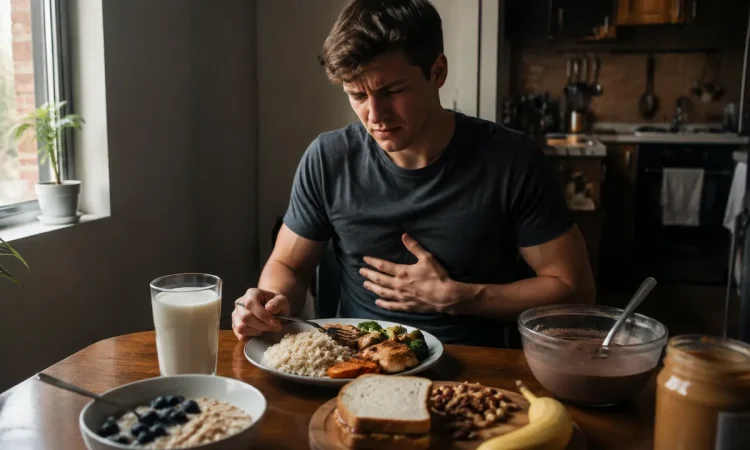
Most fitness advice assumes you’re fighting the urge to eat too much. For hardgainers, the battle runs in the opposite direction. You sit down to a meal that would look perfectly reasonable to most people, and by the third bite something in your gut says: okay, that’s enough. You push through anyway, because you’ve read that you need to be in a caloric surplus to build muscle. An hour later, you feel bloated, sluggish, maybe a little nauseous. You do it again the next day. And the day after that. Eventually, eating starts to feel like a punishment, and your body starts to dread the dinner bell.
This isn’t a character flaw. It’s physiology. People with a naturally high metabolism and a naturally low appetite the classic hardgainer profile often produce more ghrelin irregularly, have a stomach that empties at a different rate, and respond more aggressively to fullness hormones like leptin and cholecystokinin. Telling someone like that to “just eat more” is roughly as useful as telling an insomniac to “just sleep more.” Technically correct. Practically useless.
The real question is how to get the calories in without triggering the body’s shutdown response. And the answer, it turns out, has almost nothing to do with eating more food.
The Calorie Density Principle (And Why Volume Is Your Enemy)
Volume is the enemy. Not calories volume. Your stomach has stretch receptors, and when those receptors fire, fullness happens whether you’ve eaten 300 calories or 1,000. A giant salad and a small handful of almonds can create identical levels of satiety. The salad wins on micronutrients; the almonds win on calories. For someone trying to gain weight without discomfort, that distinction is everything.
This is where calorie density becomes your primary tool. You’re not trying to eat more. You’re trying to eat the same amount or even slightly less, in terms of physical volume while dramatically increasing the caloric content of what goes in.
Practically, that means a few consistent swaps. Olive oil on almost everything. Nut butters added to smoothies, oatmeal, or eaten straight off a spoon. Whole milk instead of skim, or better yet, full-fat Greek yogurt instead of low-fat. Avocado as a background ingredient rather than a garnish. Dried fruit instead of fresh when you’re snacking. A tablespoon of heavy cream in coffee. None of these additions feel like eating. None of them trigger stretch receptors in any meaningful way. But done consistently across a day, they can quietly add 400 to600 calories without a single moment of feeling stuffed.
The mindset shift required is subtle but important: you’re not adding meals, you’re adding calories to the meals you’re already eating.
Meal Timing That Works With Your Appetite, Not Against It
The three-square-meals model was built for people with reliable hunger cycles. If your appetite runs low which is common in hardgainers, especially under stress or during heavy training blocks waiting for hunger to tell you when to eat is a losing strategy. You’ll simply skip meals, or eat far less than you intended, and wonder why the scale isn’t moving.
A better framework is time-anchored eating. You eat at specific times regardless of hunger, but you keep the portions small enough that they never feel threatening. Six meals sounds exhausting in theory. In practice, if four of those “meals” are a handful of trail mix, a glass of whole milk, a small smoothie, and a spoonful of peanut butter before bed, the logistics aren’t that complicated. You’re not cooking six times. You’re just building in small, predictable caloric touchpoints across the day.
One thing worth noting: appetite tends to increase after consistent training, but with a delay. The first two or three weeks of a new training program often suppress appetite because the body is stressed and in recovery mode. Hardgainers who start lifting and immediately try to force massive caloric increases during this window are setting themselves up for digestive misery. Ease in. Let the training-driven appetite signals develop. They’ll come.
Liquid Calories: The Underused Tool With a Caveat
Liquid calories are, for many hardgainers, the single most practical intervention available. A well-constructed smoothie can deliver 700to 900 calories without triggering any meaningful fullness response, simply because it exits the stomach faster than solid food and places far less mechanical pressure on the digestive system.
A basic high-calorie smoothie formula: whole milk or full-fat coconut milk as a base, one or two tablespoons of nut butter, a banana, a scoop of oats, and optionally a protein source. That’s roughly 700 to 800 calories in a glass you can drink in ten minutes while doing something else. It barely registers as eating.
The caveat is fiber timing. If you’re loading a smoothie with raw kale, spinach, flaxseed, psyllium husk, and other high-fiber additions, you’re working against yourself. Fiber slows gastric emptying, which is great for satiety management but terrible if satiety is already your problem. Keep the fiber moderate in your high-calorie smoothies. Get your vegetables elsewhere in the day, in forms that aren’t competing with your calorie goals.
Also worth avoiding: carbonated beverages, even zero-calorie ones, before or during meals. The gas expands stomach volume and fires those stretch receptors early. A surprisingly common mistake that costs hardgainers a meaningful chunk of their meal capacity before the meal even begins.
The Stress and Cortisol Connection Nobody Talks About
Here’s something that rarely shows up in hardgainer guides: chronic stress is metabolically expensive and appetite-suppressing at the same time. Cortisol accelerates calorie burn, reduces hunger signaling, and promotes muscle breakdown. It’s a triple threat that can quietly sabotage even the most disciplined eating strategy.
A lot of hardgainers are also, not coincidentally, high-stress people. The same neurological wiring that drives perfectionism, overtraining, and overwork tends to run the metabolism hot and keep the appetite depressed. If you’re consistently eating what you believe is a surplus and still not gaining, it’s worth asking whether cortisol is burning through your deficit before it can be put to use.
Practical implications: sleep is a calorie strategy. Eight hours of quality sleep does more for anabolic hormone optimization than most supplements on the market. Eating the majority of your calories in the evening, when the nervous system has downregulated, is a legitimate tactical choice many people find their appetite is genuinely larger at night, and there’s reasonable evidence that eating more calories closer to training recovery (typically overnight) supports muscle protein synthesis. The idea that eating at night is inherently fattening has been largely debunked at this point.
Building the Habit Without Building Dread
The trap most hardgainers fall into is treating eating like a task to be optimized and suffered through. That psychological framing eating as obligation, eating as effort is self-defeating over the long term. The body reads stress and resistance, and it responds by doubling down on appetite suppression.
The more sustainable path is finding the high-calorie foods you genuinely enjoy and building your strategy around them. If you love dark chocolate, a few squares of 70% cacao per day adds real calories and something your nervous system actually wants. If you’d eat pesto on anything, pour it liberally. Food that feels like a pleasure registers differently in the gut than food that feels like medicine.
There’s also something to be said for not tracking calories obsessively, at least in the short term. For people with already complicated relationships with appetite, the act of calculating every gram can turn eating into an anxiety trigger that further suppresses hunger. A rougher approach identify your calorie-dense staples, eat them consistently, adjust based on weekly weight trends is often more sustainable and nearly as accurate.
The goal, ultimately, is a system you can maintain for months. Not weeks. Muscle accrues slowly, and the dietary habits that support it need to survive long enough to actually work. Anything that makes eating feel like a project you want to quit is, practically speaking, the wrong approach regardless of what the macro math says.