
The Myth of the “Ruined Vacation”
There’s a story a lot of gym-goers tell themselves before a trip. They’ve been consistent for months the numbers are moving, the mirror is cooperating, the routine has finally clicked into something sustainable. Then a flight gets booked, and suddenly they’re mentally preparing for a setback. Two weeks away from their gym, their meal prep, their schedule. They come home expecting to feel like a stranger in their own body.
Here’s what the science actually says: you won’t lose meaningful muscle in one to two weeks. Not even close. Muscle memory is real, and the physiological mechanisms that preserve lean tissue are far more forgiving than gym culture would have you believe. What most people lose on vacation isn’t muscle it’s momentum, routine, and the psychological confidence that comes from consistency. That’s a different problem, and it has a different solution.
Understanding What You’re Actually Protecting
Before figuring out how to maintain your gains, it helps to know what “gains” even means in a travel context. If you’ve been training seriously, you’re protecting a few things simultaneously: muscle mass, neuromuscular efficiency, cardiovascular capacity, and the behavioral habits that make training feel automatic.
Muscle mass is the most durable of these. Research on detraining consistently shows that noticeable atrophy takes three weeks or longer to kick in for trained individuals and even then, the loss is modest compared to what took months to build. Your nervous system, though, is quicker to quiet down. The crisp strength you feel when you’re firing on all cylinders? That can dull within a week of complete inactivity. And your habits those are the most fragile thing of all. A two-week break from routine can make the gym feel foreign again when you return, not because your body changed dramatically, but because the mental groove got shallow.
So the real goal of training while traveling isn’t preservation of every pound of muscle. It’s keeping the signal alive staying active enough that your body doesn’t interpret the break as a reason to downregulate, and staying engaged enough that your habits don’t fully dissolve.
The Minimum Effective Dose on the Road
This is where most travel fitness advice goes wrong. People either say “just do what you can” which is vague to the point of uselessness or they write elaborate6-day training splits that assume your hotel has a full rack and a cable machine. Neither is practical.
The more honest framing is this: two solid sessions per week, performed with genuine effort, are enough to maintain muscle and strength for the duration of most trips. That’s it. If you can get three, great. But two full-body sessions with compound movements think push-ups, rows, squats, hinges, carries done with progressive overload in mind, will keep the lights on.
The trap travelers fall into is treating every session like a compromise. “It’s just bodyweight, so it doesn’t reallycount.” That thinking is what creates the setback, not the travel itself. A set of Bulgarian split squats taken close to failure is a stimulus. Your quads don’t know you’re in a hotel room.
Working With What’s Actually There
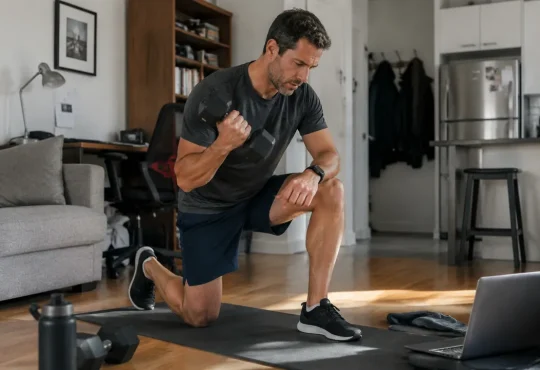
Most hotels have a gym that looks like a punishment room a treadmill, a few dumbbells that don’t go heavy enough, and a cable machine from2003. Most Airbnbs have a living room floor. And yet, neither of these is a real obstacle.
Bodyweight training has a ceiling, but that ceiling is higher than most people reach. Archer push-ups, single-leg Romanian deadlifts, tempo squats, pike push-ups, and isometric holds can all provide significant mechanical tension which is what muscle growth and retention actually require. The key variable isn’t equipment, it’s proximity to failure. A movement done with a casual10 reps to spare does almost nothing. The same movement done hard, with slow eccentrics or paused reps or added volume, does plenty.
If there are dumbbells available, even light ones, you have more options than you probably realize. Lighter dumbbells become harder dumbbells when you slow down the lowering phase, reduce rest intervals, or move into a mechanical drop set. Creativity isn’t a consolation prize here it’s the skill.
The Nutrition Reality Check
Eating well while traveling is genuinely harder than training, and it’s worth being honest about that. You’re navigating menus you didn’t write, social contexts where saying “can I see the macros on that” would be insufferable, and environments where the easiest food options are often the worst ones.
The approach that actually works isn’t meticulous tracking that tends to either fail halfway through or make the trip miserable. It’s anchor habits. Protein at every meal, because it keeps you full and directly supports muscle retention. Vegetables where you can find them, because your gut and your energy levels will thank you. Reasonable portions, because the goal is maintenance, not a caloric surplus or a deficit so steep you’re losing muscle.
What doesn’t work is the “I’m on vacation so nothing counts” mentality if you’re genuinely trying to hold on to progress. You can relax your standards considerably without abandoning them entirely. The problem is that “relaxing standards” often becomes a week of eating in a way you’d never eat at home, and then the second week feels like a continuation of the first. By the time you land, you’ve spent two weeks running a caloric surplus of several hundred calories a day and done zero resistance training. That’s when you actually feel the setback.
Sleep, Jet Lag, and the Recovery Tax
This one gets ignored constantly. Sleep is where adaptation happens. It’s where the training stimulus you applied actually gets converted into maintained or improved tissue. Travel absolutely wrecks sleep different time zones, unfamiliar beds, late nights, early flights, excess alcohol at the welcome dinner.
You can’t fully control your sleep environment on the road, but you can protect it with some degree of intentionality. Keeping your sleep schedule as consistent as the trip allows, using blackout curtains or an eye mask, limiting alcohol (which fragments sleep architecture even when it makes you feel drowsy), and managing caffeine timing these aren’t obsessive behaviors, they’re basic recovery hygiene.
The reason this matters for gains specifically: sleep deprivation elevates cortisol and suppresses testosterone and IGF-1. Even with perfect training and nutrition, a week of broken sleep will chip away at your body composition in ways that are harder to see but very real. Two sessions in the gym means nothing if the recovery environment is a disaster.
Coming Back Without Losing the Thread
The return home is where a lot of otherwise well-handled trips fall apart. You’re tired, maybe a little bloated from the food and travel, possibly jet-lagged. Getting back into the gym in that state feels harder than it actually is. The body is usually ready before the mind is.
The smartest move is a planned return session not your hardest ever, but a real session, done within the first 48 hours of being back. Not because you need to punish yourself for traveling, but because the longer the gap stretches, the more the routine erodes. One session plants the flag. It tells your nervous system and your habits that the break is over, without making your first day back feel like a test you might fail.
Traveling is one of the genuinely great things about being alive. The cost to your training is real but modest and far smaller than most people assume. The key is understanding that maintenance isn’t a lesser version of progress. It’s a skill in its own right, and knowing how to do it well means your gains are actually yours to keep, wherever you go.