
It’s Not the Caffeine
Most people go straight to blaming caffeine. They replay the afternoon coffee, the soda at dinner, the half-eaten chocolate bar on the nightstand. That’s the comfortable explanation familiar, easy to fix. But if you’ve cut the caffeine and you’re still staring at the ceiling two hours after that bowl of cereal or those crackers and cheese, then the real culprit is something your body is doing quietly, without announcing itself.
The reason your midnight snack keeps you awake has almost nothing to do with what you ate and almost everything to do with when you ate it and the chain reaction that follows inside a body that was already preparing to shut down.
Your Body Has a Schedule You Keep Interrupting
Sometime in the early evening, your brain begins releasing melatonin. It’s not a sudden switch it’s a slow tide, rising gradually as light fades. By the time you’re brushing your teeth, your core body temperature has started dropping, your digestion has slowed, your liver has shifted into overnight maintenance mode. Everything in your biology is coordinating toward one goal: sleep.
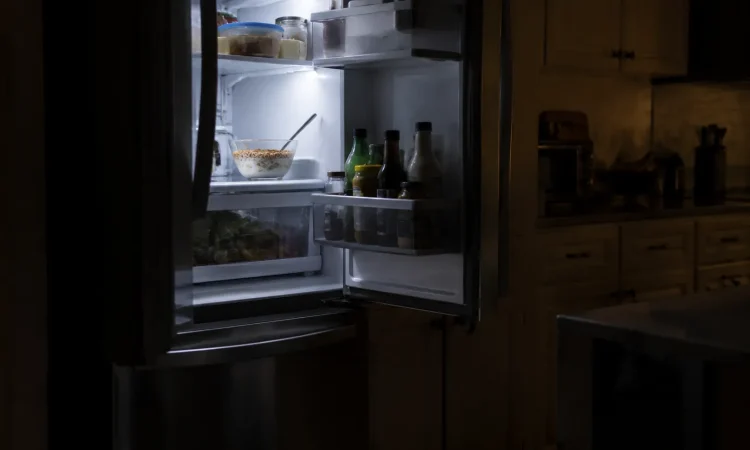
Then you open the refrigerator.
Eating even something small sends a signal that is fundamentally incompatible with what your body was doing. Digestion requires blood flow redirected to the gut. It requires the pancreas to respond with insulin. It activates the enteric nervous system, which researchers sometimes call the “second brain” because of how independently it operates. You’ve just told a system that was winding down to wake back up and get to work. The ripple effect is bigger than most people realize.
The Insulin Spike Nobody Talks About
Here’s the mechanism that almost never gets mentioned in casual conversations about sleep hygiene. When you eat carbohydrates late at night and most midnight snacks are carbohydrate-heavy, because that’s what the tired brain craves your blood sugar rises. Insulin floods in to manage it. Blood sugar drops. And when blood sugar drops sharply, the body reads it as a mild stress event.
In response, it releases cortisol and adrenaline. Small amounts, sure. But these are the same hormones that wake you up in the morning, the same ones that make your heart beat faster when you’re nervous. At two in the morning, even a minor cortisol release can be enough to pull you out of the early stages of sleep, or to prevent you from falling asleep at all.
You ate the crackers to feel calm. Your body is now, chemically, slightly alarmed.
This reactive hypoglycemia a post-snack blood sugar crash is incredibly common and almost completely invisible to the person experiencing it. You don’t feel low blood sugar as a clinical symptom. You just feel suddenly, inexplicably alert. Restless. Maybe a little anxious, though you can’t say why. Your mind starts running through tomorrow’s to-do list and you assume the insomnia is psychological. It isn’t. It’s biochemical. Your midnight snack triggered it.
Why the Body Temperature Angle Gets Overlooked
There’s a second mechanism working alongside the blood sugar issue, and it operates through your core body temperature. Falling asleep requires your body temperature to drop by about one to two degrees Fahrenheit. This cooling is part of what makes sleep physiologically possible it slows metabolic activity and helps shift the brain into its slower, restorative wave patterns.
Digesting food generates heat. It’s called diet-induced thermogenesis, and while the effect is modest after a small snack, it’s real and it’s measurable. You’re asking your body to cool down and heat up at the same time. The cooling process stalls. The onset of deep sleep gets pushed back. You lie there feeling vaguely uncomfortable, maybe a little sweaty, in that restless half-awake state that doesn’t feel like insomnia but isn’t really rest either.
Athletes and people who eat very late before competition know this feeling well. The body is working. Sleep doesn’t come easily when the body is working.
The Cravings Themselves Are a Clue
It’s worth pausing on why the midnight snack happens at all, because the craving often points back to earlier failures in the day. Sleep deprivation even mild, chronic sleep deprivation of the kind millions of people carry around as a baseline raises levels of ghrelin, the hunger hormone, and suppresses leptin, the hormone that signals fullness. A person who slept six hours last night is biochemically primed to eat more today, and especially to reach for high-carb, high-fat foods in the evening.
So the midnight snack is, in a very real sense, yesterday’s bad sleep demanding payment from tonight’s.
That loop is brutal when you see it clearly. Poor sleep drives late-night cravings. Late-night eating disrupts sleep. Which drives more cravings. The entry point to breaking it isn’t willpower it’s understanding which mechanism to interrupt first.
What Actually Happens When You Sleep With a Full Stomach
For some people, the problem isn’t the snack before bed it’s that they’ve eaten a full meal within two hours of lying down, which is a version of the same issue scaled up. When you’re horizontal, the stomach empties more slowly. Gastric acid has an easier time traveling upward. Even people who’ve never been diagnosed with acid reflux can experience mild aspiration events small amounts of stomach content reaching the esophagus that cause microarousals during sleep. These are waking events so brief you don’t consciously register them, but they fragment your sleep architecture the way a series of small interruptions fragments a long piece of writing. The form is technically intact. The meaning is lost.
You wake up feeling like you slept eight hours and got almost nothing out of it.
The 90-Minute Window
Nutritionists and sleep researchers tend to land on roughly the same number when asked how long to wait: at minimum90 minutes to two hours between your last bite and the time you intend to be asleep. Not lying in bed. Not starting your wind-down routine. Actually, biologically asleep.
That window gives insulin time to do its work without triggering a reactive crash. It gives the stomach time to partially empty. It gives thermogenesis time to dissipate. It gives the body a fighting chance at the temperature drop it needs.
If a light snack is genuinely necessary for people managing blood sugar conditions, for example, or for those who find hunger itself disruptive to sleep the options that cause the least disruption tend to be small amounts of protein or fat without a heavy carbohydrate load. A handful of nuts. A small amount of full-fat dairy. These provoke a slower, gentler insulin response and generate less thermogenic heat. They work with the body’s nighttime chemistry rather than against it.
The Quiet Renegotiation
Sleep medicine has spent decades focused on what happens in the bedroom light exposure, screen time, mattress quality, room temperature. These things matter. But the hour before bed and what you put in your body during it is a quieter, less glamorous frontier that tends to get less attention than it deserves.
The midnight snack feels innocent. It’s a small pleasure, a little comfort at the end of a long day. Nothing dramatic. But the body doesn’t experience it as innocent. It experiences it as a directive a message that says the day isn’t over yet, that there is work still to be done. And a body told to keep working is a body that cannot rest.
That’s the surprising part. Not that the food is harmful. Just that the timing of it speaks a language your biology understands perfectly, even when you don’t.