
When the Bed Becomes the Enemy
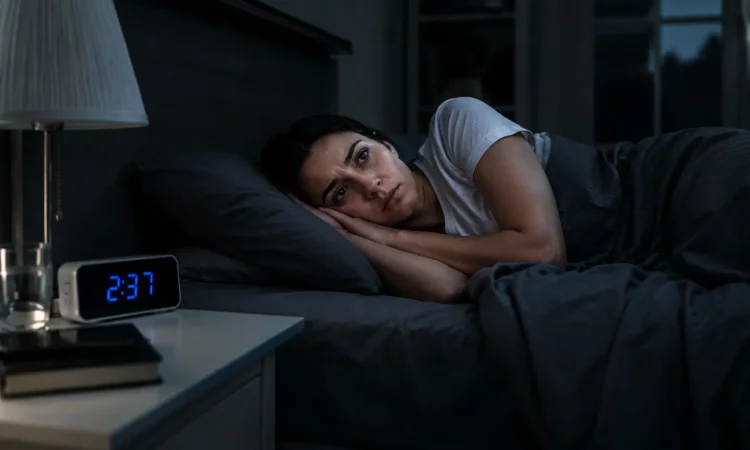
There’s a particular kind of dread that doesn’t announce itself loudly. It creeps in around9 PM, when you’re still on the couch, already calculating how many hours of sleep you’ll get if you fall asleep by eleven. You do the math. Then you do it again. By the time your head hits the pillow, you’re not tired anymore you’re vigilant. Watching. Waiting for sleep to arrive like a delayed flight you’ve been tracking for hours.
This is sleep anxiety. And the cruelest part of it is that the very act of trying harder to sleep is what keeps you awake.
Most people who struggle with insomnia don’t have a sleep problem in the traditional sense. They have a worry problem that has colonized the bedroom. The original cause a stressful week, a bout of jet lag, a bad cold may be long gone. What remains is the pattern: the anticipatory dread, the hyperarousal, the body that has learned to treat bedtime as acue for alertness rather than rest.
The Science of the Spiral
Sleep researchers have a name for the internal logic that drives this cycle: psychophysiological insomnia. The word is a mouthful, but the concept is almost embarrassingly simple once you see it. Your brain is an association machine. When you repeatedly lie awake in bed feeling anxious, your brain begins to link the bed itself with wakefulness and stress. Over time, the bed stops being a neutral object. It becomes a trigger.
This is classical conditioning playing out in your own bedroom. The same mechanism that made Pavlov’s dogs salivate at the sound of a bell is now making your nervous system fire up the moment you pull back the covers. The stimulus has changed; the biological machinery is identical.
Add to this the physiological reality of hyperarousal, and you have a feedback loop that can run for months, even years. When you’re anxious about not sleeping, your sympathetic nervous system activates. Cortisol rises. Core body temperature goes up slightly. Heart rate increases. All of these changes are the opposite of what sleep requires. Sleep needs a cooling, calming body a system that’s dialing down, not bracing for impact. Anxiety about sleep essentially fires the starter pistol for the exact physiological state that makes sleep impossible.
Then comes the morning reckoning. You’re exhausted and you already dread the coming night. And around goes the wheel.
The Trap of Sleep Hygiene Advice
At some point, nearly everyone in this spiral has been handed a list. No screens after 8 PM. Keep the room cool. Avoid caffeine after noon. Go to bed at the same time every night. This is sleep hygiene advice, and it’s not wrong but for people locked in the anxiety cycle, it often makes things worse.
Here’s why: every rule becomes another thing to fail at.
If you’re already hypervigilant about sleep, being told to optimize your environment transforms you into an obsessive inspector of your own bedtime conditions. Did the room get too warm? Was that glass of wine at dinner the thing that ruined everything? The checklist mentality is incompatible with the mental looseness that sleep actually requires. You cannot compliance your way into unconsciousness.
There’s even a clinical term for the extreme end of this phenomenon orthosomnia coined by researchers to describe people so fixated on achieving perfect sleep metrics (often through wearable devices) that their anxiety about the data actively disrupts their sleep. The cure becomes the disease.
What Actually Breaks the Cycle
The most counterintuitive and well-supported intervention for sleep anxiety is called Cognitive Behavioral Therapy for Insomnia, or CBT-I. Unlike medication, which addresses the symptom, CBT-I addresses the learned pattern. It works by systematically dismantling the associations and thought habits that perpetuate the cycle.
One of its core components is sleep restriction which sounds punishing and, initially, is. You’re instructed to limit your time in bed to roughly the amount of time you’re actually sleeping, even if that means staying awake until1 AM despite feeling exhausted. The logic is counterintuitive but sound: by building up genuine sleep pressure and reconsolidating the association between bed and sleep, you retrain your nervous system. After two weeks, most people are falling asleep faster and waking less. The short-term discomfort is real; so are the long-term results.
But beyond any formal protocol, there’s a shift in mindset that might be the most essential piece. It’s what therapists sometimes call “paradoxical intention” the practice of going to bed with the deliberate goal of staying awake, of keeping your eyes open and noticing the room rather than pursuing sleep. This defuses the performance anxiety. You stop auditioning for unconsciousness.
It sounds absurd. It works, repeatedly, in clinical trials.
The Thoughts That Come at3 AM
Part of what makes sleep anxiety so tenacious is that the mind at 3 AM is not a reliable narrator. Sleep deprivation impairs the prefrontal cortex the part of the brain responsible for rational perspective which means that by the time you’ve been lying awake for an hour, your assessment of how catastrophic this sleeplessness is has become genuinely distorted. Every worry feels permanent. Every symptom of fatigue feels life-altering.
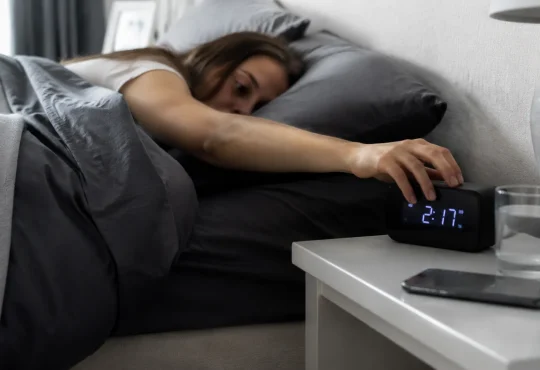
“I’ll never sleep again” is a thought that feels true at3 AM. It never is.
One of the most useful reframes is this: wakefulness is not an emergency. Humans are remarkably resilient to sleep disruption. Research on sleep deprivation shows that even after several bad nights, cognitive performance bounces back quickly once normal sleep resumes. The biological consequences of one poor night, or even a difficult week, are far less severe than the anxious mind believes in the dark. Suffering about not sleeping compounds the suffering. The insomnia itself, in most cases, is survivable even temporary if you stop treating it as a catastrophe.
This is not the same as dismissing the experience. Chronic sleep deprivation is genuinely harmful. But there’s a distinction between acknowledging difficulty and catastrophizing it, and the anxious insomniac brain reliably does the latter.
Reclaiming the Night
The path back is rarely linear. There will be nights where the old dread resurfaces where you catch yourself checking the clock, calculating, worrying. The goal isn’t to become someone who never thinks about sleep. It’s to become someone whose relationship with those thoughts has changed. You notice the worry, you don’t follow it down the hole.
Some people find that the practices adjacent to sleep a consistent wind-down, deliberate breathing, even something as simple as reading a physical book help less because they “fix” sleep and more because they offer the nervous system a different story to follow into the night. Not a checklist to complete. A rhythm to settle into.
What the research and the experience of millions of recovered insomniacs converge on is this: sleep is not a performance. It’s a surrender. And the only way to get there is to stop trying to force it, stop monitoring it, stop making it mean so much and let the night be, for once, just the night.