

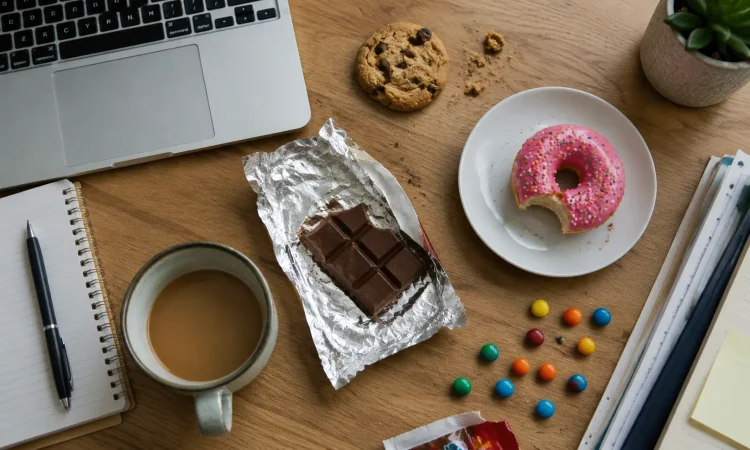
There’s a particular kind of desperation that hits around 3p.m. You’ve eaten lunch. You’re not hungry. But something in your chest or your brain, or some unnamed place in between is pulling you toward the vending machine, the candy dish on someone’s desk, the leftover birthday cake in the break room. You don’t want it, exactly. You need it. Or at least, that’s what it feels like.
Most people chalk this up to weakness. Poor discipline. A character flaw dressed up as a dietary one. But that framing misses something important: cravings are not random. They’re signals. And sugar cravings, specifically, are some of the loudest and most misread messages your body and mind send all day.
The Biology Underneath the Craving
To understand why you reach for something sweet, it helps to start with what sugar actually does in the brain. When you eat sugar, your brain releases dopamine the same neurotransmitter involved in reward, motivation, and pleasure. It’s not a metaphor when people say sugar feels like a drug. The neurochemical overlap is real. Dopamine spikes, you feel a momentary lift, and your brain logs that experience as something worth repeating.
But the story doesn’t end there. Insulin responds to the incoming glucose, blood sugar rises and then falls, and if the fall is steep enough, your body reads that drop as a mild emergency. So it sends another craving. This cycle is why sugar can feel self-perpetuating not because you lack willpower, but because you’ve triggered a biological loop that is genuinely difficult to exit mid-spin.
What often gets overlooked is that this loop is more likely to start and harder to break when your baseline is already stressed, depleted, or malnourished. A sugar craving in that context isn’t a quirk. It’s a reasonable response to an unreasonable situation.
When Your Body Is Running on Empty
One of the most common drivers of sugar cravings is also the most mundane: you haven’t eaten enough, or you haven’t eaten the right things. Specifically, a diet low in protein and fat the macronutrients that slow digestion and stabilize blood sugar leaves you riding a glucose rollercoaster all day. Each dip on that ride sends a signal that reads, in your body’s language, “we need quick energy.” And sugar is the fastest fuel there is.
Sleep deprivation plays a similar role, and it’s dramatically underappreciated. After a bad night, your levels of ghrelin (the hormone that signals hunger) rise, while leptin (the hormone that signals fullness) falls. Studies consistently show that sleep-deprived people reach for high-calorie, high-sugar foods at far higher rates than their well-rested counterparts. It’s not a coincidence that Sunday morning after a late Saturday night often ends with pancakes and syrup. Your body is trying to compensate for lost energy reserves using the most efficient tool it knows.
Iron deficiency is another quiet culprit. When your iron is low, oxygen delivery to your cells becomes inefficient, your energy tanks, and your brain starts looking for shortcuts. Sugar again is the fastest shortcut available. If yourcravings are persistent and accompanied by fatigue, brain fog, or feeling cold all the time, it’s worth getting a blood panel before assuming the problem is psychological.
The Emotional Architecture of Sweetness
Here’s where it gets more complicated, and more interesting. Sugar cravings aren’t always physical. Sometimes they’re emotional in a way that’s so deeply wired it’s almost architectural.
Think about the role of sweetness in early human experience. Sweetness in nature is a reliable marker of caloric safety ripe fruit, not poison. We are evolutionarily primed to find sweet things comforting, which is part of why sweet foods show up in celebrations, in grief, in childhood memory. Birthday cake. Holiday cookies. The candy your grandmother kept in a dish by her armchair.
This means that when you’re stressed, lonely, grieving, or simply feeling unmoored, reaching for something sweet is not just a craving it’s a form of self-soothing that has been culturally and neurologically reinforced across your entire life. The craving is pointing at an emotional need. And the honest question to sit with is: what is that need, and can it be met in a way that doesn’t require a blood sugar spike?
That question isn’t meant to guilt you out of the cookie. It’s meant to make the craving informative rather than just inconvenient.
Stress, Cortisol, and the Sweet Escape
Chronic stress deserves its own conversation here, because its relationship with sugar cravings is both direct and sneaky. When you’re under pressure, your adrenal glands release cortisol. Cortisol triggers a cascade of responses designed for short-term survival including an increase in blood sugar, because your body is preparing to fight or flee.
Once the stressor passes (ideally), cortisol drops and blood sugar normalizes. But in modern life, the stressor often doesn’t pass. Work deadlines, financial anxiety, relationship tension, low-grade existential dread these aren’t threats you can outrun. So cortisol stays elevated, blood sugar fluctuates unpredictably, and your brain keeps asking for quick glucose to deal with the emergency that never quite resolves.
This is why stress eating tends to skew sweet rather than savory. Your body isn’t being irrational. It’s responding to a stress signal that feels, metabolically, like a physical emergency. The craving is the symptom. The chronic stress is the illness.
What Gut Health Has to Do With It
There’s a newer dimension to this conversation that researchers are still mapping out: the gut-brain axis, and specifically, the influence of your gut microbiome on what you crave.
Certain strains of bacteria in your gut thrive on sugar. Some studies suggest these microbes may actually influence the signals sent to your brain, nudging you toward the foods that feed them most efficiently. It sounds almost sci-fi, but the evidence is growing. A microbiome that’s been disrupted by antibiotics, a highly processed diet, or chronic stress (there it is again) may contribute to cravings that feel external to your will because, in a real sense, they partially are.
Fermented foods, fiber-rich vegetables, and a varied diet support a more diverse microbiome, which in turn may reduce the intensity of sugar cravings over time. It’s not a quick fix microbiome shifts happen over weeks and months, not days. But it reframes the craving as something you can address systemically, rather than just white-knuckling through.
Reading the Signal Instead of Suppressing It
There’s a version of this conversation that ends with a list of substitutions eat a handful of almonds, drink some water, take a walk. That advice isn’t wrong. But it misses the more valuable move, which is to get curious about what your craving is actually communicating before you respond to it.
Are you tired? Stressed? Under-eating? Emotionally depleted? Running on cortisol and three hours of sleep? Those are different problems with different solutions, and a craving that gets quieted with a piece of dark chocolate today will be back tomorrow if the underlying message goes unread.
The craving is not your enemy. It’s a pretty reliable narrator, if you’re willing to listen to what it’s actually saying rather than just rushing to shut it up.