

That FamiliarAche Has Been Misleading You
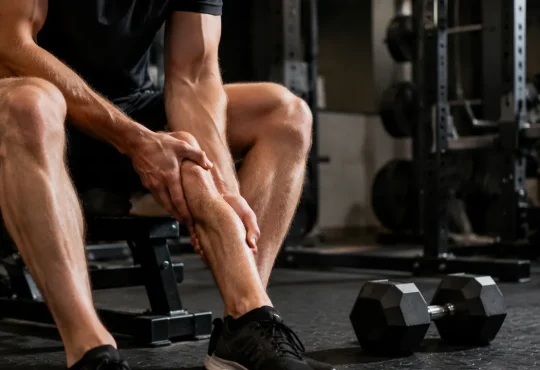
You know the feeling. Two days after a hard leg day, you ease yourself down onto a chair like you’re 80 years old, wincing with every inch. Your quads are screaming. Your glutes feel like they’ve been wrung out like a wet towel. And somewhere in the back of your mind, there’s a quiet satisfaction that hurt means it worked, right?
Not exactly. That assumption is one of the most stubborn myths in the gym, and it’s been quietly sabotaging the training of lifters at every level for decades. The truth about delayed onset muscle soreness DOMS is more nuanced, more interesting, and frankly more useful than the simple “pain equals gain” story most people were handed on day one.
What’s Actually Happening Inside Your Muscle Tissue
DOMS typically sets in 12 to 24 hours after exercise and peaks somewhere around the 48-hour mark. That delay is the first clue that something more complex is going on than a straightforward injury response.
For years, the dominant theory blamed lactic acid buildup. The thinking went: intense exercise floods your muscles with lactate, and that’s what causes the burn. But this was debunked fairly decisively when researchers found that lactic acid clears from muscle tissue within an hour of exercise. Whatever you’re feeling two days later, lactate has nothing to do with it.
The current understanding centers on microscopic damage to muscle fibers, specifically the Z-discs the structural lattices within muscle cells that hold contractile proteins in alignment. Eccentric movements, where the muscle lengthens under load, are particularly brutal on these structures. Think of the lowering phase of a squat, the descent in a pull-up, or running downhill. These motions create more mechanical stress per fiber than concentric contractions, and your body hasn’t fully adapted to them if they’re novel or unusually intense.
What follows is an inflammatory cascade. Your immune system mobilizes. Fluid accumulates in the tissue. Nerve endings in the area become sensitized a process called peripheral sensitization which explains why even light touch or casual movement can feel disproportionately painful. Your body isn’t broken. It’s doing exactly what it was designed to do: mounting a repair response.
The Soreness-Growth Disconnect Nobody Talks About
Here’s where things get genuinely counterintuitive. Muscle damage and the soreness it produces are not reliable proxies for hypertrophy. They’re not the same thing. They’re not even strongly correlated.
Plenty of elite athletes and experienced lifters make significant strength and size gains with minimal soreness. The body adapts. Once your nervous system and connective tissue have been exposed to a stimulus repeatedly, the damage response diminishes even as the training stimulus remains effective for growth. This is called the repeated bout effect, and it’s well-documented in exercise science literature.
On the flip side, you can absolutely trash yourself with unfamiliar movements and feel sore for five days straight without generating any meaningful hypertrophic signal. Soreness is primarily a novelty indicator, not a quality-of-training indicator. It tells you that your body encountered something it wasn’t prepared for. That’s useful information, but it’s not the same as confirmation that you’re building muscle.
This matters practically. Chasing soreness deliberately rotating exercises constantly, always seeking that two-day hobble is a strategy that can backfire. It keeps your body perpetually in a state of novelty-driven damage response rather than allowing it to adapt to and progressively overload a consistent stimulus. Progression, not perpetual soreness, is the actual mechanism of growth.
When DOMS Becomes a Problem Worth Taking Seriously
Most DOMS is benign. It’s uncomfortable, occasionally humbling, but it resolves on its own within three to five days without any lasting damage. The inflammatory response clears, the fibers are repaired slightly stronger than before, and you move on.
But there’s a more extreme version that deserves mention: rhabdomyolysis. This is a condition where muscle breakdown is so severe that myoglobin a protein released from damaged muscle cells floods the bloodstream at levels the kidneys can’t handle. In serious cases, it can cause kidney failure. Warning signs include dramatically dark or cola-colored urine, severe swelling in the limbs, and soreness so intense it’s beyond what any reasonable training session should produce.
Rhabdomyolysis is rare, but it’s not vanishingly rare, and certain situations elevate the risk significantly. First-time CrossFit-style workouts with extreme volume, returning to intense training after a long layoff, training in high heat without adequate hydration, or being on certain medications like statins can all push someone into dangerous territory. The “no days off, go until you puke” culture has contributed to cases that land people in emergency rooms. This isn’t fearmongering it’s a calibration check.
Managing DOMS Without Undermining Your Training
Once DOMS has set in, the most effective interventions are also the most straightforward, which is slightly anticlimactic given how much the supplement industry has tried to complicate the situation.
Light movement active recovery, walking, easy cycling increases blood flow to sore tissue and accelerates the clearance of inflammatory byproducts. It works, it’s free, and most people skip it because rest feels more intuitive when you’re in pain. Cold water immersion, or contrast bathing, has decent evidence behind it for reducing perceived soreness, especially in the 24to 48 hour window. Sleep is consistently underrated as a recovery tool across the board, and DOMS is no exception.
Ice baths have become a point of genuine debate in performance circles. There’s credible research suggesting that aggressive cold therapy post-workout may blunt the anabolic signaling that drives muscle adaptation. The anti-inflammatory effect that makes you feel better might be partially counteracting the very inflammatory cascade your body uses to trigger growth. For competitive athletes, timing matters: cold therapy is likely more appropriate in-season when recovery speed is the priority, and less appropriate during dedicated hypertrophy phases. Recreational lifters probably don’t need toagonize over this, but it’s worth knowing the tradeoff exists.
Foam rolling and massage have a reasonable evidence base for reducing the perception of soreness and improving range of motion, even if the mechanisms aren’t entirely settled. They won’t accelerate structural repair, but they make you feel better and they keep you moving and movement itself is beneficial.
NSAIDs like ibuprofen will reduce soreness. They’ll also reduce the inflammatory signaling that supports muscle protein synthesis. Using them occasionally for genuine pain management is fine. Using them habitually after every hard session is, again, potentially working against your own goals.
What Experienced Lifters Actually Learn to Do
Veterans of the weight room develop a different relationship with soreness over time. They stop chasing it as validation and start reading it as data. Unusual soreness after a familiar session is a signal worth noting it might mean you’re underrecovered, that you inadvertently shifted your technique and recruited muscles differently, or that something external like stress or poor sleep has lowered your recovery capacity.
The absence of soreness after a hard session doesn’t mean the session was wasted. It often means your body is adapted, your programming is consistent, and your recovery is working. That’s a sign of progress, not stagnation.
Learning to train through mild DOMS is a skill worth developing. Research consistently shows that training a sore muscle at moderate intensity doesn’t impair recovery and may actually speed it up. The instinct to completely rest a sore muscle until it’s 100% is largely unnecessary for recreational training, and it leads to skipped sessions that accumulate over time into genuine gaps in volume.
The body is more resilient than the soreness makes it feel in those brutal first days. Understanding what’s actually happening under the surface structurally, immunologically, neurologically changes how you respond to it. You stop treating it like a sign of damage and start treating it for what it is: a temporary, expected, manageable consequence of asking your body to do hard things.
And sometimes, honestly, that’s enough to make the stairs just a little less terrifying.