
The Hour That Belongs to No One
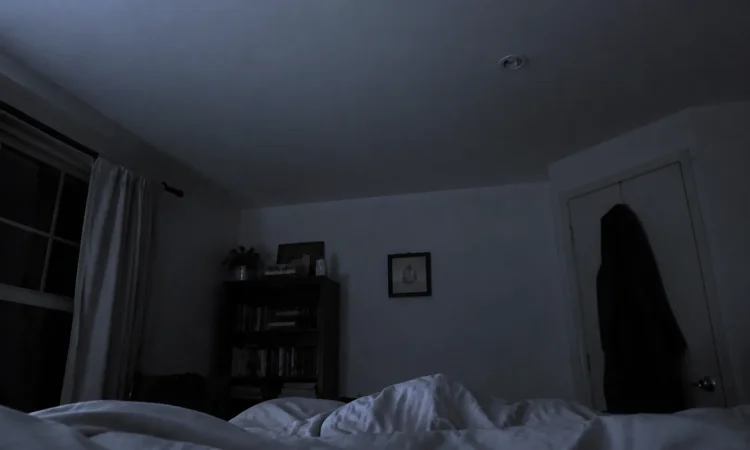
There’s a particular quality to3 AM that daytime can’t replicate. The city has gone quiet enough that you can hear the refrigerator hum, the distant bark of a dog two streets over, the sound of your own breathing. Everyone around you is asleep or so it seems. And you’re lying there, eyes open, staring at a ceiling that offers nothing back.
This isn’t insomnia in the clinical sense, necessarily. It’s something stranger and more specific: a consciousness that refuses to switch off, a mind that has chosen this exact hour to replay every conversation you’ve mishandled, every bill you haven’t paid, every relationship that slowly drifted somewhere you can’t quite name. The darkness doesn’t create these thoughts. It just stops pretending they don’t exist.
What nobody tells you is how lonely that feels not just alone, but cosmically isolated, as if the whole world has moved on to a different frequency and you’re the only one still receiving the old signal.
Why the Night Amplifies Everything
During the day, noise is a kind of mercy. Work deadlines, small talk, the logistical machinery of just being a person in the world all of it builds a scaffolding around the things you’d rather not look at directly. You stay busy not always because the work demands it, but because busyness is the most socially acceptable form of avoidance we’ve ever invented.
But by3 AM, the scaffolding is gone. The psychological buffers dissolve with the light.
Neuroscience has something to say here. The prefrontal cortex the part of the brain responsible for rational thought, perspective-taking, and emotional regulation becomes less active when we’re sleep-deprived and stressed. What remains more active is the amygdala, the brain’s threat-detection center. So when you’re lying awake at 3 AM and a mildly awkward thing you said three years ago suddenly feels like evidence of your fundamental worthlessness, your brain isn’t being dramatic. It’s being exhausted. The rational counterweight that normally says “that was minor, let it go” has gone offline. What’s left is raw signal, unfiltered and loud.
This is why everything at 3 AM feels irreversible. Careers feel finished. Relationships feel broken beyond repair. Regrets feel permanent. The hour has a way of turning provisional worries into carved certainties and it lies.
The People on the Other Side of the Ceiling
Here’s the thing about that feeling of cosmic isolation: it’s statistically absurd.
On any given night, somewhere between a third and a half of the adult population in the developed world will experience some disrupted sleep. Millions of people right now, in apartments stacked above and below yours, in houses along your street, in time zones folded around the globe they’re doing exactly what you’re doing. Staring. Thinking. Scrolling through their phone at 2:47 AM and pretending it’s going to help.
The difference is that none of us talk about it during the day. Morning comes and we pour the coffee and say “a bit tired, yeah” and move on. We don’t say: last night I lay awake for two hours convinced that I was failing at every meaningful thing in my life, and I cried a little into my pillow, and I felt so profoundly alone that it scared me.
We don’t say that. So everyone assumes everyone else is sleeping fine,coping fine, feeling fine. And the loneliness compounds.
There’s a writer named Matthew Crawford who once described the modern condition as “the experience of being surrounded by people and still feeling unseen.” That sentence was written about something else entirely, but it could have been written for3 AM. The room is dark. Your partner or roommate breathes steadily beside you or in the next room. The world continues. And you feel invisible inside your own life.
What the Darkness Is Actually Asking
Not every sleepless night is a crisis. Some of them are just biology a disrupted circadian rhythm, too much caffeine, a body recalibrating itself. But some of them carry weight. Some of them are the mind’s way of surfacing what the day has trained you to submerge.
Grief shows up at 3 AM. Not always the loud, acute grief of recent loss, but the quieter, more complicated kind grief for a version of your life you thought you’d be living by now, grief for a friendship that ended without ceremony, grief for a younger version of yourself who had more hope and less history. The day doesn’t give this grief anywhere to go. The night does.
Anxiety shows up too, wearing the clothes of productivity. At 3 AM you might find yourself mentally drafting emails, rehearsing difficult conversations, problem-solving circumstances that don’t actually require solving at 3 in the morning. The mind creates urgency to avoid sitting with uncertainty. It would rather spin than rest.
And sometimes not always, but sometimes what shows up at 3 AM is closer to an honest reckoning. A question you’ve been circling around: Is this the right job? Is this relationship actually working? Am I living in a way that reflects anything I actually value? These aren’t comfortable questions. But they’re real ones. The darkness strips away the noise and leaves you facing them without the usual escape routes.
That’s not punishment. That’s information.
The Small, Imperfect Things That Help
There’s no clean solution to 3 AM. Anyone offering you a five-step system for eliminating nighttime anxiety is either selling something or hasn’t actually experienced the thing they’re trying to fix.
What actually helps is less dramatic. Getting out of bed sometimes not to scroll, but to sit somewhere else in the dark, to let the room change, to remove yourself from the pressure of trying to sleep while lying in the exact place sleep refuses to come. Writing things down, not to solve them, but to evacuate them from the loop. The simple act of moving thought from inside your head to outside your body onto paper, into words reduces the pressure, even when nothing is resolved.
Some people find genuine comfort in the knowledge that others are awake. There’s a certain genre of late-night social media post that exists for no other reason than this: someone reaching out into the dark to confirm that other people are there. It’s not profound. It’s not elegant. But the impulse behind it is deeply human the need to be witnessed, even briefly, even by strangers.
And sometimes what helps most is simply not fighting the wakefulness. Not treating3 AM as a problem to be solved before it costs you tomorrow’s productivity. Lying there and thinking: okay. Here I am. This is happening. I don’t have to fix it tonight.
A Different Way to Hold It
The Japanese have a word, ma, that describes the meaningful pause the intentional space between things. The silence in music that gives the notes their shape. The gap between words that makes language breathe.
3 AM can be ma. Not wasted time. Not evidence of failure or dysfunction. But a pause in the continuous performance of being a functional person a moment when the architecture comes down and something more honest gets to exist for a while.
You don’t have to romanticize it. It still hurts. The thoughts are still too loud and the ceiling is still indifferent. But if you’ve been lying there tonight, turning the same thoughts over and finding no easy answer you’re not broken. You’re not uniquely suffering. You’re in the company of every person who has ever been too awake in a sleeping world, holding something that doesn’t yet have a name.
The light will come back. It always does. And you’ll still be here when it does.