
Most people walk into the gym thinking about their program. The sets, the weights, the rest intervals. What they rarely think about at least not carefully is what happened in the kitchen an hour before. That’s a mistake. The meal you eat sixty minutes before lifting isn’t just fuel in the conventional sense. It’s a conversation with your body about what you’re about to ask it to do.
The timing matters more than most people realize. Too close to training and you’re digesting while trying to perform, blood pooling in your gut instead of your muscles. Too far out and you’ve already burned through the available energy, showing up metabolically empty. Sixty minutes is the sweet spot for most people far enough to clear acute digestion, close enough that nutrients are still actively circulating.
Why the Pre-Workout Meal Is a Different Kind of Eating
There’s a tendency to treat this meal like any other just smaller, maybe. But the purpose is specific. You’re not eating for hunger. You’re eating to prime a physiological state. That means you need to think about what your muscles actually need when they’re contracting under load, what your nervous system needs to stay sharp, and what your gut can tolerate when your heart rate is climbing.
Carbohydrates are the first thing to get right. When you lift weights, your muscles draw primarily from glycogen stored glucose that lives in the muscle tissue itself. If those stores are depleted, you’ll feel it around set four of a heavy squat session. Your legs won’t fail because they’re weak. They’ll fail because they’re running on fumes. Eating digestible carbohydrates sixty minutes out gives your body time to break them down and push glucose into circulation without causing a sluggish, bloated feeling mid-session.
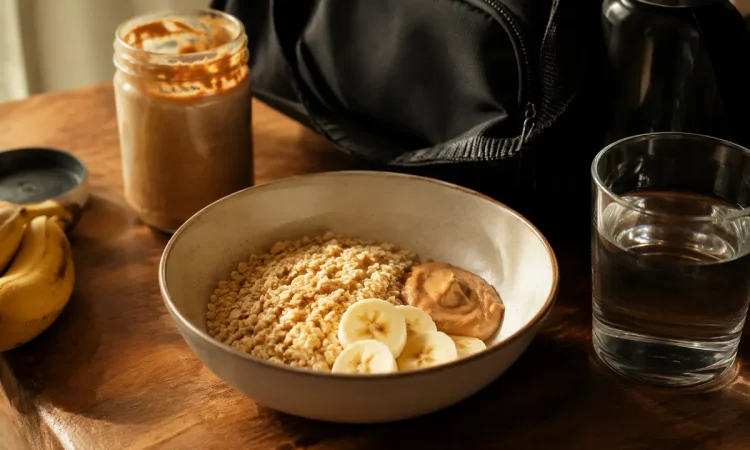
The key word is digestible. This is not the time for a bowl of lentils and roasted vegetables. Fiber is generally your friend in daily life, but it slows gastric emptying. Before training, that slowness works against you. You want carbs that move quickly white rice, a banana, a slice of toast, oatmeal without a mountain of toppings. Nothing that’s going to sit heavy.
Protein: The Pre-Workout Argument You Might Not Have Heard
Most people associate protein with post-workout recovery, and that association isn’t wrong. But there’s a compelling case for including a moderate serving of protein before you train, too. Research on muscle protein synthesis suggests that having amino acids available in the bloodstream during and immediately after training may support a more robust anabolic response. You’re essentially giving your muscle tissue something to work with from the moment the damage begins.
The caveat is quantity and source. A pre-workout protein hit should be moderate somewhere around 20to 30 grams is a reasonable range and it should come from something that digests without drama. Greek yogurt, eggs, a small serving of chicken, a protein shake if you’re time-pressed. Not a double serving of cottage cheese and a steak. Heavy protein sources take time, and time is the one thing you’re managing carefully in this window.
There’s also a subtler reason to include protein before lifting. Amino acids, particularly leucine, have been shown to trigger mTOR signaling essentially a cellular switch that tells your body to build rather than break down tissue. Getting that signal firing before you walk under the bar has a certain logic to it.
Fat: The Complicated Ingredient
Fat is where pre-workout nutrition gets more nuanced. It’s not that fat is bad metabolically, it’s a valuable fuel source for lower-intensity, longer-duration activity. But for high-intensity strength work, fat is simply too slow. It requires oxygen for oxidation and takes longer to become available as energy than carbohydrates do.
More practically: fat delays gastric emptying. A pre-workout meal that’s heavy in fat say, avocado toast with two eggs and a handful of nuts will sit in your stomach longer than you want it to. You might feel fine at the start of the session, but by the time you’re deep into a working set, that fullness can become genuinely uncomfortable.
This doesn’t mean eliminating fat entirely. A small amount often comes along for the ride in whole food protein sources, and that’s fine. What you’re avoiding is making fat a centerpiece of the meal. Keep it incidental, not intentional.
The Carbohydrate-Protein Combination in Practice
Putting the theory together looks something like this. An hour before training, a meal that delivers roughly 30 to 50 grams of carbohydrate alongside 20 to 25 grams of protein with minimal fat and minimal fiber is going to serve most recreational and intermediate lifters very well.
In real food terms, that translates to something like:
A banana with a scoop of protein powder mixed in water.
Two eggs on a slice of white toast with a small amount of jam.
Greek yogurt with a drizzle of honey and a few pieces of fruit.
Chicken rice the simplest version, not the elaborate bowl.
These aren’t glamorous meals. They don’t need to be. The goal is function, not culinary satisfaction. Save the complexity for your other meals.
Hydration Is Part of the Equation
It would be incomplete to talk about pre-workout nutrition without mentioning water. By the time you feel thirsty during a training session, you’re already operating at a performance deficit. Mild dehydration even just one to two percent of body weight measurably impairs strength output and cognitive focus.
The pre-workout window is a good time to front-load fluids. Not to the point of sloshing, but a meaningful400 to 600 milliliters of water in the hour before training, separate from what you drink during the session, makes a real difference. Electrolytes matter too, especially if you train in heat or sweat heavily. A small pinch of salt in your water, or a few salted crackers alongside your meal, can help you retain what you drink rather than flushing it straight through.
What Happens When You Skip It
A lot of experienced lifters have trained fasted at some point, and some do it regularly. Fasted training isn’t inherently catastrophic especially for shorter sessions or when glycogen stores are still relatively high from the previous day’s eating. But for most people doing any meaningful volume or intensity, skipping the pre-workout meal is a consistent headwind. Sessions feel harder. Rep counts drop. The mental edge that comes from knowing your body is ready tends to disappear.
There’s also a longer-term consideration. Training repeatedly in a depleted state can push cortisol higher and suppress recovery. Over weeks and months, that accumulates. The difference between showing up fueled and showing up empty is a difference you might not notice session to session but you’ll notice it in your progress over a training block.
Individual Variation Is Real, But Not an Excuse
It’s worth acknowledging that people respond differently to food before training. Some athletes feel their best having eaten a full meal ninety minutes out. Others do well on something minimal just thirty minutes before. Gut sensitivity, training history, and the nature of the session all influence what works.
The sixty-minute window is a starting point, not a law. What matters is developing an honest awareness of how your body performs based on what you’ve eaten and when. That kind of self-knowledge earned through paying attention rather than just following a formula is ultimately more valuable than any specific protocol.
The physiology, though, is consistent across individuals even when preferences vary. You need available glucose, some circulating amino acids, and enough fluid to sustain intensity. How you get there is flexible. That you need to get there at all is not really up for debate.