
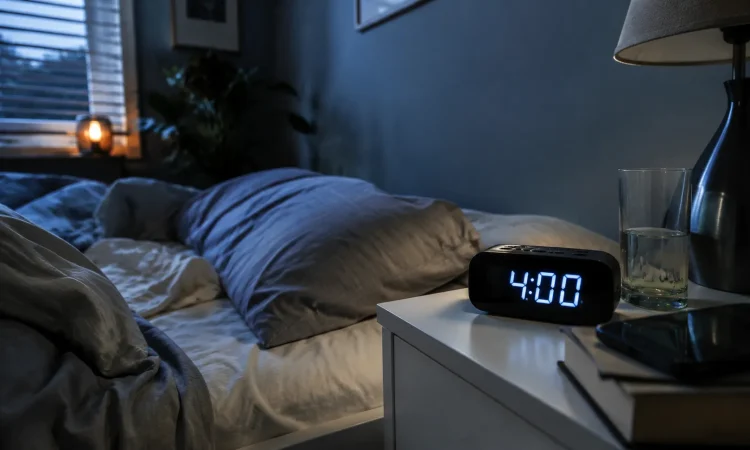
There’s a particular cruelty to waking at 4 AM. Not6, when the sky is already lightening and you can almost justify getting up. Not 2, which at least has the dignity of feeling like the middle of the night. Four in the morning is its own kind of purgatory the world is completely dark, your alarm is still hours away, and yet your eyes are open and your mind is already running laps. If you’ve been here, you know the specific misery of staring at the ceiling while exhaustion presses down on you like a weight, and sleep refuses to come back.
The frustrating irony is that the more desperately you want to fall back asleep, the harder it becomes. Anxiety about being awake creates a feedback loop that most people never break they lie there calculating how many hours of sleep they’ll get if they fall asleep right now, then right now, then right now. By the time the alarm goes off, they’ve spent two hours rehearsing stress.
Understanding why this happens is the first step to doing something about it.
Why4 AM Is a Biological Flashpoint
The human sleep cycle doesn’t run in a straight line from unconscious to awake. It cycles through different stages roughly every 90 minutes, moving from light sleep into deep slow-wave sleep and back up through REM the stage where dreaming happens and the brain processes emotion and memory. In the early part of the night, your body front-loads the deep, restorative sleep. By the second half roughly 3 to 5 AM you’re spending much more time in lighter REM sleep.
That’s why 4 AM is a vulnerability window. You’re already in shallow water, biologically speaking. The smallest disruption a noise, a temperature shift, a full bladder, a cortisol spike can pull you all the way to the surface. And cortisol, the stress hormone that primes your body for waking, actually begins climbing in the early morning hours as part of your circadian rhythm. It’s supposed to rise gradually and help you feel alert at a reasonable time. But in people under chronic stress, or those with disrupted sleep patterns, that cortisol surge can come early and hit hard. Four AM. Eyes open. Heart already moving a little faster than it should.
Add to that any underlying anxiety about work, relationships, money, health and the brain has a ready stockpile of material to burn through the moment it surfaces from REM. You weren’t anxious when you fell asleep. But somewhere in those last few hours of light sleep, your brain was already rehearsing its worries, and now, awake, it decides to continue the performance at full volume.
The First Thing to Do: Stop Fighting
This sounds counterintuitive, but the worst thing you can do in the first minutes of a4 AM wakeup is try hard to fall asleep. Effort is the enemy of sleep. Sleep requires a kind of passive surrender, and any attempt to force it activates exactly the neural systems arousal, vigilance, problem-solving that keep you awake.
Sleep scientists and cognitive behavioral therapists who work with insomnia patients call this phenomenon “sleep effort,” and it’s one of the most reliable predictors of chronic sleep trouble. The people who sleep best are often those who care least about whether they’re sleeping.
Which means the first practical move is to release the goal. Not permanently, not with resignation but as a deliberate act of redirection. Instead of trying to fall asleep, try to rest. Those two things feel similar but they’re neurologically different. Resting without sleep pressure means your nervous system can begin to downregulate even if consciousness doesn’t fully switch off. Some people find this so effective that they drift off before they realize they’ve stopped trying.
Physically, this means unclenching. Jaw, hands, shoulders wherever you hold tension. Slow the breath without forcing it into any particular pattern. Let your body be heavy in the mattress rather than braced against it.
Working With Your Nervous System, Not Against It
The body has its own toolkit for pulling the brake on stress arousal, and the most accessible lever is the breath. Not the performance-anxiety-inducing technique where you count to four, hold for seven, exhale for eight and end up more tense than when you started but something quieter. Just letting the exhale be a little longer than the inhale.
The exhale activates the parasympathetic nervous system. It’s a physiological fact. A slightly extended out-breath signals safety to the body, nudges the heart rate down, and begins the chemical cascade that makes sleep more possible. You don’t need to make it dramatic. Breathe in normally, breathe out slowly. Do it a few times. The effect is subtle but real.
Body scan is another tool that works precisely because it gives the conscious mind something to do that isn’t generating anxiety. Moving attention slowly from the feet upward noticing sensation, weight, warmth, without judgment occupies just enough of your mental bandwidth to prevent the worry spiral from gaining traction. It’s not meditation in any formal sense. It’s more like gently steering a car that’s drifting off the road.
Temperature also matters more than most people realize. Core body temperature drops during sleep, and if your bedroom is too warm, your body struggles to stay in sleep mode. If you wake at 4 and feel too hot, something as simple as sticking a foot outside the covers can help more than any supplement.
What to Do When Your Mind Won’t Quiet
Sometimes the body is cooperative but the brain refuses. You’re physically still, your breathing is slow, and yet there’s a relentless low-level commentary running the conversation you handled badly, the deadline, the thing you forgot to do, the thing you’re afraid might happen. This is where many people reach for their phones, which offers the illusion of doing something while actually making everything worse. Screen light suppresses melatonin and the content email, news, social media is specifically engineered to generate engagement, which is the opposite of drowsiness.
A better option for an active mind is what cognitive therapists call “scheduled worry time,” applied in reverse. When an anxious thought appears, instead of engaging with it, you mentally defer it. Not suppress it, which doesn’t work and usually backfires but reschedule it. There’s a genuine difference between “stop thinking about that” and “I’ll think about that properly at7 AM.” The second approach actually works for many people, because it honors the thought without feeding it.
Writing is another release valve, if you have a notepad nearby and the light situation allows. Getting the worries out of your head and onto paper performs a kind of cognitive offloading your brain stops holding onto the thought quite so tightly because it knows there’s an external record. Even a few scrawled words can be enough.
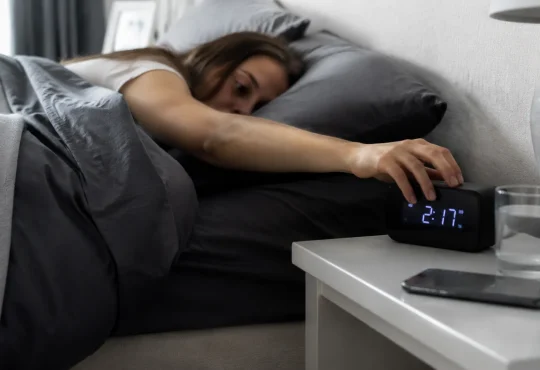
What you want to avoid, at almost any cost, is the clock. Checking the time in the middle of a4 AM wakeup is almost never useful information. It either confirms your fear that too much time has passed or tempts you into that calculus of remaining sleep hours. Cover the clock. Turn it around. Make it irrelevant.
The Longer Game
Single-night strategies help, but if4 AM wakeups are becoming a pattern, the problem probably lives in your daytime as much as your nighttime. Chronic early morning waking is one of the hallmark symptoms of both anxiety and depression not just stress, but the clinical kind and it’s worth taking seriously rather than simply managing around.
Sleep restriction therapy, which sounds brutal but is one of the most effective evidence-based treatments for chronic insomnia, works by temporarily compressing your sleep window to rebuild sleep pressure and restore the natural architecture of the night. It’s typically done with guidance from a sleep therapist or through structured CBT-I programs, many of which are now available digitally.
Caffeine timing, alcohol, exercise habits, light exposure all of it folds into sleep quality in ways most people underestimate. Alcohol in particular is a notorious culprit for exactly this kind of second-half wakeup. It helps people fall asleep faster but fragments the back half of the night, leaving them awake in the dark at 4 with no obvious explanation.
The 4 AM wakeup feels like a problem that belongs to the night. But more often than not, it’s the night’s way of handing back a bill that accumulated during the day. Paying attention to what that bill actually contains the tension you carried, the stimulants, the unprocessed emotions is the kind of accounting that eventually buys you back your sleep.