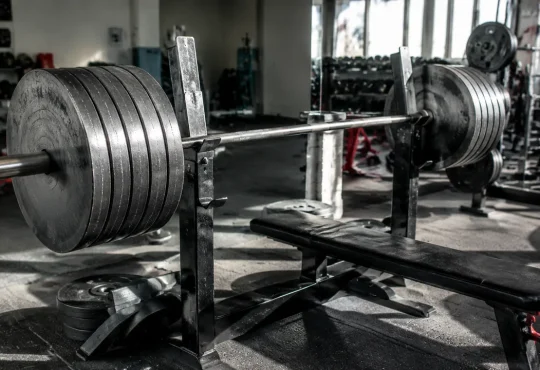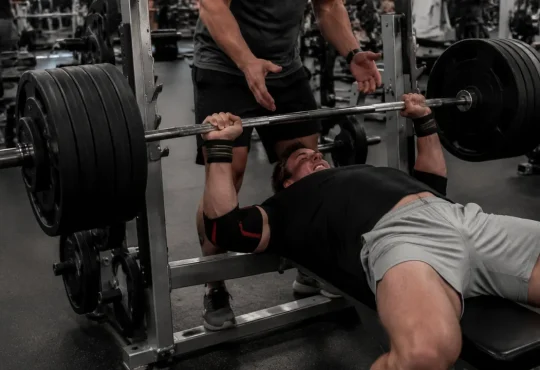

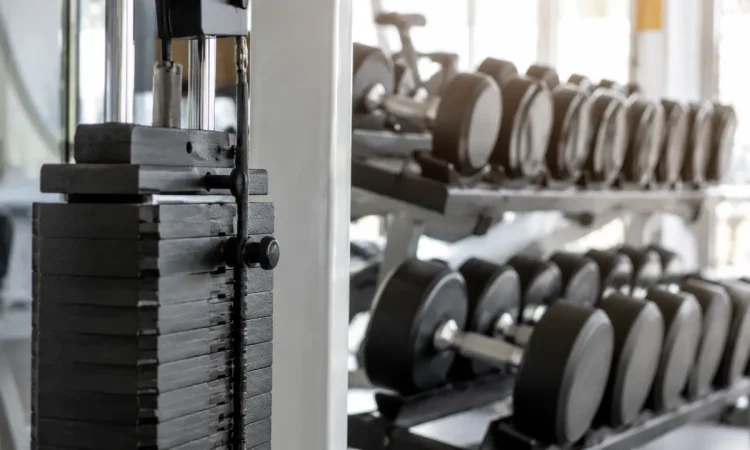
For decades, the debate has played out in gyms everywhere the experienced lifter gesturing toward the squat rack, telling newcomers that free weights are the only real way to build muscle, while the trainer on the other side of the room points to the cable stack and leg press, arguing that controlled resistance is smarter, safer, and just as effective. Both sides have always had their logic. What’s changed recently is that researchers have started putting those assumptions under serious scrutiny, and the results are more nuanced and more interesting than either camp expected.
The Old Assumptions, and Why They Held
The free weight faithful weren’t wrong without reason. Barbells and dumbbells demand stabilization. When you press a barbell overhead, your rotator cuff, your traps, your obliques they’re all firing just to keep the load balanced and your spine safe. That recruitment of stabilizing muscles was long considered a key ingredient in building functional strength and overall muscle mass. The logic was clean: more muscles involved, more total stimulus, more growth.
Machines, by contrast, lock you into a fixed plane of motion. The guided path of a chest press machine removes most of the stabilization demand. Critics argued this made machine training a kind of shortcut useful for rehab or beginners, but ultimately a ceiling for anyone serious about hypertrophy.
This belief persisted partly because it was hard to study otherwise. Early research on resistance training often used small samples, short durations, or untrained subjects people whose muscles respond to almost anything. Drawing firm conclusions from that kind of data is like trying to judge the performance of a sports car by watching someone learn to drive in a parking lot.
What Recent Research Actually Found
A wave of better-designed studies over the past several years has complicated the narrative significantly.
One of the most cited recent trials, published in the Journal of Human Kinetics, directly compared machine-based training to free weight training across matched volumes over a twelve-week period in resistance-trained participants. The finding: muscle hypertrophy was statistically similar between the two groups across all major muscle groups measured. Not “machines were close.” Actually similar, within margins that don’t carry practical meaning for most lifters.
A 2023 meta-analysis in Sports Medicine synthesized data across multiple controlled trials and reached a comparable conclusion that when volume, intensity, and mechanical tension are equated, the tool delivering that tension matters far less than whether you’re actually applying sufficient overload over time. The signal for muscle growth, in other words, doesn’t care much about the delivery mechanism.
This is a meaningful shift. It moves the conversation away from “which tool is superior” and toward understanding what variables actually drive hypertrophy tension, metabolic stress, mechanical damage to muscle fibers, and progressive overload over weeks and months. Whether a barbell or a guided cable is producing that tension becomes almost secondary.
Where Free Weights Still Have an Edge
That said, machines don’t win on every dimension, and it would be dishonest to flatten the complexity.
Free weights still produce measurably greater activation of stabilizing musculature. If you care about building the smaller muscles that support joints the muscles that keep your knees tracking properly during a squat, or your shoulder healthy under load the instability of free weights creates a training stimulus that machines simply don’t replicate. This matters especially for athletes and for aging populations, where joint integrity and movement quality have real-world consequences beyond what any scan of bicep or quad volume can capture.
There’s also a skill component. Learning to move a barbell developing the proprioception, the timing, the body awareness that comes from years of training under free-load conditions builds a kind of physical intelligence that machine training doesn’t require. Some researchers argue this neurological adaptation has downstream benefits that hypertrophy studies, which tend to measure muscle size in isolation, may not fully capture.
Functional carryover is the term that often comes up. A leg press number tells you something, but it doesn’t always predict how someone moves under the demands of daily life or sport.
Where Machines Have Been Underrated
On the flip side, machines offer something that the gym culture has historically undersold: precise, repeatable loading at specific joint angles. This matters more than it sounds.
Consider the serratus anterior a muscle along the ribcage that’s notoriously difficult to load with free weights. Or the rear delts, the vastus medialis, the lower traps. These muscles are awkward to target with barbells and dumbbells, either because of the angles involved or because other, stronger muscles tend to take over the movement. Machines allow coaches and lifters to isolate weak links in ways that free weights often can’t.
For hypertrophy specifically, there’s growing evidence that muscles respond strongly to being trained near their lengthened position under load when fully stretched. A Romanian deadlift does this reasonably well for the hamstrings. But a lying leg curl machine can load the hamstrings in a deep stretch in a way that a barbell simply cannot replicate at all. Recent research from Brad Schoenfeld’s lab and others has pointed toward stretched-position loading as a meaningful driver of muscle growth, which elevates certain machines to a status the old gym wisdom never granted them.
Cable machines in particular have earned serious reconsideration. Because cables maintain tension throughout the entire range of motion unlike free weights, which unload at the top of many movements due to the leverage curve they provide a different mechanical stimulus. Not better, but different in a way that complements barbell work rather than duplicating it.
The Integration Argument
What the newest research ultimately points toward isn’t a winner. It points toward integration.
Experienced coaches and evidence-based trainers have been quietly building programs this way for years using barbells and dumbbells for compound movements that demand coordination and develop full-body strength, and using machines and cables to isolate specific muscles, load them in stretched positions, and accumulate volume without the fatigue cost of heavier free weight sessions. The two approaches don’t compete; they fill different roles in the same program.
There’s also the fatigue management angle, which is increasingly showing up in periodization research. Heavy barbell training is taxing on the central nervous system in ways that machine training is not. A lifter who does all their volume with free weights may actually be limiting their total training capacity not because machines are easier in a pejorative sense, but because the systemic fatigue of stabilizing under load accumulates faster. Swapping some barbell volume for machine work allows more total sets per session or per week without pushing recovery into a deficit.
This isn’t an excuse to avoid difficulty. It’s an acknowledgment that different stimuli carry different recovery costs, and smart training accounts for that.
What This Means for How You Actually Train
If you’ve been dismissing the cable stack in favor of exclusively free weight work, the evidence suggests you’re probably leaving some hypertrophy on the table specifically for muscles that machines load more effectively. And if you’ve been relying entirely on machines because they feel safer or more controlled, you may be missing the stabilizer development and neurological adaptation that comes from moving under truly unguided load.
The more productive question isn’t which is better. It’s: what does each tool do well, and am I using both deliberately?
A program built around that question compound free weight movements for strength and coordination, targeted machine work for specific muscles and volume accumulation reflects what the current research actually supports. Less ideology, more useful.