

The Word That Scares People Off
Periodization. It sounds like something you’d find buried in a graduate-level exercise physiology textbook, sandwiched between VO2 max calculations and lactate threshold graphs. For most people who just want to get stronger, run faster, or stop feeling wrecked every Monday, the word alone is enough to send them back to their random YouTube workouts.
That’s a shame, because the core idea behind periodization is something any thoughtful person already does intuitively in other parts of their life. You don’t work at full intensity365 days a year at your job. You have busy seasons and slower ones. You push hard before a deadline and recover after it. Periodization is just that same common sense, applied to how you train your body.
Strip away the academic scaffolding and here’s what it actually means: plan your training in cycles so that stress and recovery alternate in a way that produces progress over time, rather than just grinding until something breaks.
Why Random Hard Work Isn’t Enough
There’s a popular myth that consistency plus effort equals results. And to a point, it’s true showing up matters enormously. But effort without structure tends to plateau fast and burn out faster. The body adapts to stress, which is the whole point of training, but it only adapts if you give it a chance to absorb what you’ve thrown at it.
When someone trains at the same moderate-high intensity week after week, the body stops treating it as a signal worth responding to. It’s just noise now. Worse, the accumulated fatigue masks whatever fitness you’ve actually built. You feel tired and stiff, your lifts stop going up, your runs don’t feel any easier and you assume you’re not working hard enough. So you push harder. The cycle continues until your knee starts talking to you in ways you’d rather not hear.
This is where periodization intervenes, not by asking you to work less, but by asking you to work differently across time.
The Three Cycles You Actually Need to Understand
Most professional periodization models involve three nested time blocks. The names vary depending on who’s teaching it, but the logic is consistent.
The biggest block usually spanning several months up to a full year is your macrocycle. Think of this as the season. If you’re training for a half marathon in October, your macrocycle runs from whenever you start preparing until race day. If you’re a recreational lifter with no specific event, your macrocycle might be built around a personal goal: adding 30 pounds to your squat by spring.
Inside the macrocycle, you have mesocycles blocks of roughly three to six weeks, each with a distinct training focus. One mesocycle might prioritize building your aerobic base with high volume and lower intensity. The next shifts toward strength. Another toward speed or power. These phases build on each other instead of competing with each other.
The smallest unit is the microcycle, which is usually just your week. Monday through Sunday, how do your sessions distribute stress and recovery? A classic mistake is stacking hard days back-to-back with no logic, leaving yourself depleted mid-week with nothing left for the sessions that actually matter most.
You don’t need to map all of this on a spreadsheet from day one. But having even a rough sense of these layers changes how you think about any individual workout. That brutally hard session on Thursday isn’t random it has a place in a larger rhythm.
A Practical Starting Point for Non-Athletes
Here’s where most guides lose people: they jump straight into Soviet weightlifting models or conjugate periodization debates that are genuinely irrelevant if you’re not a competitive powerlifter. So let’s start somewhere you can actually use.
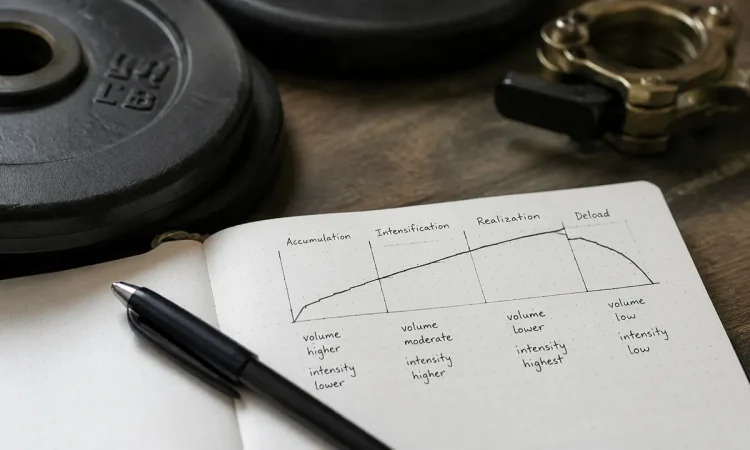
The simplest version of periodization for recreational fitness is a three-week loading wave followed by a deload week. During the three loading weeks, you progressively increase either the volume (how much you do) or the intensity (how hard you do it). Not both at once that’s a common mistake. Then on week four, you back off. Drop the volume significantly. Keep the intensity moderate. Let your nervous system and connective tissue catch up.
What you’ll notice and this surprises people the first time is that you often feel stronger and more capable after a deload week than you did at the peak of your loading block. That’s adaptation happening. That’s the whole point.
For someone running three or four days a week, this might look like three weeks of building mileage by roughly 10% each week, then one week where you cut back to 60-70% of your peak week’s distance. For a strength trainee, it could mean adding a set per exercise each week for three weeks, then dropping back to your starting setcount in week four.
The numbers don’t have to be precise. The principle does.
Listening to the Signal Your Body Is Actually Sending
One of the most underrated skills in periodization isn’t planning it’s reading feedback. Elite coaches have entire monitoring systems for this: heart rate variability trackers, readiness surveys, force plate measurements. You have something just as reliable if you pay attention to it: your own subjective sense of how you feel before and after training.
A single brutal workout that leaves you depleted for three days isn’t a badge of honor. It’s data. It’s telling you the stimulus was too far outside your current recovery capacity. Conversely, if you finish a training week and feel like you barely did anything, you didn’t accumulate enough stress to trigger adaptation.
The goal is to walk out of a hard training block tired but not destroyed. A little beaten up, maybe, but functional. If you’re consistently hitting that mark, your periodization is probably working. If you’re either breezing through or consistently unable to get off the couch, something needs adjusting.
This feedback loop is what coaches spend years learning to calibrate for athletes. You can develop your own version of it by simply keeping a short training log nothing elaborate, just a one-line note after each session. How did it feel? How did you sleep? How were your energy levels the next morning? Patterns emerge quickly.
When Life Disrupts the Plan
Here’s something the textbooks don’t say enough: periodization is a framework, not a contract. A work trip, a sick kid, a week of terrible sleep these are not program failures. They’re life. The value of having a structured plan isn’t that you follow it perfectly; it’s that you always know where you are and where you’re going when you come back to it.
If you miss a week, you don’t restart the entire macrocycle. You pick up roughly where you left off, maybe with slightly reduced intensity for the first session back, and continue. The arc of the plan absorbs disruption much better than a random training approach does, because you have context. You know what phase you’re in, what comes next, and what you’re building toward.
That orientation the sense that your training exists within a larger story is actually what most people are missing. Not a more complicated program. Not a new piece of equipment. Just the understanding that every session is part of something, and that something has been designed, however simply, to take you somewhere.