

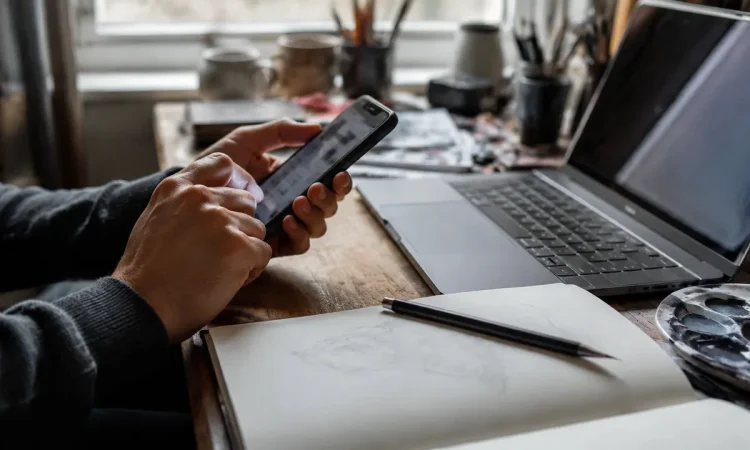
The Hum You’ve Stopped Noticing
There’s a particular kind of exhaustion that doesn’t show up on any medical chart. You finish the workday, close the laptop, sit down to write or paint or think and nothing comes. Not writer’s block, exactly. Not burnout in the clinical sense. Just a strange flatness, like a radio signal that’s been slowly crowded out by static. You know the frequency you’re looking for, but you can’t quite tune in.
Most of us have normalized this feeling to the point of invisibility. We assume creativity ebbs and flows, that inspiration is fickle, that maybe we just aren’t “feeling it” today. We rarely stop to ask what, exactly, has been filling our mental bandwidth for the past twelve hours and what that filling might be costing us.
Digital noise is the answer most of us are reluctant to name. Not because we don’t suspect it, but because naming it requires us to do something about it.
What We Mean by Digital Noise
The term sounds technical, almost benign. But digital noise isn’t just loud notifications or a cluttered inbox. It’s the cumulative cognitive load of being perpetually reachable, perpetually updated, and perpetually stimulated.
It’s the seventeen-second video you watched without meaning to. The comment thread you got pulled into on a topic you barely care about. The news refresh habit that yields the same anxious headlines you already read an hour ago. The group chat that demands emotional labor disguised as casual conversation.
None of these things, in isolation, feel significant. That’s precisely the problem. The damage is diffuse, distributed across dozens of micro-moments throughout the day. By the time you sit down to do any creative work, the well isn’t empty it’s been slowly sipped from, all day long, by a hundred small, forgettable straws.
Neuroscience has a term for what happens in the brain during periods of uninterrupted quiet: the default mode network. It’s the system that activates when we stop actively processing external input and it’s where a remarkable amount of creative thinking actually happens. Daydreaming, free association, the sudden sideways connection between two unrelated ideas these are products of a brain given permission to wander. Digital noise doesn’t just compete with that wandering. It colonizes the time that wandering requires.
The Attention Economy Wasn’t Designed With You in Mind
Here’s something worth sitting with: the systems delivering your digital noise were engineered by some of the most brilliant minds of our generation, using decades of behavioral psychology research, to be as attention-retaining as possible. You are not failing at willpower. You are up against architecture.
The infinite scroll was a deliberate design choice. The red notification badge activates the same neural pathway as a slot machine payout. Autoplay removes the micro-decision that tiny moment of friction that might have let you stop. These are not accidents of technology. They are features.
When you understand this, the conversation shifts. It’s no longer about whether you’re disciplined enough to put the phone down. It’s about recognizing that maintaining creative headspace now requires active, intentional defense in a way it simply didn’t twenty years ago. The default setting, if you do nothing, is noise. Quiet has become a resource you have to cultivate, not a state you naturally fall into.
Creatives Who Noticed Early
Some of the most productive creative figures of the last two decades have been unusually blunt about this. Cal Newport built an entire intellectual framework digital minimalism around the premise that our relationship with technology needed to be interrogated, not just managed. His observation wasn’t that social media was evil but that it was expensive, in ways we weren’t accounting for.
Writers like Jonathan Franzen and Zadie Smith have been openly uncomfortable with the always-on culture, not out of technophobia but out of a clear-eyed sense of what writing demands: sustained, uninterrupted attention over long stretches. The essay, the novel, the layered argument these forms require a cognitive patience that is fundamentally incompatible with a brain that has been trained to expect a new stimulus every thirty seconds.
Musicians, architects, designers they describe the same thing in different vocabularies. The jazz pianist Brad Mehldau has talked about the importance of boredom, real boredom, as a prerequisite for musical ideas. When your brain is never bored, it’s never desperate enough to generate something genuinely new.
The Counterintuitive Thing About Creativity
We tend to think of creative energy as something we need to feed with input, inspiration, research, stimulus. And there’s truth in that. Reading broadly, experiencing things, staying curious these matter.
But the other half of the equation gets almost no attention: creativity also needs room to exhale. The inputs you’ve gathered need unstructured time to settle, collide, and recombine in unexpected ways. If you never stop feeding the machine, the processing never happens.
Think of it like sleep. You could argue that more waking hours means more productivity. And in the short run, that might even be true for certain kinds of work. But creative cognition the kind that produces original ideas rather than competent execution happens largely outside of focused effort. It happens in the shower, on a slow walk, in the space between tasks when you let your mind drift rather than immediately filling the gap with a screen.
Digital noise doesn’t just disrupt that space. It trains you out of tolerating it. The moment of boredom that might have sparked an idea becomes a moment you reflexively fill with stimulation. Do that enough, and you lose not just the idea but the capacity for the kind of mental state that produces ideas.
Reclaiming the Signal
None of this is an argument for dramatic disconnection. A retreat to some pre-internet ideal isn’t the point, and for most of us it isn’t possible. The question is whether you’re engaging with digital life deliberately or just drifting through it on autopilot.
A few things that actually work not as life hacks, but as genuine rewiring of habit: creating hard environmental barriers around creative time (phone in another room, not just face-down), building tolerance for unstructured mental space the same way you’d build physical endurance, and being honest about which digital inputs are genuinely feeding you versus which ones are simply filling silence.
The last one is harder than it sounds. A lot of what we consume online feels like research, socialization, or professional necessity and sometimes it is. But often it’s just the brain’s preference for low-effort stimulation over the harder, quieter work of thinking. Distinguishing between the two requires the kind of self-awareness that perhaps not coincidentally tends to atrophy alongside deep attention.
What Silence Is Actually Offering You
There’s a reason so many creative people, across disciplines and centuries, describe solitude and silence not as deprivation but as resource. Rilke wrote letters from castles he retreated to specifically for the quality of their quiet. Georgia O’Keeffe moved to the New Mexico desert and attributed much of her most vital work to what she found there not just the light, but the absence of noise, social obligation, and distraction.
This isn’t nostalgia or elitism. It’s a recognition that certain kinds of thinking only become possible once the volume drops below a certain threshold. Not all of us can disappear to the desert. But most of us can carve out more silence than we currently allow ourselves if we’re willing to take seriously the idea that the noise has a cost.
The flatness you feel when you sit down to create isn’t a character flaw or a creative dry spell. It’s information. Your brain is telling you what it’s been doing all day, and what it hasn’t had the space to do. The signal is still there. It’s just waiting for a quieter moment to come through.