
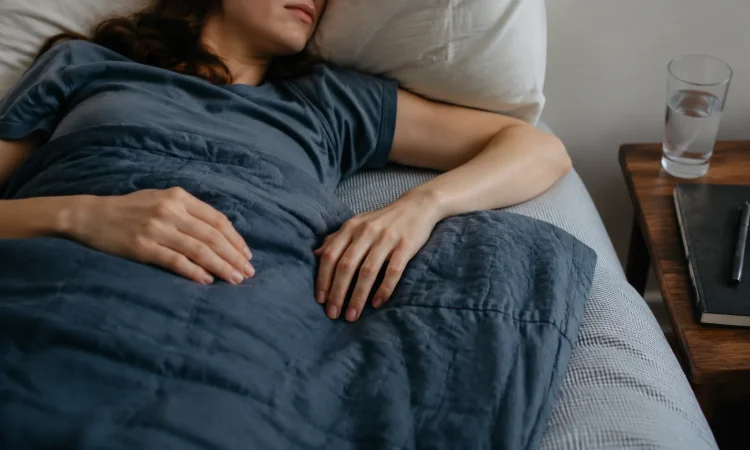
Most people treat sleep like a light switch something that should just turn off the moment their head hits the pillow. When it doesn’t, frustration builds. The frustration makes it worse. And somewhere around 1 a.m., you’re lying in the dark doing math about how many hours you’ll get if you fall asleep right now.
That loop is not a character flaw. It’s a nervous system problem. And the good news is: nervous systems can be trained.
Why Your Brain Resists Sleep in the First Place
The human brain was not designed for modern bedtimes. It was wired for a world where darkness meant danger, where slowing down required genuine safety, and where the kind of mental chatter we call “overthinking” was actually a useful threat-scanning mechanism. When you lie down and your thoughts start spiraling replaying a conversation, planning tomorrow’s agenda, worrying about something you said three years ago your brain isn’t malfunctioning. It’s doing exactly what it evolved to do.
The problem is context. That threat-detection system doesn’t know the difference between a deadline and a predator. Cortisol doesn’t read calendars.
This is why willpower alone doesn’t work. Telling yourself to “just relax” is like telling your heart to slow down during a sprint. You can’t override physiology with intention. What you can do is give your nervous system a different set of signals consistent, repeatable ones that it learns to associate with safety and descent into sleep.
That’s the whole game.
The Concept of a Sleep Anchor
Elite athletes don’t perform better by trying harder in the moment. They perform better because they’ve built routines that trigger the right physical and psychological states automatically. Sleep works the same way.
A sleep anchor is any sensory or behavioralcue that you pair with the act of falling asleep, consistently enough that the association becomes automatic. It could be a specific scent, a particular breathing pattern, the texture of a certain pillow, even the sound of a white noise machine. The content almost doesn’t matter. What matters is repetition and timing.
Think of Pavlov not as a dusty psychology reference, but as a practical blueprint. His dogs didn’t choose to salivate. They were conditioned. You’re trying to condition your brain to begin the descent into sleep the same way your body begins to digest food when it smells something it recognizes as a meal. Involuntary. Automatic. Below the level of conscious effort.
The anchor has to happen every night, in the same order, at roughly the same time. One week of consistency won’t do it. But three to four weeks of it will start to rewire the association at a neurological level.
The4-7-8 Method and What’s Actually Happening
There are dozens of breathing techniques marketed for sleep, but the4-7-8 pattern developed from ancient pranayama practice and popularized by Dr. Andrew Weil has earned its reputation for a specific physiological reason.
Here’s the basic structure: inhale through the nose for 4 counts, hold for 7 counts, exhale slowly through the mouth for 8 counts. Repeat four times. The whole thing takes under two minutes.
What actually happens during that exhale is the key. A long, controlled exhale activates the parasympathetic nervous system the branch of your autonomic nervous system responsible for rest and digestion. It’s sometimes called the “rest and digest” system, and it directly counteracts the “fight or flight” response. When you extend the exhale beyond the inhale, you’re essentially pumping the brakes on cortisol. Heart rate drops. Muscle tension releases. Blood pressure follows.
The hold at7 seconds forces the body to tolerate a moment of suspension and tolerating suspension is, interestingly, one of the skills sleep requires. You have to be willing to not be in control for a moment. That 7-second hold is almost a rehearsal for letting go.
Body Scanning: The Attention Trick That Quiets the Mind
The mind can only hold a limited amount of attention at once. One of the most effective ways to quiet intrusive thoughts isn’t to fight them it’s to give the mind something else to focus on that’s boring enough to not trigger more thinking, but engaging enough to keep it from wandering.
Enter the body scan.
Starting from your toes and moving slowly upward, you consciously direct attention to each part of the body not to fix or analyze anything, just to notice. Is there tension in your calves? Your jaw? The space between your shoulder blades? You’re not trying to relax those areas by force. You’re just observing, with the kind of quiet neutrality you might bring to watching clouds.
Here’s why this works: the act of focused internal observation shifts the brain out of the default mode network the part responsible for rumination, self-referential thinking, and mind-wandering and into something closer to a present-moment awareness state. That shift in neural activity is measurable. And it happens to be very close to the brain state that precedes sleep.
People who practice this regularly often report that they rarely make it past their waist before they’re asleep. The body scan doesn’t put you to sleep it creates the conditions where sleep can arrive naturally.
The Temperature Variable Nobody Talks About Enough
Sleep science has a surprisingly strong consensus on one environmental factor that most people ignore: core body temperature needs to drop by about 1 to 2 degrees Fahrenheit for sleep to initiate. This is why you naturally feel sleepy in a cool room and restless in a warm one. It’s why a hot shower before bed, counterintuitively, helps you sleep faster the rapid cooling afterward signals to the brain that it’s time to go down.
Most bedrooms are kept too warm for optimal sleep onset. The research-backed sweet spot sits between 65 and 68 degrees Fahrenheit for most adults. That might feel uncomfortably cool when you first walk in, but your body will find it appropriate once you’re horizontal.
If you can’t control your room temperature, cool your extremities instead. Sleeping with your feet outside the covers, or cooling your wrists with a damp cloth before bed, can mimic some of the effect. The mechanism is the same: surface cooling triggers the central temperature drop the brain is waiting for before it initiates the sleep cascade.
The Cognitive Shuffle: A Newer Tool Worth Knowing
Developed by cognitive scientist Luc Beaulieu-Prévost and later popularized by sleep researcher Dr. Luc Beaulieu, the cognitive shuffle is one of the more fascinating recent additions to the sleep toolkit.
The idea is simple but clever. When the brain is ready for sleep, it begins to generate random, loosely connected imagery the kind of nonsensical visual sequence that precedes dreaming. When you’re anxious or ruminating, you stay locked in linear, logical thinking instead. The cognitive shuffle is an attempt to manually induce that randomness.
Here’s how it works: pick a random, emotionally neutral word something like “toaster” or “hammock” and then slowly visualize unrelated images for each letter. T: a turtle. O: an ocean. A: an astronaut. The images should be vivid but disconnected. No narrative. No logic. You’re essentially tricking the brain into pattern-matching with pre-sleep neural behavior.
It sounds almost too simple. But the science behind it is grounded in what we know about sleep onset: the brain needs to exit analytical mode before it can cross the threshold. Giving it something visually random and semantically meaningless is a reliable shortcut.
Consistency Is the Real Technique
Every method in this article works. None of them work once. The trap most people fall into is treating sleep techniques the way they treat over-the-counter cold medicine reaching for them only when symptoms appear, expecting immediate relief, moving on when they don’t get it.
Sleep training is different. The10-minute threshold isn’t something you hit on the first night you try the4-7-8 method or the cognitive shuffle. It’s something you approach gradually as your nervous system begins to recognize the pattern. The anchor deepens with each repetition. The body scan gets faster. The breathing becomes less effortful.
What you’re building isn’t a trick. You’re building a neurological pathway a well-worn route your brain learns to take every night with less and less friction. Some people get there in two weeks. For others it takes a month. But the direction is reliable, and the destination is worth the repetition.