
For years, the advice has been simple: drink eight glasses of water a day. It’s repeated in doctor’s offices, printed on wellness posters, and drilled into us as one of the most basic acts of self-care. But here’s what that advice leaves out water alone, in many cases, passes right through you. Your body absorbs it, uses some of it, and flushes the rest. What determines whether that water actually reaches your cells, nourishes your tissues, and maintains the delicate fluid balance your body depends on? Minerals. The food matrix you eat. The sodium-potassium pump firing inside every cell membrane. Hydration, it turns out, is far more sophisticated than sipping from a bottle.
Why Water Alone Often Isn’t Enough
Think of your cells as rooms with very selective doors. Water doesn’t just wander in freely it moves through a process called osmosis, drawn across cell membranes by the concentration of solutes on either side. When electrolyte levels are off, water can flood spaces between cells rather than entering them, or it can be expelled before it ever does any real work. This is why people who drink enormous quantities of water without adequate mineral intake can still feel sluggish, develop headaches, or experience the paradox of persistent thirst.
Endurance athletes know this dynamic better than most. Marathon runners who hydrate exclusively with plain water during long races risk hyponatremia dangerously low sodium levels a condition that causes nausea, confusion, and in severe cases, neurological damage. The water is there. The minerals to make it functional are not. The cells can’t use what the chemistry won’t allow.
Most of us aren’t running marathons, of course. But on a subtler scale, the same principle applies daily. A diet low in potassium, magnesium, and sodium creates conditions where water consumption doesn’t translate to cellular hydration. You’re filling a leaky vessel and wondering why you’re always thirsty.
Electrolytes: The Chemistry Running in the Background
Sodium and potassium are the primary drivers of cellular fluid balance. The sodium-potassium pump a protein embedded in every cell membrane actively moves three sodium ions out of the cell and two potassium ions in, using energy in the form of ATP to do so. This creates an electrochemical gradient that governs not just hydration, but nerve signaling, muscle contraction, and nutrient transport. When either mineral is chronically low or high, the entire system shifts. Cells either swell or shrink. Neither is good.
Magnesium tends to fly under the radar, but it’s involved in over 300 enzymatic reactions and plays a direct role in maintaining the integrity of cell membranes. Magnesium deficiency is surprisingly common estimates suggest that up to half of Americans don’t meet the recommended daily intake and one of its less discussed effects is impaired cellular hydration. Low magnesium disrupts the sodium-potassium pump, interfering with the very mechanism that regulates how water enters and stays inside cells.
Calcium rounds out the core electrolyte picture, contributing to fluid regulation and cell signaling. Phosphorus and chloride matter too, though most people eating a varied diet aren’t short on those.
Foods That Hydrate From the Inside Out
This is where things get genuinely interesting. Whole foods don’t just contain water they contain structured water within a complex matrix of fiber, minerals, and phytonutrients that changes how that water is absorbed and retained. Eating a cucumber, which is about 96% water, delivers hydration differently than drinking an equivalent volume of plain water from a glass. The cellular structure of the cucumber slows digestion, allowing for a more gradual, sustained release of fluid into the bloodstream.
Watermelon is another example worth taking seriously. Beyond its obvious water content, watermelon contains lycopene, citrulline, and meaningful amounts of potassium a combination that supports both vascular function and fluid balance simultaneously. The magnesium in dark leafy greens like spinach and Swiss chard works in the background, supporting the pumps and channels that keep cells properly hydrated. Celery, often dismissed as mostly fiber and crunch, carries sodium in its natural form alongside potassium, creating a built-in electrolyte pairing.
Coconut water has earned its reputation as a natural hydration aid, not out of marketing hype but because of its potassium density roughly 600 milligrams per cup along with small amounts of magnesium and sodium. It’s not a sports drink replacement in every context, but for moderate exercise or everyday replenishment, it genuinely works with the body’s mineral requirements rather than against them.
Bone broth deserves mention here, particularly for its sodium, potassium, and trace mineral content. The long cooking process extracts minerals from connective tissue in a form the body readily absorbs. For people dealing with illness, digestive stress, or heavy sweating, it can be a remarkably effective hydration tool.
The Gut Connection Most People Overlook
Hydration doesn’t happen at the mouth or even in the stomach. It happens predominantly in the small intestine, and to a significant degree in the colon. The gut microbiome influences how efficiently you absorb water and electrolytes another layer of complexity that the “just drink more water” advice completely ignores.
Fermented foods like kimchi, sauerkraut, kefir, and yogurt contribute to microbiome health in ways that indirectly support hydration. A gut lining that’s inflamed or poorly populated with beneficial bacteria is less efficient at water and mineral absorption. This is why some people notice improved energy and reduced thirst when they clean up their diet not because they’re drinking more water, but because their gut is actually absorbing what they consume.
Fiber also plays a surprising role. Soluble fiber, found in oats, chia seeds, and legumes, forms a gel-like substance in the digestive tract that holds water and releases it slowly.Chia seeds, in particular, can absorb up to ten times their weight in water. Eating them doesn’t just add fiber to your diet it creates a slow-release hydration mechanism inside your digestive system.
Rethinking What You Reach For
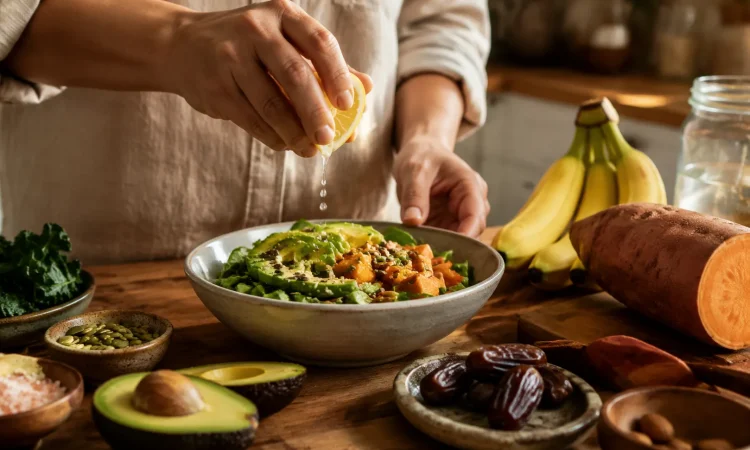
A practical shift in thinking looks something like this: instead of counting glasses of water, pay attention to the mineral density of what you eat. A day that includes leafy greens, some avocado, a handful of seeds, quality salt on your food, and maybe a piece of fruit isn’t just nutritious in the conventional sense it’s building the electrochemical foundation that makes hydration possible at the cellular level.
Salt, long demonized, deserves rehabilitation in this conversation. Not all salt is created equal, and not all salt use is harmful. For people eating whole foods and exercising regularly, adequate sodium intake is necessary for maintaining fluid balance. The problem has never been salt itself it’s sodium in ultra-processed foods stripped of the potassium and magnesium that would naturally balance it.
Staying hydrated in the truest sense of the word means treating the body as the electrochemical system it is. Water is the medium, but minerals are the message. The foods that carry both, in the right ratios, within a matrix the body recognizes and knows how to use those are what genuine cellular hydration is built on. The glass of water still matters. It just works better when the rest of the picture supports it.