
The Myth of the Perfect Wardrobe
There’s a particular kind of exhaustion that comes from standing in front of a closet stuffed with clothes and feeling like you have nothing to wear. Most people have been there. The hangers are packed so tight you can barely pull anything out, and yet everything feels wrong mismatched, worn-out, or somehow from a version of yourself that no longer exists. The instinct is to shop. To fix the emptiness with something new. But capsule wardrobe culture has quietly been challenging that assumption for years, suggesting that the answer isn’t more, it’s less and more intentional.
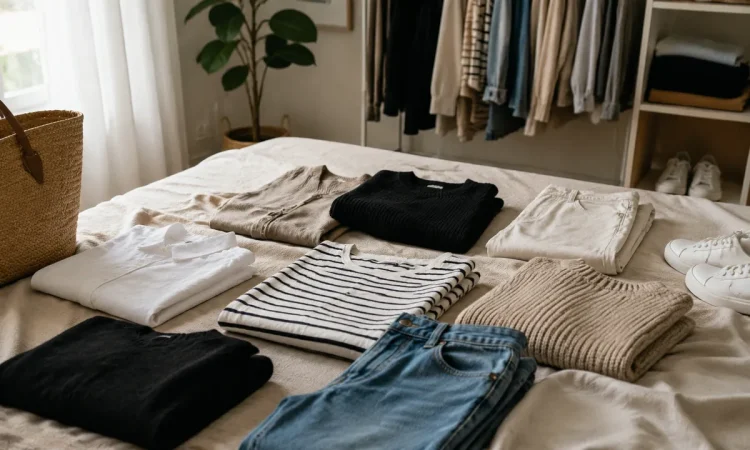
The phrase “capsule collection” used to belong to fashion insiders. It referred to a small, curated set of pieces that could carry someone through a season or a whole year without needing constant replenishment. Susie Faux, a London boutique owner, popularized the concept in the 1970s, and Donna Karan turned it into high fashion in the 1980s with her Seven Easy Pieces. But somewhere along the way, the concept got hijacked by aesthetics-obsessed content creators and minimalism influencers who made it look like you needed to spend a thousand dollars on beige linen to participate.
You don’t. Not even close.
Start With an Audit, Not a Shopping Cart
Before anything else, the work is in what you already own. Pull everything out. Not the semi-organized shuffle where you glance at a shelf and decide it looks fine actually remove it all, lay it out, and see the full picture. Most people are genuinely surprised by what they find. A well-cut blazer buried under gym clothes. Three nearly identical black tops. A pair of dark jeans they forgot about. The chaos of a cluttered closet creates the illusion of scarcity, but the reality is often abundance just badly organized.
This audit serves a real purpose beyond decluttering. You’re mapping what you already have against how you actually live. Not how you imagined living when you bought that cocktail dress three years ago, or how you wish you dressed, but the texture of your real daily life. Work, errands, social occasions, rest. When you start categorizing by context rather than category by how you move through your week rather than by type of garment patterns emerge quickly. You might discover you have nine casual tops and two pairs of pants. Or twelve scarves and nothing that layers well underneath them.
The goal at this stage is not to throw things away. It’s to see clearly.
The Art of the Swap Before the Buy
Once you have clarity on what you own and what’s missing, resist the reflex to open a browser tab. There’s a whole economy of clothing exchange that most people underuse, starting with the people closest to them.
Clothing swaps among friends have been happening forever, but they’ve gained real momentum as sustainable fashion conversations have become more mainstream. The premise is simple: you bring what you no longer wear, you leave with something you’ll actually use. No money changes hands. What makes these swaps more than just a glorified hand-me-down pile is intention when everyone brings pieces they genuinely cared about, the quality of what circulates tends to be decent.
Even without organizing a formal event, the casual version of this works. A text to a friend who wears a similar size, a mention in a group chat, a quick look through your sister’s closet before she donates a bag to Goodwill. These micro-exchanges happen naturally when people stop treating clothing as too personal to share. Most items sitting unworn in someone else’s closet would be genuinely useful to someone in your immediate circle.
Community clothing libraries and free stores which exist in more cities than most people realize operate on the same logic at a larger scale. Some are hosted through mutual aid networks, others through churches, community centers, or university campuses. You show up, browse, take what you need. There’s no transaction, no points system. Just stuff that needs a new owner.
Rethinking What “New” Actually Means
There’s a different kind of newness that comes from working with what you have, and it requires a certain creativity that shopping actually suppresses. When you can always just buy something, you never develop the skill of seeing what’s already in front of you differently.
Tailoring is the most underrated tool in this whole process, and basic alterations don’t require professional help. Hemming pants, taking in a waist, removing sleeves these are learnable skills that YouTube tutorials cover in exhaustive detail. A pair of trousers that felt shapeless and awkward can become something you reach for constantly after a simple adjustment. A dress that hit at the wrong length can be cropped into a skirt. The piece doesn’t change; the fit does, and fit is almost everything.
Styling, too, is genuinely transformative in a way that gets underestimated. The same oversized button-down can read as three completely different outfits depending on whether it’s tucked, half-tucked, or worn open over a fitted top. A structured bag changes the weight of a casual outfit. A pair of shoes carries more visual narrative than people give footwear credit for. When you stop adding and start experimenting with combination, you start to see range in your existing wardrobe that you never noticed before.
Color and pattern mixing is another area where people get cautious when they shouldn’t. The so-called rules around what works together were largely invented by people trying to sell you more clothes so you’d have pieces that “match.” In practice, the eye is more forgiving and more interested than those rules suggest.
When Zero Truly Means Zero
Let’s be specific about what “without spending a dime” looks like in practice, because it’s more literal than it sounds. There are physical spaces designed around this premise.
Freecycle networks, originally founded in 2003, operate through local chapters in thousands of cities worldwide. The model is purely gift-based: people post items they want to give away, others respond and arrange pickup. Clothing shows up regularly, and if you’re patient and specific about what you’re looking for, you can find good pieces. The platform is unglamorous. The results can be excellent.
Buy Nothing groups, which exploded in popularity during the pandemic and have continued growing, operate similarly through Facebook or their own app. The community dimension makes these feel more personal than a traditional swap you’re often giving to or receiving from someone nearby, sometimes someone you end up knowing. The quality of what circulates tends to be higher because people feel some accountability to the network.
Freebox culture in urban areas means that physical boxes of free clothing appear on sidewalks regularly, particularly in neighborhoods with higher residential turnover. August and May bring waves of abandoned items as leases turn over near universities. Walking with attention costs nothing.
Building Toward Something That Lasts
A capsule collection isn’t really a destination. It’s a way of thinking about clothing that shifts over time as your life shifts. The version you build at thirty looks different from the one that made sense at twenty-two. Career changes, climate changes, shifts in what you care about all of it moves the needle on what belongs in the rotation.
What doesn’t change is the underlying discipline: buy less, use more, understand what you actually need before acquiring anything. The people who do this well don’t follow strict minimalist rules orcount their items obsessively. They’ve simply developed a habit of honest appraisal of their wardrobe and of the impulse to shop that keeps the collection lean and functional without requiring constant reinvestment.
The closet that feels like nothing to wear is usually a closet with too much in it, not too little. The remedy is almost never more shopping. It’s more clarity about what you have, what you need, and what the gap between those two things actually is. That kind of clarity is free.