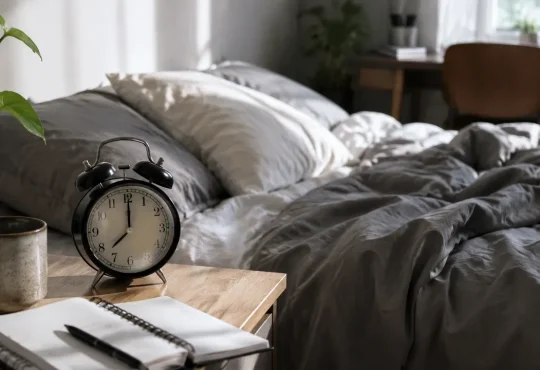

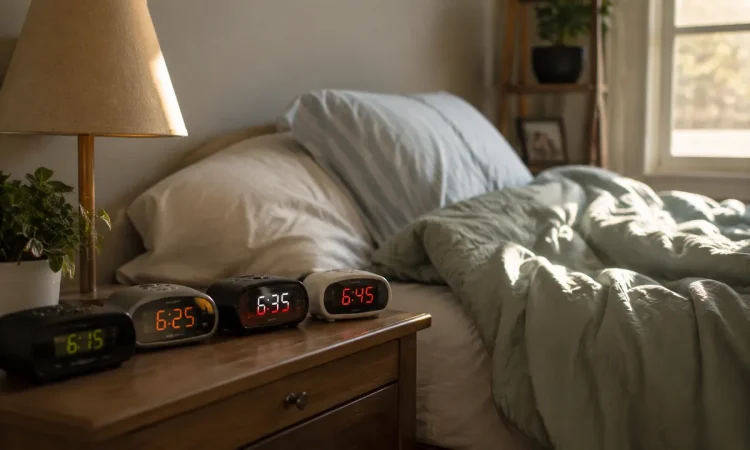
I used to set four alarms. Not because I was a heavy sleeper, but because I genuinely did not trust myself. The first alarm was the optimistic one 6:15 a.m., full of possibility. The second was the realistic one. The third was the negotiation. The fourth was the surrender. And even after all that theater, I’d drag myself out of bed feeling like I’d lost a fight I never agreed to enter.
The thing is, I wasn’t sleep-deprived. I was getting seven to eight hours most nights. The problem wasn’t the quantity of sleep. It was the relationship I had built slowly, unconsciously with mornings themselves.
The Real Enemy Wasn’t the Clock
There’s a pervasive myth that morning people are just wired differently, that they carry some genetic advantage that lets them greet 6 a.m. with enthusiasm the rest of us will never access. And while chronobiology is real and sleep chronotypes do vary, that story lets a lot of people off the hook too easily including me, for a long time.
What I eventually realized is that my resistance to mornings wasn’t biological. It was psychological, and more specifically, it was associative. My brain had spent years linking the early morning with one thing: obligation. The alarm meant I had to do something I didn’t want to do. The morning was never mine. It belonged to a commute, a job, a list. No wonder my nervous system staged a daily revolt.
The shift didn’t start with a new bedtime. It started with a question I’d never actually asked myself: what would make me want to get up?
Rewiring Through Anticipation, Not Discipline
Most morning advice is built on the architecture of discipline. Wake up at 5a.m. Cold shower. Journal three pages. Run five miles. The implication is that if you just push through the resistance long enough, the resistance will dissolve. Sometimes that works. But it tends to attract people who already have a certain relationship with self-coercion, and for everyone else, it just adds another layer of shame when they fail.
What actually worked for me was a much quieter intervention: I gave my brain something to look forward to.
Not something productive. Not something optimized. Something genuinely pleasurable that only happened in the morning, that I protected fiercely, and that had zero connection to my to-do list.
For me, it started with coffee and a specific podcast I refused to listen to at any other time of day. Trivial, I know. But within two weeks, something subtle shifted. I was waking up a few minutes before the alarm. Not dramatically early, not with energy I didn’t have just slightly ahead of it, with something resembling mild curiosity rather than dread.
That’s not willpower. That’s Pavlov.
The Identity Piece Nobody Talks About
There’s a layer beneath the habits that most morning-routine content never touches, and it’s the one that actually runs the show: identity.
If you believe, at some fundamental level, that you are “not a morning person,” then every morning becomes an act of going against yourself. You’re not just fighting grogginess you’re fighting your own self-concept. And that’s a battle with terrible odds, because the self-concept almost always wins.
I didn’t try to become a morning person. That framing felt like a costume that didn’t fit. Instead, I started asking a different question: what kind of mornings do I actually like?
Turns out I liked slow ones. I liked mornings with no urgency in the first thirty minutes, where I wasn’t immediately accountable to anything or anyone. I liked the specific quality of light before the neighborhood fully woke up. I liked the version of my own thinking that existed before the day’s noise moved in.
None of that required getting up earlier. It required getting up intentionally.
The Architecture of a Morning That Doesn’t Fight You
Once I stopped trying to manufacture discipline and started designing for pleasure, the whole structure changed.
The first thing I removed was the phone. Not forever, not as some digital detox performance just for the first twenty minutes. Because I noticed that the mornings that felt terrible almost always started with me immediately importing other people’s urgency into my nervous system. An email. A news headline. A message I couldn’t immediately respond to. By the time I’d been awake for ten minutes, I was already reacting to a world that hadn’t even fully started yet.
The second thing I changed was the sensory environment. This sounds minor, but it wasn’t. I started leaving a lamp on a timer so the room shifted to warm light a few minutes before my alarm. I moved the coffee setup to be completely frictionless grinder ready, water already in the kettle. I stopped sleeping in a room that felt chaotic the moment I opened my eyes. Small things, but they compounded.
The third thing and this is the one that surprised me most was protecting the morning from being useful. There’s enormous cultural pressure to monetize your morning, to make it “count.” But the moment I tried to make my morning productive, it started to feel like work again. So I drew a line: the first hour is mine, and mine means purposeless by design. Reading something I wanted to read. Walking without a destination. Sitting outside for a few minutes for no reason at all.
What Changed and What Didn’t
I want to be honest about what this is and isn’t. I’m not waking up at 5 a.m. My sleep schedule is almost identical to what it was two years ago. I haven’t transformed into some sunrise-photographing evangelist who posts about cold plunges.
What changed is simpler and stranger: I stopped bracing for the morning. The low-grade tension that used to accompany waking up that physical resistance, that sense of the day already pressing down it’s mostly gone. Not because I meditate it away or because I’ve optimized my cortisol. But because I spent a few months quietly dismantling the associations that made mornings feel like punishment.
The brain is plastic. It learns what you teach it through repetition, not through willpower. Every morning I gave myself something pleasant and unhurried, I was casting a vote for a different association. And eventually the tally shifted.
There’s also something worth saying about the cumulative effect on the rest of the day. Mornings that start on your own terms have a texture that follows you. Not in some cosmic, manifestation-adjacent way just pragmatically. When you haven’t already spent your first waking hour in resistance mode, you arrive at the actual demands of your day with something left in reserve. That margin matters more than any productivity hack I’ve ever tried.
The alarm still goes off. I still don’t leap out of bed with theatrical enthusiasm. But most mornings now, there’s a beat just a beat where I remember what’s waiting, and I don’t hate it. For someone who spent years fighting their own mornings, that’s not a small thing. That’s the whole thing.