
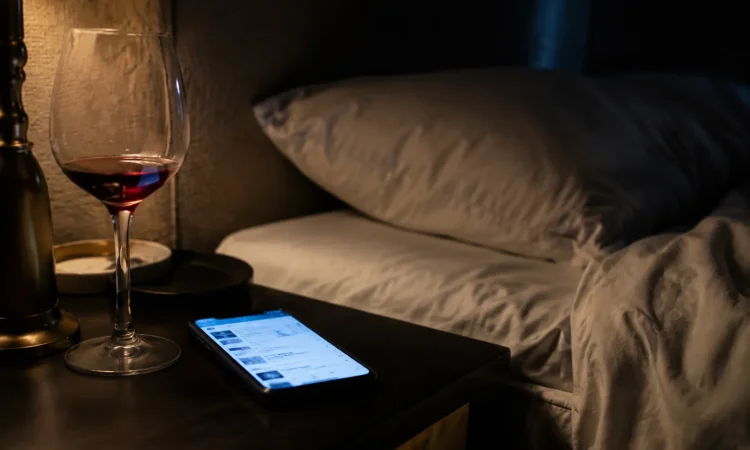
You probably already know you shouldn’t drink three espressos at 9 p.m. or doom-scroll until 2 a.m. Those are the obvious ones. But most people who wake up exhausted aren’t doing the obvious things wrong they’re doing the subtle things wrong. The habits that feel harmless, even reasonable. The glass of wine to “wind down.” The one last episode. Lying in bed problem-solving tomorrow’s meeting. These are the quiet saboteurs, and they’re worth examining closely.
Your Phone Isn’t Just Keeping You Awake It’s Rewiring Your Wind-Down
The blue light argument gets recycled so often that people have tuned it out, which is a shame, because the deeper problem isn’t even the light. It’s the psychological activation. When you’re scrolling through social media or reading news at 10 p.m., your brain is registering novelty, social comparison, low-grade anxiety, and the occasional dopamine spike from a funny video. That’s a neurological cocktail that has nothing to do with preparing for sleep.
Your nervous system needs a gradual descent not a sudden cliff. Going from an activated, reactive state directly to horizontal in the dark is like slamming the brakes on a highway. The car stops, but the energy doesn’t disappear. It vibrates. That’s why you lie there “tired but wired,” unable to fall asleep despite genuinely wanting to.
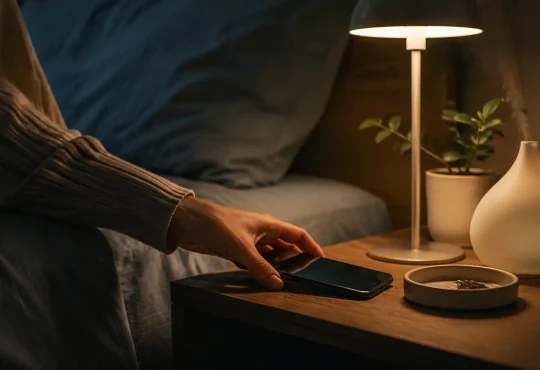
The fix isn’t about willpower. It’s about designing a gap even twenty to thirty minutes of genuinely low-stimulation activity between your last screen and your pillow. The brain needs transition time, not an on/off switch.
The Wine That’s Fooling You Both
Alcohol before bed is one of the most persistent sleep myths in circulation. It helps you fall asleep yes. What it also does is fragment the second half of your night completely. Alcohol suppresses REM sleep, the stage where emotional processing and memory consolidation happen. You might sleep eight hours and still feel like you ran on gravel because you never reached the deep, restorative cycles your body needed.
The deceptive part is the falling-asleep experience. It feels like it’s working. You drift off easily, you’re relaxed, it’s pleasant. But the bill arrives around 3 a.m., when your body metabolizes the alcohol and rebounds into a lighter, more fragmented state. That’s when you start half-waking, overheating, or just lying there in that restless gray zone that isn’t sleep but isn’t quite waking either.
One drink isn’t necessarily catastrophic. But using alcohol as a sleep aid consistently creates a dependence loop that gradually erodes your natural ability to wind down without it.
Eating Late Does More Than Just Slow Your Digestion
There’s a reason your grandmother told you not to eat right before bed, and it wasn’t just about indigestion. Your core body temperature needs to drop by about one to two degrees Fahrenheit for your body to initiate deep sleep. Digestion raises your core temperature. So eating a large meal within two or three hours of sleep is essentially throwing a wrench into one of the most fundamental biological sleep triggers you have.
Beyond temperature, late eating also affects melatonin production. Your gut has its own circadian rhythm, and when you’re feeding it food at midnight, you’re sending conflicting signals to a system that was designed to follow the sun. Over time, this kind of misalignment doesn’t just hurt your nights it contributes to metabolic disruption that extends well into your days.
Variable Bedtimes Are Quietly Destroying Your Sleep Architecture
People often treat weekends as a sleep debt repayment system. Stay up until 1 a.m. Friday and Saturday, sleep until 10, recover. Except that’s not how circadian biology works. Your body runs on a clock that’s exquisitely sensitive to consistency. Every time you shift your sleep and wake times significantly, you’re essentially giving yourself a mild case of jet lag. Researchers even have a term for it: social jet lag.
The effects are cumulative and underappreciated. Inconsistent sleep timing degrades the quality of sleep you get even when you’re technically in bed long enough. Your body never fully commits to the deep sleep cycles it needs because it can’t predict when it’s safe to do so. The most underrated sleep intervention available to most people isn’t a supplement or a fancy mattress it’s going to bed and waking up at the same time every day, including weekends.
Working Right Up to Bedtime Keeps Your Brain on the Clock
This one hits hardest for people who work from home, where the boundary between “work mode” and “rest mode” is entirely self-constructed and therefore easily ignored. Answering emails at 10:30 p.m. doesn’t just delay sleep by thirty minutes it keeps your prefrontal cortex in a planning, evaluating, problem-solving state that’s physiologically incompatible with the mental release sleep requires.
The brain can’t easily toggle between professional alertness and genuine rest. There’s a wind-down period needed, and when work eats into that window, you’re essentially rolling directly from one kind of cognitive demand into another. The result is racing thoughts at bedtime not anxiety exactly, but a kind of mental static from a brain that was never given permission to stop working.
Closing your laptop at a defined time and doing something with no task-completion pressure attached reading fiction, a slow walk, conversation that doesn’t involve logistics creates the psychological transition your brain needs to begin disengaging.
The Bedroom Environment You’ve Stopped Noticing
Humans are remarkably good at habituating to their environments, which is both useful and dangerous. If your room is slightly too warm, has ambient light from streetlights or standby electronics, or has a mattress that’s degraded quietly over eight years, you’ve probably stopped noticing. But your sleep quality hasn’t.
The optimal sleep environment is cool (around 65 to 68 degrees Fahrenheit for most people), dark, and quiet. Most bedrooms in modern homes fail on at least one of these counts. The thermostat gets left at a comfortable waking temperature. The TV standby light glows red in the corner. The curtains let in enough light that sunrise starts disrupting sleep an hour before your alarm.
None of these feel dramatic. That’s what makes them effective saboteurs. Small environmental mismatches don’t prevent sleep they degrade it, and degraded sleep is harder to trace back to a cause than no sleep at all.
Lying Awake in Bed Is Teaching Your Brain the Wrong Lesson
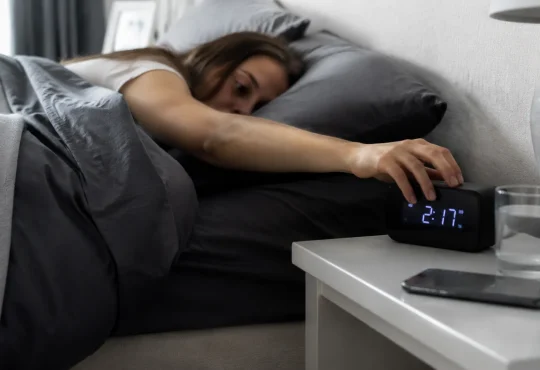
This last one is genuinely counterintuitive. When you can’t sleep, the instinct is to stay in bed and try harder. But every minute you spend lying awake in bed is conditioning your brain to associate that space with wakefulness, frustration, and the particular low-grade suffering of watching the minutes tick toward an alarm you can’t avoid.
Sleep specialists call this conditioned arousal, and it’s one of the core mechanisms behind chronic insomnia. The bed becomes a stimulus for wakefulness rather than rest. The fix getting up, going to a dim room, doing something calm until you feel genuinely sleepy, then returning feels wrong. It goes against every tired instinct. But it respects the way associative learning actually works. Your brain needs the bed to mean sleep, not struggle.
The strange truth about sleep is that most of the damage is done in the hour or two before you ever close your eyes. The quality of your night is largely determined by the quality of your evening and that’s a window where the choices are small, habitual, and easy to overlook until you decide to look at them carefully.