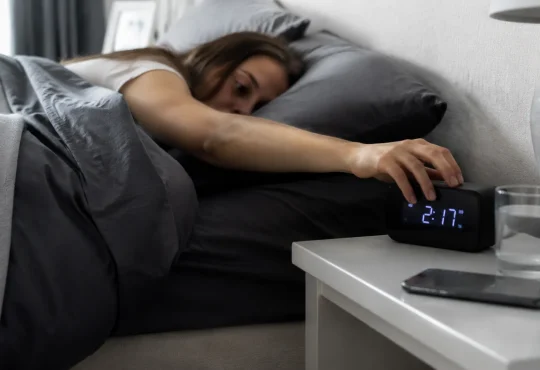


The Lie We Tell Ourselves Every Friday Night
You’ve made it to the weekend. Five days of early alarms, late meetings, and a sleep debt that feels like a second mortgage. So you do what seems completely reasonable: you sleep in. Saturday morning, you don’t set an alarm. Sunday, same deal. By the time you crawl out of bed at 10 or 11, you figure you’ve balanced the books. You’re recovered. You’re ready.
Except you’re not. If anything, Monday morning hits harder than it did last week. Your head is foggy, your body feels sluggish, and you’re already dreaming about the next weekend. It’s a cycle that feels productive but is quietly making everything worse.
This isn’t a willpower problem or a coffee problem. It’s biology and you’re fighting it with exactly the wrong tool.
Your Body Keeps a Clock You Can’t Override
The human circadian rhythm is one of the most stubborn systems in the body. It doesn’t care about your schedule. It doesn’t take weekends. Running on roughly a 24-hour cycle, it governs when you feel alert, when your core body temperature rises and falls, when cortisol peaks, and when melatonin kicks in. It’s ancient, deeply embedded, and responds primarily to one thing: light, and the consistent timing of your behavior around it.
When you sleep in on Saturday and Sunday, you’re not just resting. You’re shifting your circadian phase forward. Sleep scientists have a specific term for it social jetlag and it describes the misalignment between your biological clock and your social clock. The effect is almost identical to flying across two time zones every single weekend. Your body gets pulled in one direction by biology and another by the demands of modern life, and the seam between those two forces runs right through Monday morning.
Research published in Current Biology found that for every hour of social jetlag, the risk of being overweight or obese increases by roughly 33percent. That’s not a metaphor for feeling bad. That’s a measurable physiological disruption happening inside your body every time you decide to sleep until noon.
The Debt That Doesn’t Pay Off
Sleep debt is real, but it doesn’t behave like financial debt. You can’t pay it back in bulk. The body doesn’t process recovery sleep the way you might hope depositing lost hours into some reservoir that eventually makes you whole again.
A landmark study from the University of Colorado followed people through cycles of restricted sleep and recovery sleep. What they found was uncomfortable: even after two full days of sleeping in, participants hadn’t fully recovered their cognitive performance or their metabolic function. Attention lapsed. Reaction times stayed slow. And perhaps most telling, participants reported feeling less sleepy than they actually were a phenomenon called sleep debt amnesia, where the longer you carry a deficit, the less accurately you perceive how impaired you are.
This is where the trap closes. You sleep in over the weekend, feel decent by Sunday afternoon, and interpret that as full recovery. But the performance data tells a different story. You’ve reduced the feeling of sleepiness without restoring the underlying function. You head into the week confident that you’ve recovered, while running on a tank that’s still half empty.
What Actually Happens When You Sleep In
Here’s the specific mechanism that makes weekend catch-up sleep so counterproductive: it delays your circadian rhythm. When you stay up later Friday night because you can and then sleep in Saturday morning, you’re pushing your internal clock back. Melatonin starts releasing later. Your body temperature reaches its waking peak later. Everything shifts.
Then Sunday night comes. You’re not tired at10pm the way you’d need to be to get eight hours before a 6am Monday alarm. Your body still thinks it’s on Saturday time. You lie in bed scrolling your phone for an hour. You finally fall asleep after midnight. When the alarm goes off Monday morning, you’ve slept five hours and your circadian rhythm is fighting you the entire way out the door.
This is textbook sleep inertia compounded by circadian misalignment. The fog isn’t just “being tired.” It’s your brain trying to function while your biological clock insists it should still be sleeping. That sensation can last for hours, and no amount of coffee fully cuts through it.
The Social Cost Nobody Talks About
Beyond the personal physiology, there’s a social dimension to this that rarely gets examined. The weekend catch-up habit doesn’t exist in isolation it’s reinforced by culture. Late Friday nights are a social norm. Brunch at 11am on Saturday is a ritual. Staying up for the game, the party, the season finale: these are the textures of a social life.
Nobody wants to be the person who goes to bed at 10pm on a Friday. And nobody talks honestly about the compounding cost of years spent running this pattern. The conversation tends to stay at the surface level you feel tired, you drink more coffee, you wait for the next weekend.
What’s rarely said out loud is that chronic social jetlag is associated with higher rates of depression, impaired metabolic health, and reduced cognitive performance not just on Monday, but consistently across time. A 2012 study found that even moderate chronic sleep restriction, around six hours a night over two weeks, produced cognitive deficits equivalent to two full nights of total sleep deprivation. The participants didn’t notice because the decline was gradual. Their baseline had shifted and they had no reference point left to compare it to.
That’s the real danger. Not one bad Monday. A slow erosion of your sharpest self, so gradual you mistake it for aging or stress or just how life feels in your thirties.
What Recovery Actually Looks Like
Fixing sleep debt doesn’t mean suffering through exhaustion with military discipline. The research points toward something more nuanced: consistency over compensation.
The goal is to protect your sleep timing as much as your sleep duration. Going to bed and waking up within the same 30-minute window every day including weekends is one of the most effective things you can do for sleep quality. Not because it’s morally superior, but because it keeps your circadian rhythm stable. When your rhythm is stable, you fall asleep faster, you spend more time in deep and REM sleep, and you wake up without the biological inertia that makes mornings feel like climbing out of wet concrete.
If you’ve built up a genuine deficit during the week, the better move is to add30 to 60 minutes to your sleep on the weekend not two or three hours. Enough to take the edge off without blowing up your rhythm. Some chronobiologists also suggest that a short nap in the early afternoon,20 minutes, can help manage daytime fatigue without interfering with nighttime sleep architecture.
The harder fix is upstream. If you’re chronically under-slept during the week, the weekend isn’t the problem the week is. Something about your schedule, your commitments, or your relationship with screens and late nights is costing you sleep every single day. The weekend isn’t a solution to that problem. It’s a symptom of it.
Rethinking What Rest Means
There’s a particular kind of magical thinking embedded in the catch-up sleep habit the belief that the weekend is where recovery happens, which means the week is where you’re allowed to sacrifice. Five days of deficit, two days of repair. It feels balanced on paper.
But the body doesn’t read the calendar that way. It reads consistency, rhythm, and timing. When those three things are stable, sleep becomes deeply restorative in a way that catch-up sleep never quite manages. When they’re not, no amount of extra hours in bed will fully substitute for what the irregular rhythm iscosting you.
The irony is that sleeping in feels like self-care. It feels like listening to your body. But what your body is actually asking for, at the level of cells and hormones and circadian signals, is something far less dramatic: the same bedtime, again and again, without exception. Not punishment. Rhythm. And rhythm, it turns out, is the one thing you can’t borrow from the weekend.