

The Night You Decided to Really Commit to Sleeping
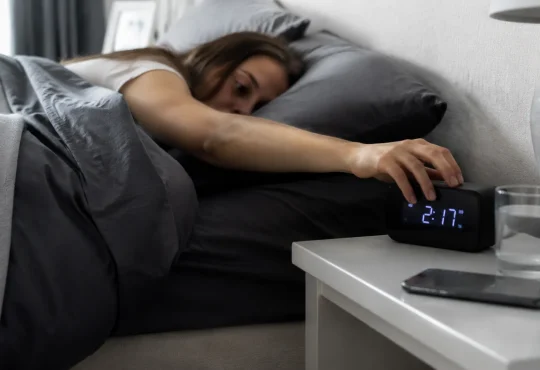
You’ve been lying there for forty minutes. The room is dark, the temperature is right, you’ve done everything the sleep hygiene articles told you to do. And now, staring at the ceiling, you make a quiet but fateful decision: tonight, you are going to try harder.
You close your eyes with deliberate force. You slow your breathing on purpose. You mentally command your limbs to relax, one by one, like you read somewhere. And somehow impossibly you feel more awake than you did an hour ago.
This is not a personal failure. This is sleep science working exactly against you, in exactly the way it was always going to.
Why Effort and Sleep Are Fundamentally Incompatible
Sleep isn’t a skill you can improve through discipline. It’s not like running a faster mile or learning a new language, where pushing harder actually produces better results. Sleep is an involuntary biological state your brain has to fall into it, not climb toward it.
The moment you start trying to sleep, you introduce something sleep cannotcoexist with: directed cognitive effort. Your prefrontal cortex, the part of the brain responsible for goal-setting, monitoring, and effortful control, becomes active the instant you frame sleep as a task to accomplish. And an active prefrontal cortex is precisely what the brain needs to quiet down before you can sleep. The effort itself is the obstacle.
Think of it this way. Imagine being handed a blank piece of paper and told: do not think about anything. The instruction to not think is itself a thought. The monitoring required to check whether you’re succeeding is mental activity. Trying to achieve a state of mental absence creates the very presence you’re trying to escape.
Sleep researchers call the version of this specific to sleep “sleep effort” the harder you consciously pursue sleep, the more psychophysiological arousal you generate, which keeps the brain in a state incompatible with the sleep onset you want. It’s a clean, elegant trap.
The Role of Hyperarousal and What the Body Misreads
There’s another layer here that most people don’t consider. When you lie awake trying to sleep, your body doesn’t interpret the situation as “person resting in bed.” It interprets it as “person lying still under stress.” And stress, in the body’s ancient operating logic, calls for wakefulness.
Cortisol creeps up. Heart rate stays slightly elevated. The mind starts scanning not for threats exactly, but in the same underlying mode. This is hyperarousal, and it’s the physiological state that underlies chronic insomnia in most people who have it. Not a broken circadian clock. Not a structural sleep disorder. Just a nervous system that has learned, through repeated experience, that bedtime is a place where something effortful and somewhat threatening happens.
The cruel irony is that this hyperarousal often feels like nothing dramatic. It doesn’t feel like panic. It just feels like being annoyingly awake. A little restless. Mind turning over small thoughts. That mild, buzzing alertness is your nervous system doing exactly what it’s designed to do it has simply been trained to do it at the wrong time.
When the Bed Becomes the Problem
Here’s where the psychology gets genuinely interesting. Sleep researchers, particularly those working in the tradition of cognitive behavioral therapy for insomnia, have long observed that people who struggle with sleep often develop what’s called conditioned arousal. The bed itself the pillow, the darkness, even the act of getting under the covers starts to function as a cue for wakefulness rather than sleep.
This isn’t metaphor. It’s classical conditioning in the most literal sense. If you have spent enough nights lying awake in your bed, striving and failing to sleep, your brain begins to associate that physical environment with the aroused, frustrated state you’ve been in during those hours. Eventually, getting into bed triggers the arousal response automatically, before you’ve even had a chance to try anything.
Some people notice this without realizing what it means: they feel sleepy on the couch, drag themselves to bed, and then nothing. Eyes open. Brain on. It seems random. It isn’t. Thecouch hasn’t been contaminated by the association. The bed has.
This is why one of the counterintuitive recommendations in evidence-based insomnia treatment is to spend less time in bed, not more. To get up when you can’t sleep rather than lying there willing yourself into unconsciousness. The goal is to break the conditioned link between the bed and wakefulness, and that can only happen if you stop reinforcing it by doing the exact thing lying awake, trying hard, failing that built it in the first place.
The Paradox at the Center of It
What makes this whole pattern so persistent is that it feels like the rational response. Of course you should try harder. You’re not sleeping. Trying harder is what adults do when something isn’t working.
But sleep occupies a strange category of human experience one where the direct application of will produces the opposite of the intended result. You can’t force laughter by trying to laugh. You can’t manufacture genuine relaxation by deciding to relax. And you cannot sleep by attempting to sleep. These are all states that arise as consequences of something else, not as achievements in themselves.
The psychologist and sleep researcher Allison Harvey has described this as the paradox of control: the more control you try to exert over sleep, the less control you actually have over it. Her research on insomnia found that cognitive attempts to manage sleep monitoring, strategizing, deliberately relaxing consistently worsened outcomes compared to approaches that redirected attention entirely.
What works, it turns out, is something that looks a lot like indifference. Not defeat, not resignation, but a genuine loosening of the grip. The goal shifts from “I need to sleep now” to “I’m going to rest here without agenda.” It sounds passive. In practice, it’s surprisingly hard to do because your brain will keep sliding back toward assessment, toward checking whether it’s working, toward effort.
Rethinking What You’re Actually Doing at Midnight
None of this means you’re helpless. It means you’ve been solving the wrong problem. The question isn’t how to sleep better it’s how to stop accidentally preventing sleep.
That shift matters because it changes what you do. Instead of adding more techniques to your pre-sleep routine, you start examining what makes the bedroom feel like a performance arena. Instead of optimizing for the perfect conditions, you start noticing when you’ve made sleep into a metric you’re tracking, a goal you’re pursuing, a problem you’re troubleshooting.
The people who sleep well, by and large, don’t think much about sleep. They lie down, and sleep comes. They have no elaborate system because they’ve never needed one. What looks like a gift is really just the absence of the interference that trying creates.
Getting there from a place of chronic effort isn’t simple, and it isn’t quick. But it starts with understanding what you’re actually doing when you decide, at midnight, that tonight you’re going to really commit to this. You’re not setting yourself up for rest. You’re setting yourself up for another long, awake night working hard at the one thing that only works when you stop.