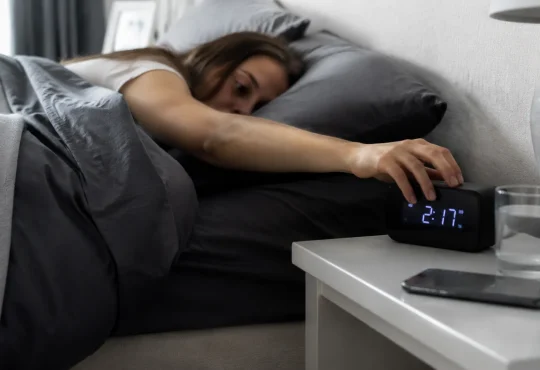


Walk into any pharmacy or grocery store in America, and you’ll find melatonin sitting right there in the supplement aisle no prescription needed, priced like a bottle of vitamins, marketed with words like “natural” and “gentle.” The cultural message is clear: this is the safe, obvious thing to reach for when you can’t sleep. Millions of people have accepted that message without much question.
But here’s what rarely makes it onto the packaging: taking melatonin regularly might be quietly training your brain to stop doing one of the things it’s supposed to do on its own.
What Your Brain Actually Does Every Evening
Melatonin is a hormone, not a sedative. That distinction matters more than most people realize. Your pineal gland starts releasing it naturally as daylight fades it’s less a sleep trigger and more a signal that says “the world is getting dark, start winding down.” Your body temperature begins to drop. Your alertness softens. A cascade of processes begins that eventually tips you into sleep.
This system is exquisitely sensitive to context. It responds to light, temperature, stress hormones, meal timing, and physical activity. It’s not a switch it’s a negotiation between your body and its environment, happening every single night, recalibrating itself continuously.
When you take a melatonin supplement, you’re inserting an external signal into that negotiation. For someone dealing with jet lag or a rotating shift schedule, that can be genuinely useful you’re essentially nudging a disrupted clock back toward alignment. That’s the legitimate, research-supported use case.
The problem is that most people taking melatonin aren’t jet-lagged. They’re just having trouble sleeping, often for reasons that have nothing to do with their circadian timing.
The Feedback Loop Nobody Warned You About
There’s a principle in biology called downregulation. When a cell receives a signal repeatedly and consistently from an outside source, it tends to reduce the number of receptors it maintains for that signal. It’s an adaptive response the body is essentially saying, “we’re getting plenty of this, no need to stay so sensitive.”
Whether melatonin supplementation causes significant downregulation in humans is still being actively studied, and researchers haven’t reached a definitive consensus. But the broader concern isn’t only about receptor sensitivity. It’s about the feedback signal that tells your body whether to produce melatonin at all.
Your pineal gland doesn’t independently decide to release melatonin each night. It does so in response to a chain of signals most critically, the suppression of light input to your retina. When you consistently provide melatonin from an external source, you’re potentially reducing the pressure on that system to perform. You’re solving the downstream problem without addressing the upstream one.
Over time, some chronic users report that stopping melatonin leads to noticeably worse sleep than they had before they started. Whether this is true physiological dependence or simply the return of the original sleep problem now perceived as worse through contrast is hard to disentangle. But the pattern is real enough that sleep researchers have started paying more attention to it.
The Dosing Problem That Almost Nobody Talks About
Here’s something that genuinely surprises most people: the doses sold in American supplements are dramatically higher than what research suggests is physiologically appropriate.
Most sleep studies demonstrating melatonin’s effectiveness use doses in the range of 0.3to 0.5 milligrams. Walk down that same pharmacy aisle and you’ll find products offering 5mg, 10mg, even 20mg doses that can raise your blood melatonin to levels somewhere between 10 and 100 times what your body would naturally produce. These higher doses aren’t more effective. They’re just more of a hormone flood.
Because melatonin is classified as a dietary supplement rather than a drug in the United States, it bypasses the kind of regulatory scrutiny that would normally flag a 20-fold excess dose as something worth examining. The market has simply drifted toward higher numbers because consumers tend to equate higher doses with stronger effects, and no one has been legally required to correct that assumption.
The irony is that those megadoses may actually interfere with sleep architecture rather than improve it. Some users report vivid or disturbing dreams, morning grogginess that lingers well past waking, and a feeling of being chemically flattened rather than genuinely rested. These aren’t placebo complaints they’re consistent with what happens when melatonin receptors are saturated for extended periods during sleep.
What’s Actually Broken When You Can’t Sleep
Most chronic sleep difficulty in otherwise healthy adults traces back to a fairly predictable set of causes: chronic stress and elevated cortisol, poor light exposure habits (bright screens late at night, not enough daylight in the morning), inconsistent sleep schedules, alcohol, and in a significant number of cases, anxiety that becomes hyperactivated the moment someone lies down in the dark.
Melatonin addresses essentially none of these. It can slightly shift your sleep timing and may have a mild sedative effect in some people, but it doesn’t lower cortisol, doesn’t reset your light exposure patterns, and doesn’t help an anxious mind disengage from its own loops.
What it does do, quite effectively, is create the feeling of doing something about the problem. That psychological function isn’t trivial uncertainty is uncomfortable, and having a pill to take provides a sense of agency. But there’s a real cost when that sense of agency substitutes for addressing the actual drivers of poor sleep.
The people who seem to benefit most from behavioral approaches to sleep things like consistent wake times regardless of how the night went, morning light exposure, reducing evening stimulation, and dealing directly with anxious thought patterns through cognitive techniques often report a kind of sleep that feels qualitatively different from supplement-assisted sleep. More consolidated. More restorative. Less fragile.
A More Honest Way to Think About It
None of this means melatonin is dangerous or that every person taking it is making a serious mistake. For short-term, specific applications resetting after transatlantic travel, adjusting to a new shift schedule, the occasional sleepless night before something stressful a low dose used briefly is a reasonable tool.
The issue is chronic, habitual use in the absence of any real circadian disruption. That pattern, which describes a substantial portion of American melatonin users, is where the risk-benefit math starts to look less favorable.
Your sleep system is not broken. In almost all cases, it’s responding sometimes unhelpfully, sometimes in ways that feel unmanageable, but always in response to real inputs. The goal worth pursuing isn’t finding a better way to override it. It’s learning what it’s actually responding to.
That’s slower work than opening a bottle. It’s also the kind of work that tends to produce sleep you don’t have to manufacture every night.