

The High-Achiever’s Dilemma: When Your Drive to Succeed Ruined Your Sleep
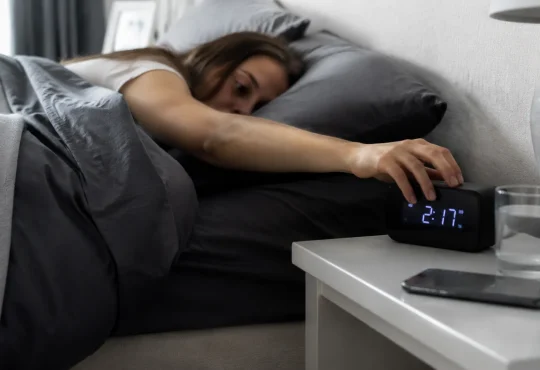
There’s a version of Sunday night that high achievers know intimately. The workweek hasn’t started yet, but the mind already has. You’re running through Monday’s agenda at 11 PM, mentally drafting an email you won’t send for nine hours, and somewhere between that and the ceiling, sleep becomes a thing that happens to other people.
This isn’t insomnia in the clinical sense not always, anyway. It’s something more specific, more insidious. It’s the mind that built your career turning on the body that’s supposed to sustain it.
The Brain You Trained to Never Stop
High achievement doesn’t happen by accident. It’s the product of years of conditioning rewarding vigilance, punishing complacency, treating rest as a liability. You learned to stay one step ahead, to anticipate problems before they arrived, to keep the mental engine idling even when the workday technically ended.
That conditioning works. It works so well that eventually the brain stops recognizing “off” as a valid mode.
Neuroscience has a term for this: hyperarousal. It’s the state where your nervous system remains on alert long after the threat has passed or in the case of high achievers, long after the productive hours are done. The prefrontal cortex, the part of your brain most engaged during complex planning and decision-making, doesn’t get a clean shutdown signal. It was never trained to receive one.
So it keeps running. It reviews. It rehearses. It optimizes. And it does all of this at 1 AM, using your bed as an office.
Productivity Culture’s Quiet Complicity
There’s a reason this pattern is so common among people who appear to have everything together. The culture that rewards high performance quietly stigmatizes the very thing the body needs most.
Think about the language we use. “I’ll sleep when I’m dead.” “Hustle while they sleep.” These aren’t fringe slogans they’re embedded in the motivational vocabulary of boardrooms, business podcasts, and LinkedIn inspiration posts. Rest gets reframed as lost time. Recovery gets coded as weakness.
The high achiever internalizes all of this. And because achievement keeps happening the promotions, the metrics, the recognition the equation seems to hold. Until it doesn’t.
Sleep deprivation has a particularly cruel cognitive signature. It degrades exactly the capacities that high achievers prize most: working memory, emotional regulation, complex reasoning, and creative problem-solving. The irony is structurally perfect. You sacrifice sleep to perform better, and the sacrifice quietly erodes the very performance you were protecting.
What’s Actually Keeping You Awake
Most people assume sleep problems are about stress. And stress is certainly part of it. But for high achievers, the architecture of wakefulness is usually more layered than simple anxiety.
There’s the identity problem. For someone who defines themselves through output and accomplishment, sleep represents a kind of suspension of self. You stop producing. You stop solving. You stop being useful. For a mind trained to conflate worth with productivity, this is existentially uncomfortable even if it’s never articulated that consciously.
There’s also the planning compulsion. High achievers are often gifted futurists. They think in timelines, contingencies, and outcomes. That same mental skill that makes them exceptional at strategy makes it nearly impossible to leave tomorrow alone. The brain, trained to model scenarios, keeps running simulations. Not because anything is wrong. Just because that’s what it does.
And then there’s the rumination loop the end-of-day audit that never actually closes. Did I handle that meeting correctly? Should I have pushed back harder? What’s the best move on that project? These aren’t anxious spirals in the pathological sense. They’re the ordinary cognitive housekeeping of someone who cares deeply about doing things well. But at midnight, caring deeply and sleeping well are at war with each other.
The Body Keeping Score in Real Time
Here’s what the sleepless high achiever often misses: the consequences aren’t coming. They’re already here.
Cortisol the body’s primary stress hormone follows a natural daily rhythm. In healthy sleep patterns, it peaks in the morning to support wakefulness and tapers through the day. Chronic sleep disruption flattens and distorts that curve. Elevated evening cortisol makes it harder to fall asleep. Harder sleep makes cortisol worse. The loop closes, and tightens.
The physical downstream effects read like a checklist that no ambitious person wants to confront. Impaired immune function. Elevated cardiovascular risk. Disrupted metabolic regulation. Accelerated cognitive aging. None of these show up in a quarterly review. None of them get flagged in a performance conversation. They accumulate silently, expressed years later in ways that no amount of professional success can offset.
Sleep is not a luxury the body negotiates around. It’s when memory consolidates, tissue repairs, emotional experience integrates, and the glymphatic system clears the metabolic waste that builds up during waking hours. Skip enough of it, and you’re not optimizing anymore. You’re borrowing against a loan with compounding interest.
Why Solutions Fail the High Achiever
The standard sleep hygiene advice consistent bedtime, dark room, no screens isn’t wrong. It’s just insufficient for a particular kind of person.
A high achiever who decides to “fix” their sleep often approaches the problem exactly the way they approach every other problem: with intensity, research, and optimization protocols. They download sleep tracking apps. They buy devices that monitor heart rate variability. They approach each night like a performance event, grading themselves on sleep efficiency scores and REM percentages.
The problem is that sleep is one of the few human processes that actively resists effort. You cannot will yourself to sleep. You cannot optimize your way into unconsciousness. The harder you try, the more alert you become. The monitoring creates performance pressure. The performance pressure creates arousal. And the arousal keeps you awake, now with data.
This is sometimes called orthosomnia the paradox of sleep problems caused by the obsessive pursuit of better sleep. It’s almost elegant in how precisely it targets the high-achiever personality.
A Different Kind of Rewiring
The shift that actually helps isn’t tactical. It’s deeper than that.
It starts with examining the beliefs underneath the behavior. Not the schedule or the screen time those are symptoms. The belief that stopping means failing. The belief that rest must be earned. The belief that the mind should remain available at all hours because availability signals commitment.
None of these beliefs are true. But they feel true to someone who was rewarded, over many years, for behaving as though they were.
Genuine recovery begins when rest is reclassified not as the absence of productivity, but as a condition of it. Not a pause in the work, but part of the work itself. This isn’t semantic wordplay. It’s a cognitive reframe that actually has to land, which means it takes time and probably some friction before it sticks.
There’s also something to be said for building deliberate transition rituals between the performing self and the resting self. Not a 47-step bedtime routine, but a genuine psychological handoff. A walk. A conversation that has nothing to do with work. A book that asks nothing of you professionally. Something that signals to the nervous system: the day is closed. You can put it down.
The hardest part for high achievers isn’t implementing the routine. It’s tolerating the discomfort of actually letting go sitting with an unresolved problem, an unsent email, a decision that can wait until morning. That tolerance is a skill. It has to be developed the same way any skill does: through practice, and through the willingness to be bad at it first.
The drive that got you here isn’t the enemy. But it needs a boundary it was never given. And learning to draw that line to genuinely clock out of your own ambition for a few hours each night might be the most counterintuitively productive thing you ever do.