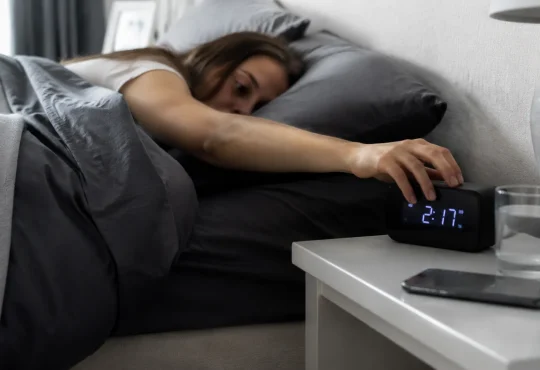


You lie down. The room is dark, the temperature is right, and by every external measure, conditions are perfect for sleep. But your mind won’t stop. Thoughts about tomorrow’s meeting bleed into anxious loops about last week’s conversation, and somewhere in the middle of all that noise, your body is quietly doing something far more consequential than just “feeling stressed.” It’s bathing your brain in cortisol and that chemical flood, if it becomes chronic, doesn’t just keep you awake tonight. It starts remodeling the architecture of how you sleep, how you think, and how anxious you feel by default.
This is not a story about stress being bad for you. That part you already know. This is a story about mechanism about what actually happens inside the skull when the system designed to save your life gets stuck in the on position.
The Hormone That Was Never Meant to Stay
Cortisol is elegant in its original design. When your nervous system detects threat real or perceived the hypothalamic-pituitary-adrenal axis (HPA axis) fires a cascade of signals that land at the adrenal glands, which sit like little hats atop your kidneys. They release cortisol. Your heart rate climbs, glucose floods your bloodstream, your immune response gets temporarily suppressed to redirect energy elsewhere. You are, in that moment, chemically optimized for action.
The hormone also has a natural rhythm. Cortisol peaks about 30 to 45 minutes after waking a phenomenon researchers call the cortisol awakening response and then gradually tapers through the day, reaching its lowest point in the middle of the night. That nightly trough is not coincidental. It’s the biochemical permission slip your brain needs to transition into deep, restorative sleep.
Chronic stress doesn’t just raise your cortisol; it flattens and distorts that curve. Studies tracking cortisol profiles in people with long-term work stress, caregiver burnout, or anxiety disorders consistently show a pattern where the evening drop either becomes shallow or fails to happen at all. The result: your brain approaches midnight with cortisol levels that are more consistent with 8 a.m. To your nervous system, it is perpetually morning. Time to be alert. Time to scan for threats.
What Cortisol Actually Does to the Sleeping Brain
Sleep is not one thing. It cycles through distinct phases light sleep, deep slow-wave sleep, and REM each serving different functions, from cellular repair to emotional processing. Cortisol has a particular hostility toward slow-wave sleep, the deepest stage, where the glymphatic system essentially power-washes the brain, clearing out metabolic waste including the amyloid proteins associated with neurodegenerative disease.
Elevated nighttime cortisol suppresses slow-wave sleep. The brain doesn’t just get less rest it gets a structurally different kind of rest, one that’s lighter, more fragmented, and more prone to full waking. EEG studies show that people under chronic stress spend more time in lighter sleep stages and experience more micro-arousals throughout the night, even when they don’t consciously register waking up. You can sleep eight hours and still feel like you barely slept, because in a meaningful neurological sense, you didn’t.
There’s also the matter of CRH corticotropin-releasing hormone, the upstream signal that triggers cortisol release in the first place. CRH receptors are densely expressed in the locus coeruleus, the brain’s primary norepinephrine hub and a key promoter of arousal. When CRH levels are chronically elevated, it’s like leaving the porch light on all night inside the brainstem. The system stays primed for wakefulness at a level below conscious awareness.
The Hippocampus Takes the Hit
Here’s where it gets structurally serious. The hippocampus critical for memory consolidation and, crucially, for putting the brakes on the HPA axis is unusually rich in glucocorticoid receptors. It’s exquisitely sensitive to cortisol, which is why high-stakes stress can impair memory formation in real time. But prolonged cortisol exposure doesn’t just impair function. It damages structure.
Dendritic atrophy in the hippocampus has been documented in humans under sustained psychological stress. The neurons don’t die outright, but they retract, shrinking their connection trees, reducing their ability to communicate with neighboring cells. In animal models, chronic stress exposure measurably reduces hippocampal volume findings that have since been replicated in human imaging studies involving veterans with PTSD, people with major depressive disorder, and individuals with chronic insomnia.
This matters for sleep because a healthy hippocampus is part of the feedback loop that tells the adrenal glands to stand down. When that feedback degrades, the HPA axis loses a key regulator. The stress response becomes less responsive to its own off-switch. Cortisol stays elevated. Sleep gets worse. Which generates more stress. The loop tightens.
Hyperarousal: When the Threat Detector Gets Recalibrated
Researchers who study chronic insomnia have increasingly moved away from thinking about it as a sleep problem and toward understanding it as a hyperarousal problem. The insomniac brain isn’t failing to sleep because sleep is unavailable it’s failing to sleep because it is physiologically convinced that sleeping is unsafe.
This is not metaphorical. Neuroimaging studies show that people with chronic insomnia exhibit elevated metabolic activity in wake-promoting regions of the brain during attempted sleep. The amygdala, already sensitized by chronic cortisol exposure, scans for threat in what should be a neutral environment. The prefrontal cortex, whose job is in part to dampen amygdala reactivity, has been structurally compromised by the same sustained cortisol load. The watchdog has been trained to bark at everything, and the system that would normally calm it down is operating at reduced capacity.
This recalibration is gradual, which is part of why it’s so insidious. Nobody goes to bed one night and wakes up with a rewired threat-detection system. It accumulates across months and years of sustained stress deadlines that never end, relationships that simmer with tension, financial pressure that has no clear resolution horizon. Each night of poor sleep slightly lowers stress tolerance for the next day, which slightly elevates the cortisol baseline, which slightly degrades the next night’s sleep architecture.
The Window That Still Exists
None of this is destiny. The brain’s capacity for change neuroplasticity doesn’t stop working the moment you enter a stress spiral. Hippocampal neurogenesis, the growth of new neurons in the hippocampus, continues throughout adult life and is demonstrably sensitive to both stress and its relief. Exercise, quality sleep, and certain therapeutic interventions have all been shown to promote this regenerative process. The structure that was compromised by sustained cortisol can rebuild, though not overnight, and not without removing or reducing the source of the load.
Understanding the mechanism matters because it reframes the problem. If chronic stress is rewiring your brain toward wakefulness at a structural level, then the solution can’t be another sleep hygiene tip. It has to involve actually reducing the cortisol burden and that requires taking seriously the conditions generating it. Whether that’s cognitive behavioral therapy for insomnia, which directly targets hyperarousal patterns, or addressing the upstream stressors themselves, the biology is telling a consistent story: the body is not malfunctioning. It’s adapting. The question is whether we give it a different environment to adapt to.
Your nervous system is not your enemy. It built a system designed for your survival and then faithfully ran that system for as long as the perceived threat remained. The problem was never the alarm. It was that nobody told it the fire was out.