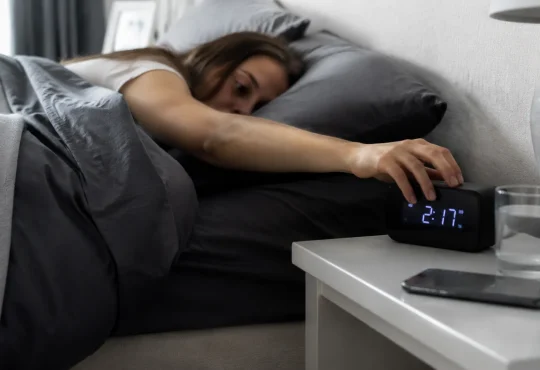

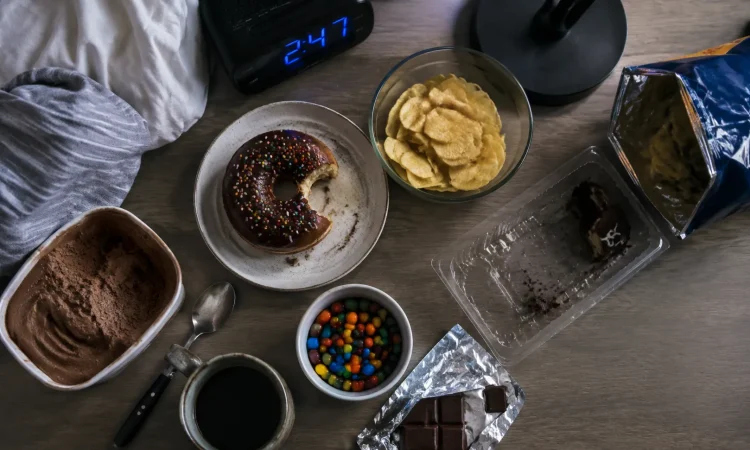
You already know the feeling. You drag yourself through a rough night maybe three hours, maybe five, maybe technically eight but broken into jagged pieces by a crying kid or a racing mind and by ten in the morning you’re staring down a vending machine like it owes you something. The granola bar doesn’t cut it. Neither does the coffee. What you actually want is everything: the bagel, the chips, the leftover birthday cake in the break room that you’d normally walk right past.
This isn’t a willpower problem. It’s biology, and it’s a lot more specific than most people realize.
The Two Hormones Running the Show
Your hunger isn’t some vague feeling that floats around your stomach waiting to be noticed. It’s governed by a surprisingly precise hormonal system, and two players sit at the center of it: ghrelin and leptin.
Ghrelin is the one that makes you want to eat. It spikes before meals, signals your brain that fuel is needed, and then ideally settles back down once you’ve eaten enough. Leptin does the opposite it’s released from fat cells and tells your brain that you’re satisfied, that the tank is full, that you can step away from the kitchen now.
In a well-rested person, these two hormones operate in something close to a functional dance. They’re not perfect, but they balance each other out in a way that allows most people to eat roughly in proportion to what their body actually needs.
Sleep disrupts that balance in a way that’s almost cruel in its directness. Even a single night of poor sleep is enough to measurably elevate ghrelin levels while simultaneously suppressing leptin. Your body, in its confused state, reads sleep deprivation as a kind of metabolic emergency. The hunger signal gets louder. The satiety signal gets quieter. And you’re left standing in that gap, ravenous, with no internal mechanism telling you when to stop.
What the Research Actually Shows
This isn’t theoretical. A now-famous study published in PLOS Medicine tracked 1,000 participants over more than a decade and found clear associations between short sleep duration and elevated BMI with hormonal disruption as a primary mechanism. Earlier work from the University of Chicago put subjects through controlled sleep restriction (just two nights of four hours each) and found an 18% reduction in leptin and a 28% increase in ghrelin. That’s not a small shift. That’s the hormonal equivalent of flipping your body into scarcity mode.
What’s interesting and a little disturbing is what subjects in those studies reported craving. Not more vegetables. Not an extra serving of grilled chicken. They wanted dense, high-calorie, high-carbohydrate foods. Sweets, salty snacks, starchy comfort foods. The kind of calorie load that would have made evolutionary sense if you were, say, surviving a famine or recovering from physical trauma. Which, in a way, your body thinks you are.
Sleep deprivation activates the endocannabinoid system the same reward pathway triggered by cannabis which amplifies the hedonic appeal of food. You’re not just hungrier in a mechanical sense. You genuinely want food more. The pleasure anticipation circuitry lights up, particularly for junk food, in ways that are measurably different from a rested brain.
The Cortisol Complication
Ghrelin and leptin get most of the attention, but there’s a third actor that complicates the picture further: cortisol. When you don’t sleep well, your body registers stress. The HPA axis your hypothalamic-pituitary-adrenal system responds by pumping out more cortisol, which is your primary stress hormone.
Cortisol has a complicated relationship with appetite. In the short term, acute stress can actually suppress hunger. That’s why you might not feel like eating right after a genuine crisis. But chronic elevated cortisol the kind that builds up when you’re regularly under-sleeping does something different. It increases appetite, particularly for calorically dense foods, and it specifically promotes fat storage around the abdomen.
It also undermines insulin sensitivity, which means your blood sugar regulation starts to wobble. That wobble creates its own hunger signals. The crash after a blood sugar spike hits harder, leaves you shakier, and sends you reaching for the next quick fix. The cycle becomes self-reinforcing in ways that are genuinely difficult to interrupt just through conscious restraint.
Why Willpower Is the Wrong Framework
Here’s where a lot of well-meaning health advice goes off the rails. People who overeat after poor sleep are routinely told that they need more discipline, better meal planning, a stricter relationship with food. What these suggestions miss is that the biological deck is stacked so heavily against you that willpower a finite cognitive resource that is itself degraded by sleep loss simply isn’t up to the task.
Sleep deprivation affects the prefrontal cortex, the region of the brain responsible for impulse control, long-term thinking, and the ability to weigh consequences. At the same time, it amplifies activity in the more emotionally reactive limbic system. You are, in a very literal neurological sense, less able to make measured food decisions while simultaneously more driven by impulsive, reward-seeking ones. Asking someone in that state to just eat better is a bit like asking someone with a broken leg to run it off.
This matters not just for individuals trying to manage their weight, but for how we talk about food choices at a public health level. The persistent cultural narrative that overeating is primarily a character flaw has real costs it obscures the role of sleep deprivation, which is itself often driven by structural factors like shift work, chronic stress, and inadequate time for rest.
The Feedback Loop Nobody Warns You About
One of the more insidious aspects of this whole system is that poor eating and poor sleep reinforce each other in a loop that’s surprisingly hard to break. Eating large amounts of dense, processed food late at night which is what the ghrelin-spiked, leptin-suppressed, cortisol-flooded brain steers you toward disrupts sleep architecture. Heavy meals close to bedtime delay sleep onset, suppress slow-wave sleep, and increase nighttime wakefulness.
So the sleep deprivation drives the bingeing, and the bingeing further degrades the sleep, which makes the next day’s hormonal environment even worse. People who find themselves stuck in this pattern often blame themselves for lacking routine or self-control, without recognizing that they’re caught in a biological feedback system that was never designed to be corrected through sheer determination.
Alcohol is a related trap. It’s one of the most common ways people try to accelerate sleep onset after a stressful day, and it does knock you out faster. But it fragments sleep in the second half of the night and suppresses REM sleep, leaving you more tired the next day and more hormonally primed to overeat than you would have been if you’d simply stayed awake a little longer.
Breaking the Cycle Requires Starting in the Right Place
Addressing this problem from the food side alone is possible but slow going. Yes, protein-rich meals and foods with a lower glycemic index do a better job of moderating ghrelin spikes than refined carbohydrates do. Staying ahead of hunger rather than eating reactively meaning structured meals rather than grazing out of desperation helps blunt the worst of the hormonal chaos.
But the more direct intervention is sleep itself. Not optimizing it in the productivity-podcast sense of taking cold showers at 5am and tracking your REM cycles obsessively. Just protecting enough of it, consistently enough, that your ghrelin and leptin have a fighting chance of staying calibrated.
Seven to nine hours remains the evidence-based target for most adults. The research on what happens below six hours is remarkably consistent: the hormonal disruption is measurable, the appetite effects are real, and the metabolic consequences compound over time. Even partial sleep restriction not dramatic sleep deprivation, just regularly getting six hours when your body needs seven or eight produces meaningful hormonal shifts that accumulate across days and weeks.
There’s also something to be said for the timing of sleep, not just the duration. Your ghrelin rhythm is tied to your circadian clock. Irregular sleep schedules going to bed at midnight one night and 3am the next confuse the circadian system in ways that affect hormone timing even when total sleep hours look adequate on paper. Consistency, it turns out, matters almost as much as quantity.
The body is not punishing you for a bad night. It’s doing exactly what it was designed to do: mobilize energy when it senses threat or deprivation. The problem is that the environment most of us actually live in chronically under-slept, overstimulated, under-rested keeps that threat signal running on a low, persistent hum that it was never evolved to handle. The hunger is real. The cravings are real. They’re just not telling you what you actually need.