
The Slip Nobody Sees Coming
You were in the middle of something. A document half-finished, a task queued up, a thought that almost crystallized into a plan. Then, somehow, forty minutes have passed and you’re three layers deep into a thread about a celebrity feud you don’t even care about. You didn’t decide to go there. You just… arrived.
This is the part that messes with people the absence of a clear decision. There was no moment where you consciously chose distraction over work. The shift happened beneath the threshold of deliberate choice, quietly, almost biologically. And that’s precisely what makes it so hard to fight.
What’s actually driving this isn’t laziness or poor discipline. It’s a cluster of micro-cues tiny psychological triggers that your brain responds to before your prefrontal cortex even gets a vote. Three of them, in particular, operate so smoothly that most people never recognize them for what they are.
The First Cue: Cognitive Completion Signals
The brain has a strong drive toward closure. Psychologists have documented this obsession since the 1920s the Zeigarnik effect describes how unfinished tasks linger in working memory, demanding attention. But there’s a flip side that gets less press: when a task reaches a perceived natural endpoint, the brain releases a small burst of dopamine and briefly withdraws its focus.
Notice the word “perceived.” The brain doesn’t wait for actual completion. It responds to the feeling of completion reaching the bottom of a page, finishing a paragraph, submitting a form, even just saving a file. These micro-moments of apparent resolution create a tiny attentional gap. The task feels done enough. The mind loosens its grip, even momentarily.
That gap is where the phone comes in.
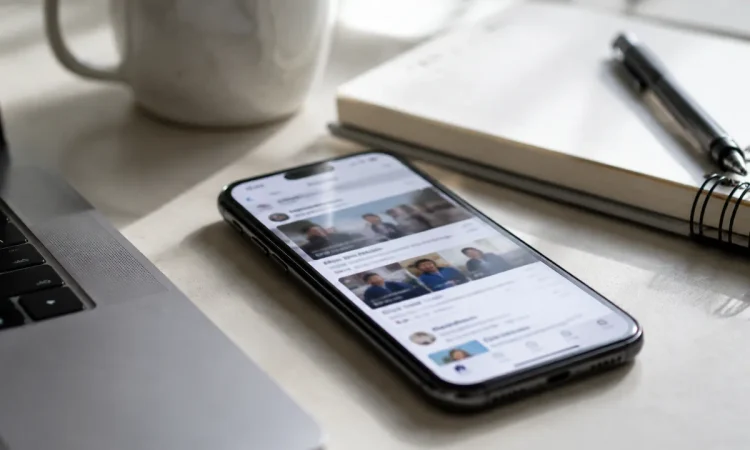
Social media apps are architecturally designed to rush into exactly that kind of gap. The infinite scroll format, the algorithmically refreshed feed these are engineered to fill the space between your last completed micro-task and your next one. Your brain doesn’t experience this as hijacking. It experiences it as a reasonable next step, a natural continuation of activity.
The practical implication is uncomfortable: ending a work block at a natural stopping point may actually increase your vulnerability. Writers have known this intuitively for a long time. Hemingway reportedly stopped work mid-sentence, not at the end of a chapter, so the brain would keep pulling him back. He was, without formal psychology training, exploiting the Zeigarnik effect in reverse using incompletion as a tether.
The Second Cue: Low-Stakes Novelty Seeking
Somewhere in the middle of a demanding task, the cognitive load builds. The problem gets harder, or the path forward gets ambiguous, or the work just requires sustained attention for longer than feels comfortable. In those moments, the brain begins scanning for novelty not because you’ve consciously decided to seek it, but because novelty is one of the fastest ways the brain knows to regulate arousal and relieve mental strain.
This is where a critical but under-discussed distinction comes in: the difference between high-stakes novelty and low-stakes novelty.
High-stakes novelty tackling a new type of problem at work, exploring an unfamiliar creative direction demands even more cognitive effort. It amplifies the load rather than relieving it. The brain, in a state of mild cognitive fatigue, won’t reach for that. It reaches for low-stakes novelty: the gossip update, the trending video, the comment section drama. These deliver the neurological signal of newness without requiring anything from you. No judgment, no evaluation, no risk.
The phone has become the world’s most frictionless low-stakes novelty machine. Every refresh offers new content. Every scroll is potentially surprising. And the stakes are effectively zero there’s nothing to get wrong, no consequence for disengaging, no cognitive cost for checking out. Against the background of a challenging work task, that contrast is almost gravitational.
What makes thiscue particularly seductive is that it masquerades as a reasonable break. Your internal narrative frames it as stepping back, giving your brain a rest, refreshing before diving back in. And there is some truth to that short cognitive breaks do support sustained performance. The problem is that scrolling isn’t a break. It’s a different kind of stimulation that keeps the arousal system active without directing it toward anything productive. You don’t return from ten minutes of Instagram feeling restored. You return depleted and vaguely distracted, chasing a thread of something you half-saw two screens ago.
The Third Cue: Social Uncertainty as Intrusive Pull
This one is the most quietly powerful and the least talked about.
Humans are intensely social animals. Our nervous systems evolved to continuously monitor the social environment tracking relationship status, detecting potential threats or opportunities within the group, staying alert to changes in how others perceive us. In a tribal context, that monitoring was survival-critical. In a modern context, it generates a near-constant low-level background anxiety about what’s happening socially, what people think, whether something important has shifted in the relational landscape.
Social media feeds this anxiety in the exact cadence that keeps the loop going. It doesn’t resolve the uncertainty it refreshes it. Every time you check and find something new, the behavior is reinforced. Every time you check and find nothing, the uncertainty remains unresolved, which keeps the pull active. It’s a variable reward structure, identical to what makes slot machines so adhesive. The not-knowing is the engine.
Now layer that onto a work context. You’re sitting alone, doing deep work, cut off from social input for an extended stretch. Your nervous system, still running ancient monitoring software, registers that extended social silence as something worth checking on. Is everything okay out there? Has something changed? The phone represents, at a primal level, a window into the social environment that your biology insists on surveilling.
The “just checking” impulse checking messages, checking notifications, checking social feeds is rarely about the content you expect to find. It’s about the social uncertainty you’re trying to resolve. And because social media never actually resolves that uncertainty, the checking becomes recursive. One glance leads to another, and before long you’ve spent half an hour not working, not resting, but caught in the loop of unresolvable social monitoring.
Why Willpower Alone Won’t Cut It
Understanding these three cues reframes the whole conversation about digital distraction. Most productivity advice treats the problem as a discipline issue build better habits, use app timers, commit to focus blocks. That advice isn’t wrong, exactly. But it’s targeting the symptom rather than the mechanism.
The completion signal, the low-stakes novelty seeking, the social uncertainty pull these are pre-deliberate. They operate before your conscious decision-making gets involved. Trying to resist them purely through willpower is like trying to hold your breath through dinner. You can do it for a while, but the mechanism eventually wins.
The more durable approach is to restructure the conditions rather than fight the responses. Stop your work at a deliberate moment of incompletion rather than at a natural endpoint. Design your work environment to offer its own low-stakes novelty variation in task, physical environment, or working rhythm so the brain doesn’t have to go looking for it. And address the social monitoring instinct directly by scheduling discrete, time-limited check-ins rather than leaving the social window perpetually open in the background.
None of this eliminates the pull. These cues are built into how human cognition works, running on circuitry that long predates smartphones. But naming them changes the experience in a subtle, important way. The next time you pick up your phone mid-task, you have the option to recognize what’s actually happening not a failure of willpower, not a character flaw, but a predictable response to a specific psychological trigger. That recognition doesn’t automatically stop you. But it creates the half-second of deliberate space where a choice becomes possible.
And sometimes, that half-second is enough.