
There’s a particular kind of exhaustion that doesn’t come from working too hard or staying up too late. It comes from doing everything you think you’re supposed to do and still waking up feeling like something scraped you off the floor. You followed the advice. You read the articles. You made the changes. And yet.
The frustrating truth is that a lot of mainstream sleep wisdom is either outdated, misunderstood, or just plain wrong. It spreads through wellness culture the way bad information always does: wrapped in enough logic to sound reasonable, repeated often enough to feel like fact. And because sleep is so deeply personal so tied to how we feel, function, and cope we’re unusually vulnerable to believing things that give us a sense of control over it.
Here are three of the most persistent sleep myths quietly working against you, and what the science actually says.
The 8-Hour Rule Is Sacred
Few beliefs are more universally accepted than this one: you need exactly eight hours of sleep, and anything less is slowly destroying you. It’s delivered with such confidence by doctors, by productivity gurus, by that one friend who tracks everything in an app that questioning it feels almost irresponsible.
But here’s what the research actually shows. Sleep need is genuinely individual. The figure of eight hours comes from population averages, not from any biological law carved into human DNA. Studies consistently find that somewhere between six and nine hours covers the realistic range for healthy adults, with most people clustering around seven. A meaningful subset of the population functions optimally on six and a half hours. Another subset genuinely needs nine.
The problem isn’t that people are sleeping too little. Often, the problem is that they’re lying in bed for eight or nine hours because they believe they must and then feeling anxious when sleep doesn’t fill that entire window. That anxiety has a name: orthosomnia. It’s the obsessive pursuit of perfect sleep metrics, and it’s become disturbingly common in the age of wearables and sleep tracking apps. The device tells you that you only got74% of your “sleep score,” and suddenly you’re monitoring your own rest with the same intensity a coach watches game tape. That hyper-vigilance is itself a significant driver of insomnia.
The more useful question isn’t whether you slept eight hours. It’s how you feel after waking without an alarm. If you feel rested, alert, and reasonably functional without caffeine as a crutch by midmorning, your sleep is probably adequate regardless of what the clock says.
Catching Up on Sleep Over the Weekend Actually Works
This one feels so logical it almost doesn’t seem like a myth at all. You ran a sleep deficit Monday through Friday. You slept in Saturday and Sunday. The math balances. You should be fine.
Except sleep doesn’t work on an accounting ledger.
When you consistently cut sleep short during the week even by one or two hours each night you accumulate what researchers call sleep debt. The science on whether this debt is truly “repayable” is more complicated than the weekend sleep-in crowd wants to admit. Some cognitive deficits do improve after recovery sleep. Reaction time, certain memory consolidation processes, mood regulation these can bounce back, at least partially.
But the metabolic and hormonal damage is a different story. A 2019 study published in Current Biology tracked participants through a week of restricted sleep followed by weekend recovery sleep. Even after the extra weekend rest, metabolic markers remained disrupted. Weight gain patterns continued. Insulin sensitivity didn’t fully normalize. The body had already absorbed the hit, and a couple of long Saturday mornings weren’t enough to undo it.
There’s also the circadian angle, which tends to get ignored in these conversations. Sleeping in significantly on weekends shifts your body clock in the same way crossing time zones does. It’s been given a name social jetlag and it means you’re essentially flying from New York to London every Friday night and back every Sunday evening. Come Monday morning, your body genuinely believes it’s the middle of the night. The grogginess you feel isn’t laziness. It’s your circadian rhythm protesting the whiplash.
The cruelest irony is that weekend oversleeping often leaves people feeling more tired, not less. That heavy, foggy feeling after nine or ten hours in bed isn’t rest. It’s your system struggling to reorient.
Alcohol Helps You Sleep
This might be the most seductive myth on the list, because it’s grounded in a real and immediate effect. A glass of wine at dinner, a beer before bed you do fall asleep faster. The drowsiness is genuine. Nobody’s imagining it.
What happens after you fall asleep is where the story turns.
Alcohol is a central nervous system depressant, which is why it produces sedation. But sedation is not the same as sleep, even though it can feel that way in the moment. In the first half of the night, alcohol suppresses REM sleep the stage associated with memory consolidation, emotional regulation, and the kind of dreaming that helps the brain process the day. You may be unconscious, but you’re not getting the restorative depth that healthy sleep actually provides.
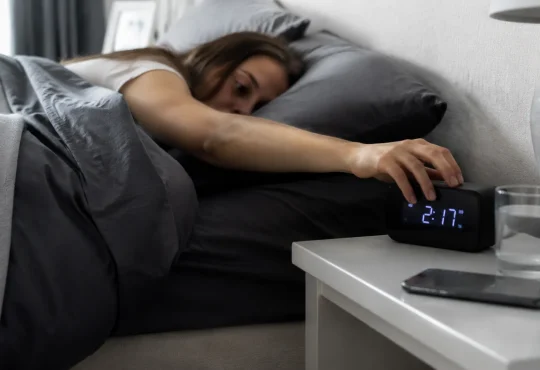
As your body metabolizes the alcohol typically in the second half of the night things get worse. Alcohol breaks down into a compound called acetaldehyde, which is mildly toxic and activating. This is why even moderate drinkers often find themselves awake at 3 or 4 in the morning, heart rate elevated, mind suddenly restless. The sedating effect has worn off. The stimulating aftereffect has kicked in. And the sleep architecture for the rest of the night becomes fragmented and shallow.
Regular use complicates this further. The body adapts to alcohol’s sedating properties relatively quickly, meaning you need more to achieve the same effect. Meanwhile, the sleep disruption doesn’t adapt away it tends to worsen. People who rely on alcohol as a sleep aid often find themselves in a quiet trap: drinking more to fall asleep, sleeping worse because of it, and feeling tired enough the next day that the drink in the evening feels even more necessary.
None of this means a single glass of wine with dinner is going to wreck your health. Context matters. But the specific habit of using alcohol to “wind down” for sleep is built on a misunderstanding of what that wind-down is actually doing to the hours that follow.
Why These Myths Persist
It’s worth sitting with why these particular beliefs are so sticky. Part of it is that they all contain a grain of something real averages do cluster around eight hours, some sleep debt does recover, alcohol does cause sedation. Half-truths are always harder to dislodge than outright falsehoods.
Part of it is the cultural story we tell about sleep. We’ve collectively treated it as a productivity variable, something to optimize and manage and schedule rather than a biological process with its own rhythms and requirements. That framing makes us receptive to rules and hacks and numerical targets, because those fit neatly into a productivity mindset.
And part of it is simply that sleep is invisible. You can’t observe what’s happening inside your own brain at 2 a.m. You only experience the output how you feel in the morning which is easy to misattribute. Slept eight hours and feel terrible? Must be stress. Drank last night and fell asleep quickly? Clearly the wine helped.
The evidence, examined carefully, points somewhere less comfortable: that the habits many people have built around sleep the rigid hour-counts, the weekend bingeing, the nightcap routine may be actively undermining the rest they’re working so hard to get. Not dramatically, not all at once, but steadily, in ways that compound over months and years.
Adjusting doesn’t require an overhaul. It usually starts with one thing: paying less attention to the clock, and more attention to how you actually feel when you wake up.